Stairs are rarely something that you think about until they become a challenge. Two home accessibility solutions come up most often: stairlifts and vertical platform lifts (VPLs). Both restore safe, independent movement between floors. Both can be installed in an existing home without a major renovation. But they work differently, suit different users, and carry very different price tags.
By the end of this blog, you’ll know which option fits your home, your mobility needs, and your budget, and how to get a quote.
What Is a Stairlift?
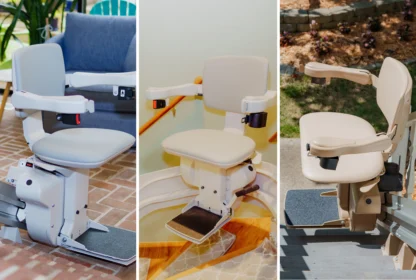
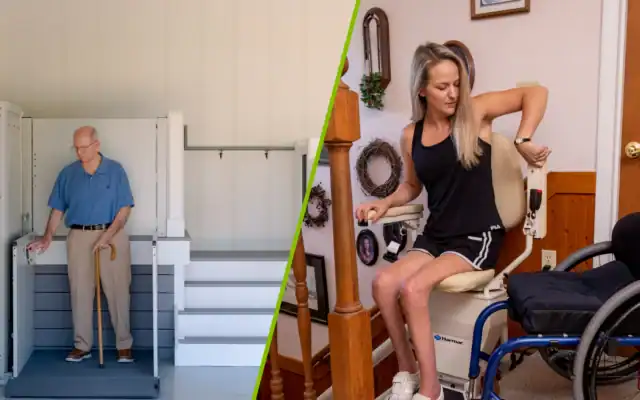
A stairlift is a motorized chair that travels along a rail mounted directly to the stair treads, not the wall, as many people assume. The user sits in the chair, buckles a seatbelt, and uses a simple button or joystick to ride smoothly up or down the staircase. At the top, the seat swivels to face the landing, making it safer to stand and step off.
Stairlifts are a practical fit for people who have difficulty walking stairs but can still sit and stand on their own. If climbing stairs causes pain, shortness of breath, or balance issues, but you don’t rely on a wheelchair or scooter, a stairlift can solve the problem quickly and affordably.
They come in three main configurations:
- Straight stairlifts for standard, unobstructed staircases
- Curved stairlifts for staircases that turn, bend, or cross a landing (custom-built to fit your specific staircase shape)
- Outdoor stairlifts for exterior stairs, built with weather-resistant materials and seat covers
Most straight stairlifts can be installed in just two to four hours. Curved models take longer due to custom rail fabrication but can typically ship within three weeks. 101 Mobility stairlifts are powered by batteries, so a power outage won’t leave you stranded mid-staircase.
What Is a Vertical Platform Lift?
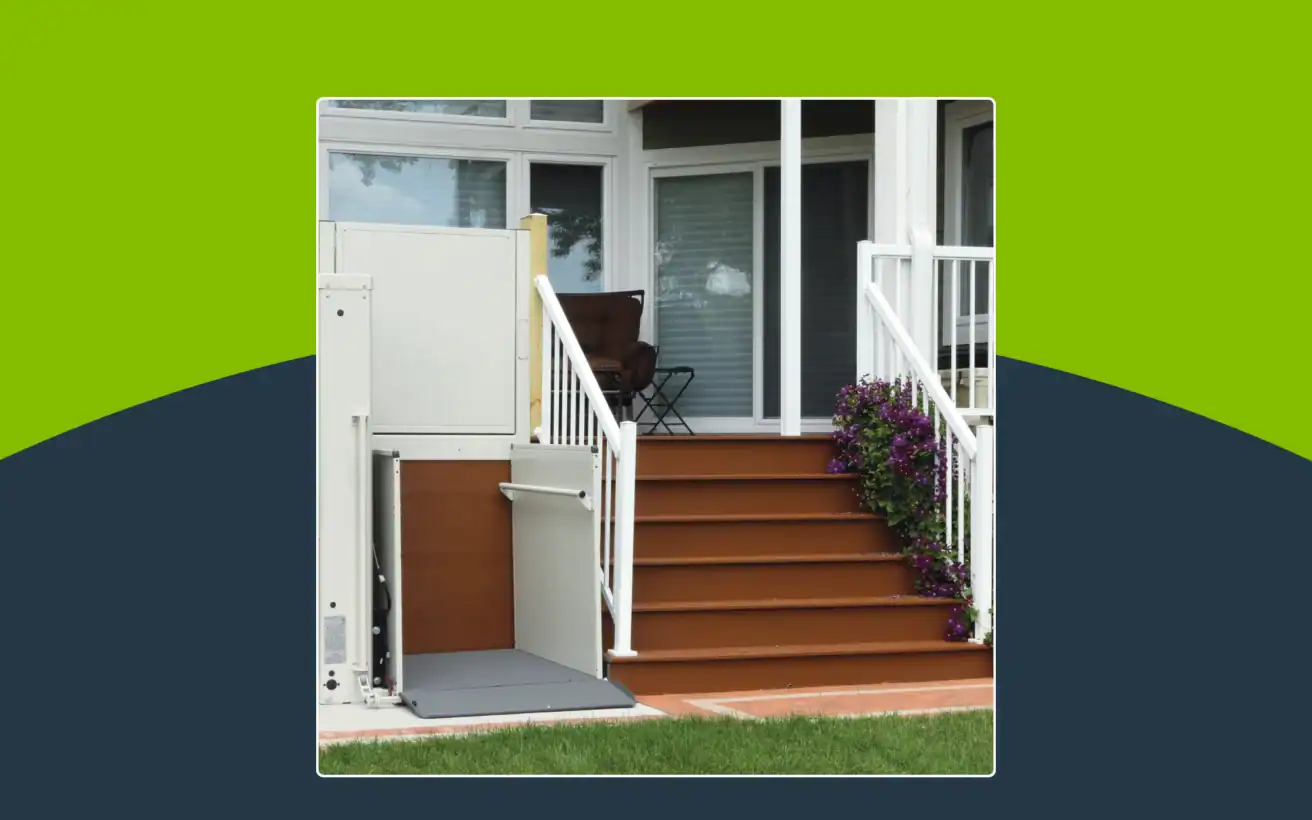
A vertical platform lift (VPL) works like a compact, open-air elevator. Rather than carrying a seated user along a rail, it raises an entire platform straight up between two levels. You roll onto the platform with your wheelchair, scooter, or walker; the gate closes, and the platform lifts.
VPLs are also versatile in terms of placement. They don’t require a staircase at all. They simply need a structural surface to anchor to and sufficient vertical clearance. That makes them a strong solution for:
- Raised porches or deck entries
- Sunken living rooms
- Garage-to-main-floor transitions
- Indoor floor-to-floor access where a staircase rail isn’t an option
Most residential VPL installations take one to two days. Outdoor models include weather-resistant coatings, heater kits, and protective enclosures for year-round use. Standard residential platforms typically support up to 750 pounds, with custom options available for higher weight capacities.
Key Differences Between the Two
Matching Your Mobility and Your Home’s Space
Choosing between a stairlift and a vertical platform lift (VPL) comes down to two things: how you prefer to move and the space available in your home.
Stairlifts: Simple transfers, compact design
With a stairlift, you sit down, ride smoothly, and stand up at the other end. This is a natural fit if you can step and transfer safely. It is also the most space-saving choice. The rail attaches directly to your stairs, and the seat folds up out of the way when not in use. If your hallway or entry is tight, a stairlift keeps your stairs clear and open for the rest of the household.
Vertical Platform Lifts: No transfers, larger footprint
A VPL removes the need to transfer entirely. You simply roll onto the platform in your wheelchair, power chair, or scooter, glide up, and roll off. It is the ideal choice if transferring introduces a fall risk rather than reducing one.
However, VPLs require a dedicated footprint. Outdoors, they need a flat, poured concrete pad. Indoors, they require dedicated floor space at both levels and plenty of ceiling clearance. Because of these physical requirements, a VPL isn’t always a fit for every layout. If your space is limited, a stairlift often becomes the safest, most practical option to keep you moving freely.
What Does a Stairlift vs. Vertical Platform Lift Cost?
Cost is often the first question people ask, and it’s worth being direct.
Stairlifts are generally the more affordable entry point:
- Straight stairlifts: $2,800–$8,000 (including installation and a one-year service warranty)
- Curved stairlifts: Starting at $13,000 (custom rail required)
- Outdoor straight stairlifts: $5,000–$8,000
- Stairlift rentals: $175–$450/month for short-term needs
- Vertical platform lifts carry a higher upfront investment:
- Standard residential VPLs: $10,000–$23,000 (including site preparation and professional installation)
- Larger or fully enclosed residential models: Up to $30,000+
The specific cost of any installation depends:
- Travel height
- Site complexity
- Platform size
- Materials
- Any additional features like automatic gates, backup power, or additional home modifications needed, like a new electrical outlet or carpentry work
For accurate pricing specific to your home and situation, the most reliable step is a professional in-home assessment. Visit the stairlift pricing guide and vertical platform lift pricing guide for current ranges, and keep in mind that both figures include professional installation and warranty coverage.
How to Choose the Right Solution for Your Home
Rather than a lengthy checklist, this decision comes down to four practical questions.
1. Does the user rely on a wheelchair, power chair, or scooter?
If yes, a vertical platform lift is almost always the right choice. The ability to stay in the mobility device without any transfer is a fundamental safety advantage.
2. Where in the home is access needed?
If the challenge is a traditional interior staircase, a stairlift is a natural fit. If the barrier is a porch step, a garage entry, or a level change without stairs, a VPL is likely the more practical platform lift for home use.
3. Do other household members need to use the stairs freely?
A stairlift folds away when not in use. A VPL occupies a fixed footprint. If the staircase is shared frequently and space is tight, a stairlift leaves more room for others to pass.
4. What’s the realistic budget?
Stairlifts have a lower starting price, particularly for straight staircases. VPLs are a larger investment but for users who need one, there’s no comparable alternative.
Whatever your initial instinct, a professional in-home assessment removes the guesswork. A trained consultant will measure your space, assess your specific layout, and recommend the right solution for your household, not just a generic product category.
101 Mobility offers free in-home consultations, with no obligation to purchase. Schedule yours here.
Frequently Asked Questions
What is the difference between a vertical platform lift and a stairlift?
A stairlift carries a seated user along a rail mounted to the stair treads, requiring the ability to sit and stand independently. A vertical platform lift raises an entire platform straight up between two levels, allowing wheelchair and scooter users to ride without transferring. The core difference is mobility: stairlifts suit people who can still sit and stand; VPLs suit users who need to stay in their mobility device.
Can a vertical platform lift be used indoors and outdoors?
Yes. VPLs are available in both indoor and outdoor configurations. Outdoor models are built with weather-resistant coatings and protective enclosures to ensure reliable operation year-round. Outdoor installations typically require a concrete pad as a stable anchor point, which is factored into the overall installation cost. For colder climates, an optional cold weather kit is available, which improves lift performance when operating in temperatures below 20 degrees Fahrenheit (-7 degrees Celsius).
Do I need a staircase to install a vertical platform lift?
No. That’s one of the key advantages of a VPL. It moves straight up and down between two levels. This makes it a strong option for raised porches, deck entries, garages, or any height difference that doesn’t involve a traditional flight of stairs.
Which is less expensive: a platform lift or a stairlift?
Stairlifts typically have a lower starting cost. A straight stairlift starts at around $2,800, while a standard residential VPL starts at approximately $12,000. The final cost for either solution depends on your specific home layout, travel height, and any customization required. Both options include professional installation and a service warranty when purchased through 101 Mobility.
Does Medicare or insurance cover vertical platform lifts or stairlifts?
Neither stairlifts nor VPLs are typically covered by Medicare or standard health insurance. Medicare classifies both as home modifications rather than durable medical equipment. That said, veterans may qualify for funding through VA benefits, and various federal, state, and local programs may offer assistance for home accessibility upgrades. 101 Mobility also offers flexible financing options through Hearth at many locations to help manage the cost over time. Ask your local 101 Mobility team about current financing and funding options during your free consultation.
The Right Choice Starts with the Right Fit
A stairlift and a vertical platform lift both accomplish the same essential goal: keeping you safe and mobile in your own home. The difference is in how they get there.
A stairlift is the right fit if the user can sit and stand independently and the challenge is a traditional staircase. A VPL is the right fit if the user relies on a wheelchair or scooter, or if the home layout doesn’t include a conventional staircase to work with.
101 Mobility has served more than 159,000 individuals across 18,000 communities nationwide. Every consultation starts in your home, with a trained specialist who understands the layout, the user, and the options. There’s no pressure, no guesswork, and no hidden fees in your final quote.
Ready to find out which solution fits your home? Explore our stairlifts and vertical platform lifts, or schedule a free consultation with a local 101 Mobility expert today.