How Much Space Does a Stairlift Need at the Top and Bottom of Stairs?

If you’ve ever stood at the bottom of your staircase and wondered whether a stairlift would actually fit, you’re not alone. It’s one of the most common concerns families face when exploring mobility solutions for aging in place. The stairs that felt perfectly normal for decades can suddenly feel like an obstacle, and the last thing you want is to invest in a solution that doesn’t work in your specific home.
The good news is that most homes can accommodate a stairlift with the right planning. Understanding the key stairlift space requirements before you schedule a professional assessment helps you feel confident going into the process and helps you ask the right questions.
This guide covers everything you need to know, including:
- How much space is needed at the top and bottom landings
- Stair width and rail clearance requirements
- A step-by-step measuring checklist
- Space-saving features that solve tight-fit challenges
- Why a professional survey is the most important step
What Is a Stair Landing, and Why Does It Matter?
A stair landing is the flat area at the top or bottom of a staircase. It’s the zone where you board the stairlift, dismount safely, and where the rail ends or begins. The size and condition of these flat areas directly determine whether a stairlift can be installed safely and used comfortably.
Stairlift installation measurements aren’t just about the stairs themselves. A staircase that meets width requirements but has a cramped bottom hallway or a tight doorway at the top may need a custom solution. Knowing what to look for ahead of time makes all the difference.
Space Needed at the Bottom of the Stairs
How Much Floor Space Is Required?
The bottom landing is defined as the area at the base of the staircase where the stairlift rail ends and the user enters or exits the lift. As a general rule, allow at least 18 to 24 inches (450–600 mm) of clear, level floor space beyond the last step at the bottom. This gives the stairlift chair enough room to park fully and allows users to sit down or stand up without feeling rushed or crowded.
For heavy-duty models or users with specific mobility needs, that requirement can increase to up to 30 inches (760 mm). For example, a bariatric stairlift with a wider seat and reinforced footplate needs more room to extend into the landing area safely.
The bottom landing is defined as the area at the base of the staircase where the stairlift rail ends and the user enters or exits the lift.
What If Space Is Tight at the Bottom?
Tight hallways and narrow entries are common, especially in older homes. A few solutions exist:
- Powered, Automatic & Manual Folding Rail Options: These options are for the bottom landing, where there is a high-traffic area. The rail extends beyond the bottom step 12”-16”. This is so you can safely exit the stairlift on the bottom landing. The Folding Rail helps alleviate a tripping hazard that the rail could cause at the bottom of the staircase. The Powered & Mechanical Folding rails will fold automatically, while the Manual Folding rail has a handle and is manually folded up and down. If there is a wall that extends the bottom step 12”-16” on the same side, the SL is installed a folding rail is not needed
- Folding footrests and armrests: Reduce the stairlift’s physical footprint when parked
- Custom Extended Rail & Parks: An Overrun, 90 Degree or 180 Degree Park can be added to Custom Curved Stairlifts so the stairlift can be out of the way of high traffic areas, be safely away from the top of the stairs, and give more room to get on and off the stairlift
Bottom Landing Space Quick Reference

If your bottom landing falls short of these ranges, don’t assume a stairlift is out of the question. A professional can assess whether space-saving configurations solve the problem.
Space Needed at the Top of the Stairs
Understanding the Overrun Rail
At the top of the staircase, the concern shifts from boarding ease to safe dismounting and clear passage. Most stairlifts use what’s called an overrun rail, which is a section of track that extends past the last step, providing space for the chair to park fully off the staircase for safer exits. This overrun section is typically about 4 inches (100 mm) beyond the top step.
Once the chair is parked at the top, the user needs enough flat landing space to swivel the seat, plant their feet firmly, and stand up safely. For most users, this means having several feet of clear, level floor at the top of the stairs. If a wheelchair transfer is needed, additional depth becomes essential.
Stair Width and Rail Clearance Requirements
How Wide Does Your Staircase Need to Be?
Stair width is one of the most straightforward measurements but it’s also one people often get wrong by measuring the wrong thing.
Here’s what the numbers look like:
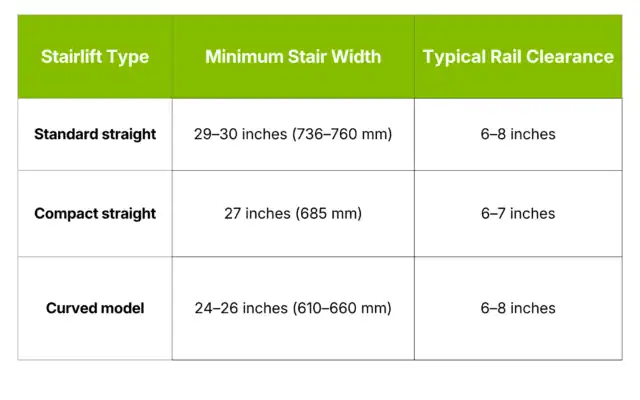
- Most straight stairlifts require a stair width of approximately 29–32 inches. This is dependent on the height and knee-to-back measurements of the user.
- Premium or compact straight models may fit stairs as narrow as 27 inches in some configurations
- Most Custom Curved Stairlifts require a minimum stair width range of 32 – 34 inches. This is dependent on the height and the knee-to-back measurements of the user. It is also dependent on the space at the turns. There are some manufacturers that have technology that can accommodate narrower staircases than 32 inches.
Measure the usable width from baseboard to baseboard (or trim to trim), not wall to wall. Handrails, light fixtures, and wall features that protrude into the stairway all reduce usable width and must be factored in.
What Is Rail Clearance?
Rail clearance is the distance from the wall to the outer edge of the stairlift rail. This typically ranges from 4 to 6 inches, depending on the model and track design. This space allows the seat to clear the wall and possibly a handrail. When the seat, armrests, and footrest are in the folded position, the stairlift should extend about 12.5- 16 inches into the staircase. With a typical staircase width, this should allow enough room on the opposite side for people to comfortably use the staircase.
Stair Width and Rail Clearance by Model Type
Step-by-Step: How to Measure Your Staircase
Taking your own measurements before a professional visit helps you understand what you’re working with and prepares you for an informed conversation with your installer. Use this checklist as a starting point.
Staircase Measuring Checklist
Step 1: Choose the installation side
Decide whether the stairlift will run along the wall side or the open (banister) side. Note any obstacles on either side (handrails, light switches, wall fixtures).
Step 2: Measure the stairway length
Measure from the top tread down to the finished floor at the base of the stairs. This gives the installer the total rail length needed.
Step 3: Measure the usable stair width
Measure from baseboard to baseboard (not wall to wall). Account for any trim, handrails, or decorative elements that project into the space.
Step 4: Check bottom landing clearance
Measure the flat floor space from the base of the bottom step outward. You’re looking for at least 18–24 inches of clear, level space.
Step 5: Check top landing clearance
Measure the flat floor space from the top step forward. Confirm there’s enough room for the overrun rail (approximately 4 inches past the top step) plus safe standing room beyond.
Step 6: Identify obstacles near doors
Note whether any doors open onto the top or bottom landing. Measure how far they swing into the space.
Step 7: Measure head clearance
At any point on the staircase (especially near landings and under overhead structures) confirm that head clearance reaches the recommended 78 inches (approximately 2 meters).
Step 8: Locate the nearest power outlet
Most stairlifts plug into a standard outlet. Note where the nearest outlet is at the top and bottom of the stairs.
A professional home survey will verify all of these measurements and check additional factors like knee clearance, seat positioning, and structural attachment points.
Space-Saving Features That Make Stairlifts Work in Tight Spaces
Modern stairlifts are designed with real homes in mind, including older homes with narrow staircases, small landings, and quirky layouts.
Several features help maximize usable space:
Folding Components
- Folding seats: When not in use, the seat folds up flat against the rail, reducing the protrusion to approximately 12–18 inches from the wall, depending on the model
- Folding footrests and armrests: These retract to minimize the unit’s footprint, keeping the stairway accessible to others in the household
Rail Configurations
- Powered hinge rails: Option for Straight & some Custom Curved Stairlifts. Bottom portion of the rail folds up when the Stairlift is parked on the upper portion of the rail. This alleviates a tripping hazard and room for doors to open at the bottom of the staircase.
- Park rails and overrun rails: Option for Custom Curved Stairlifts only. Extend the track or add a 90 Degree or 180 Degree Park. The stairlift is completely off the staircase at the top or the bottom. Great option to free up space on the staircase
- Custom curved rails: Custom-engineered rails for staircases that have landings and turns. The rail follows the curve of the staircase and can be designed as mentioned above for custom overruns and parks
101 Mobility carries a range of models, including the Bruno Elan Straight Rail Stairlift, Bruno Elite Curved Stairlift, Harmar Pinnacle, and the Handicare Freecurve Curved Stairlift, with configurations suited to both standard and challenging staircase layouts. Contact your closest 101 Mobility location for the most current offerings.
Why Professional Installation Matters
Self-measurement gives you a useful starting point. But it can’t replace a professional home survey. A certified installer from 101 Mobility will assess every detail that measurements alone can’t capture, such as:
- Seated position and knee clearance to ensure the user fits comfortably on the specific model
- Landing depth relative to the user’s mobility needs, including wheelchair transfers if applicable
- Structural attachment points to confirm the rail can be mounted safely
- Power access to verify a suitable outlet is reachable without the use of an unsafe extension cord
- Code compliance to ensure the installation meets local safety and building requirements
If, after a thorough survey, a stairlift genuinely cannot fit safely in the available space, alternatives exist. Home elevators and through-floor lifts are worth exploring in cases where staircases are too narrow or landings are too constrained for any stairlift configuration.
Frequently Asked Questions
How much space does a stairlift need at the top of the stairs?
Curved stairlifts need a rail overrun of about 4 inches beyond the top step, plus enough flat landing space for the user to dismount safely and step away from the chair comfortably. If a wheelchair transfer is needed at the top, additional depth is required. Straight stairlifts end at the top steps bullnose.
How much space does a stairlift need at the bottom of the stairs?
Plan for at least 18 to 24 inches of clear, level floor space beyond the last step at the bottom. Heavy-duty models may need up to 30 inches. Powered hinge rails can help if a door opens nearby.
Can a stairlift fit on a narrow staircase?
Yes, in many cases. Compact straight models can fit stairs as narrow as 27 inches. A professional assessment will confirm what’s possible in your specific home.
Can stairlift rails be folded to save space?
There are Manual, Automatic Mechanical & Power Folding Rails. These are needed to alleviate tripping hazards at the bottom of the staircase and to remove obstruction into a room or a door.
Take the First Step Toward a Safer Home
Understanding how much space a stairlift needs at the top and bottom of stairs is the foundation of a confident decision. Whether your staircase is wide and straightforward or narrow with a tight landing, solutions exist, and the right one depends on your specific home, needs, and the expertise of a certified installer who’s seen it all before.
At 101 Mobility, we offer free in-home consultations with experienced accessibility specialists who will measure your staircase, walk you through your options, and recommend a solution designed around your home and your safety.
Schedule your free consultation today and find out exactly what’s possible. Peace of mind, independence, and a safer home are closer than you think.