For many seniors, the home they’ve lived in for decades is a place of comfort and memories. However, as mobility changes, certain features—like a steep flight of stairs or a narrow hallway—can begin to feel like significant obstacles. Whether you are a senior determined to age in place safely, an adult child researching options for a parent, or a caregiver looking for the best equipment, the goal is the same: maintaining independence without compromising safety.
When dealing with challenging floor plans, it’s natural to have questions. You might worry that your staircase is simply too narrow for a lift or that a bulky chair will block the path for other family members. You may feel overwhelmed by the technical differences between straight and curved models or fearful of making a costly investment in the “wrong” piece of equipment.
At 101 Mobility, we specialize in turning any staircase, even a narrow or steep one, into a safe, accessible pathway. As your trusted mobility equipment partner, we go beyond just selling products. We provide expert guidance, professional installation, and the peace of mind that comes from knowing your loved one is protected by a solution tailored specifically to their home’s unique dimensions.
Why Steep and Narrow Staircases Are So Challenging
In home design, so-called “challenging” stairways are usually those with a very sharp slope, steps that aren’t deep enough to stand on comfortably, or very little room at the top or bottom for a person to move around. If your home feels like it wasn’t built for a stairlift, you’re likely right—most older homes were designed to save space rather than accommodate mobility equipment.
Navigating these tight spaces can be tricky at any time, but as we age, the challenges can grow more pronounced.
- A Steeper Slope Increases Danger: When stairs are very steep, gravity is working against you. If you lose your balance even slightly, the sharp drop can make it much harder to steady yourself and significantly increase the risk of a serious fall.
- Not Enough Room for Your Feet: Many narrow staircases have shallow steps, meaning there isn’t much surface area on which to plant your foot. If you can’t get your whole foot firmly on the step, you’re forced to balance on your toes or heels, which is exhausting and unsafe for anyone with joint pain or balance issues.
- Bulky Equipment in Small Spaces: In a tight hallway, every inch of space matters. Standard, “off-the-shelf” stairlifts can be too bulky, leaving no room for other family members to walk past or making it difficult for the user to safely get into and out of the chair without hitting a wall or a door.
- Homes Weren’t Built for This: Many older houses were built before modern mobility standards existed. They can feature sharp turns, narrow landings, or doorways placed right at the edge of a step, all of which make installing a traditional, “one-size-fits-all” lift nearly impossible.
Understanding these obstacles is the first step toward finding a custom solution.
Can Stairlifts Be Installed on Tight or Steep Staircases?
The short answer is yes—a stairlift can almost be installed on tight or steep staircases, but it is important to understand that not every model is up to the task. While a standard straight lift might struggle with these dimensions, specialized equipment is designed specifically for these architectural challenges.
The deciding factor in a successful installation is often the custom rail design. Unlike basic models, custom-built rails are engineered to follow the exact “spine” of your staircase. This allows the lift to:
- Maximize Clearance: Curved stairlifts can hug the inside or outside of the staircase much more closely than a standard rail, leaving more room for others to walk.
- Handle Steep Slopes: Custom engineering ensures the chair remains perfectly level and stable, even as it navigates a sharp vertical pitch.
- Navigate Tight Spots: Because the rail is made for your specific home, it can be routed to avoid hitting walls or blocking doorways at the top and bottom.
Because these installations leave very little room for error, professional measurements are essential. At 101 Mobility, we use precise imaging and measurement tools to ensure that your lift is a perfect fit for your home’s unique geometry.
What to Look for in a Stairlift for Small or Steep Stairways
When a staircase is exceptionally steep or a hallway is narrow, choosing the right equipment becomes a matter of both safety and daily convenience. Because standard models can be too bulky for these unique spaces, you should look for specific features that prioritize a slim profile and a secure ride. Understanding these design elements will help you identify which lift will truly fit your home’s layout.
Slim, Foldable Chair and Footrest
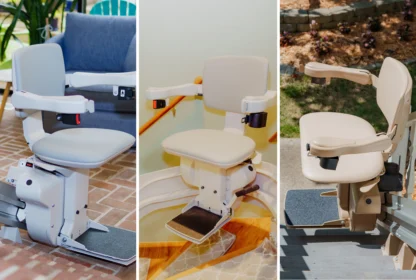
In a tight hallway, every inch of walkway is precious. You want a slim chair where the seat, armrests, and footrest can all fold up tightly against the wall when they aren’t in use. This ensures that other family members can still walk up and down the stairs safely without the equipment becoming a tripping hazard or blocking the path.
Custom-Bent Rail (Not Modular)
For steep or narrow stairs, a custom-bent rail ensures you’re getting just the right fit. Unlike a modular rail system, a custom rail is measured to the exact millimeter of your staircase, allowing it to hug the wall and follow the specific angle of your steps much more closely. This tight fit maximizes the remaining room on the stairs for foot traffic and ensures a smoother, more stable ride.
Tight Turning Radius
If your staircase has a turn or landing, the chair needs to be able to navigate those corners without swinging too far into the hallway. A lift designed with a tight turning radius can stay closer to the wall or banister as it moves through a curve. This prevents the user’s knees from getting too close to the opposite wall in narrow sections of the home.
Parking Positions That Keep Hallways Clear
A high-quality stairlift for small spaces should offer flexible parking options. This means the rail can be designed to extend slightly past the top or bottom of the stairs, allowing the chair to be parked around a corner or further down a hallway. By moving the chair out of the main stair path when it’s not being used, you keep the entryways and landings completely clear for everyone else.
Strong Drive System for Steeper Pitches
Steep staircases require a more robust motor and drive system to ensure the chair moves at a consistent, safe speed without straining. A strong drive system provides the necessary power to carry a user up a sharp incline while maintaining a level, comfortable seat. This gives the user confidence and peace of mind, knowing the lift is designed specifically to handle the heavy lifting of a steep climb.
Best Stairlifts for Steep Staircases and Tight Hallways
When it comes to home accessibility, the “best” stairlift is not a universal choice. The ideal model depends on your staircase’s unique layout, including its angle, width, and any turns. Because every home is different, 101 Mobility evaluates a wide range of top-tier equipment to find the perfect match for your specific architectural challenges.
We’ve collected some stairlift models commonly recommended for navigating exceptionally steep stairs and space-constrained hallways.
Bruno Elite Curved Stairlift
The Bruno Elite Curved Stairlift blends style and functionality in any setting. Enjoy a seamless ride with soft starts and stops, customizable design options, and adjustable features like armrests, footrest, and seat height. This stairlift comes standard with a swivel seat for easy boarding and exiting on top landing and manual flip-up arms, seat and footrest. Optionally you can add a power folding footrest which folds away when the seat is folded up.
Handicare 4000
The Handicare 4000 features a twin-rail system for extra stability, which is often a priority for users on steeper inclines. This model is highly adaptable, offering some of the tightest internal and external turns available on the market today. It comes standard with fold-up seats, footrest, and armrests.
Handicare Freecurve Curved Stairlift
The Handicare Freecurve is custom-engineered for homes with very limited space at the bottom of the stairs. It features a single-rail design that is slim, making it an unobtrusive option for narrow hallways. This model comes standard with manual flip-up arms, seat, and footrest for extra space on steps when not in use. Customers can also upgrade to a power folding seat and footrest or a power folding rail, where the rail folds upward automatically while stairlift moves to create space in a doorway or narrow hallway.
Harmar Helix Curved Stairlift
If your staircase features complex turns or a particularly sharp pitch, the Harmar Helix is a reliable solution. Its custom-bent rail is designed for a precise fit, and the chair’s compact footprint helps it navigate tight landings without blocking access to nearby doors. The base model includes manual flip-up arms, seat and footrest.
Savaria Stairfriend
The Savaria Stairfriend is built for durability and smooth operation on multi-story staircases. It is designed for a steady, vibration-free ride and can accommodate landings or changes in direction. The seat and footrest are both foldable on this model.
Harmar UP Stairlift
The Harmar UP Stairlift is a modern solution designed for quick installation and adaptability. Despite its easy setup, it maintains a slim profile that makes it a strong contender for homeowners who need a space-saving lift without a long wait time for custom fabrication.The UP Stairlift comes standard with advanced features, including a power swivel seat, power footrest, onboard voice communications.
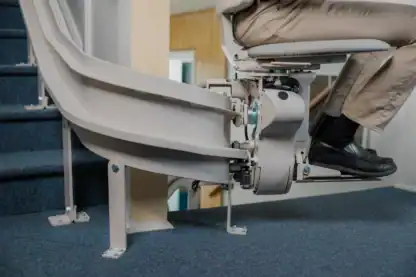
Curved vs Straight Stairlifts: Why Curved Is Usually Best for Tight Spaces
A common point of confusion for many homeowners is whether they really need a curved stairlift model versus a straight-rail model. While straight stairlifts can be more budget-friendly, they are designed for very specific conditions: a constant width and a perfectly consistent angle from top to bottom.
In homes with steep or narrow staircases, curved stairlifts are often the only safe and effective choice for several reasons:
- Adapting to Narrow Points: Unlike straight rails, curved rails are custom-made to adapt to the narrowest parts of your staircase, ensuring the chair doesn’t graze the wall or banister.
- Navigating Landings and Turns: If your stairs have even a small landing or a slight turn, a straight model simply won’t work. Curved models navigate these transitions seamlessly.
- Managing Steep Sections: If the pitch of your stairs changes—becoming steeper at the top or bottom—a straight rail cannot safely accommodate that shift.
- Clearing the Hallway: Curved rails allow the chair to “park” around a corner at the top or bottom, keeping the main hallway and stair entry completely clear for other residents.
Why an In-Home Stairlift Assessment Matters
When you are dealing with a challenging staircase, a simple measurement of the width is not enough to ensure a safe installation. An in-home assessment by professionals is the only way to guarantee that your new lift will function perfectly in your specific space.
During an free in-home consultation, a 101 Mobility expert looks at the whole picture of your home’s architecture:
- Beyond Width: Professionals measure the exact pitch of every section of the stairs and the depth of the treads to ensure the lift can handle the incline safely.
- Obstacle Identification: They account for wall-mounted handrails, low-hanging bulkheads, or nearby doorways that might interfere with the lift’s path.
- User Comfort and Safety: An assessment ensures the chair is positioned so the user can get on and off comfortably without feeling “crowded” by walls or facing a steep drop.
By taking these detailed measurements, we eliminate the worry of making the “wrong” purchase and ensure your home remains a safe, accessible environment for years to come.
Get Expert Help Choosing the Right Stairlift
Choosing a stairlift for a steep or narrow staircase can feel like a daunting task, but you don’t have to make the decision alone. At 101 Mobility, tight hallways and steep inclines are routine scenarios for our team, and we take pride in finding safe, reliable solutions for even the most “impossible” floor plans.
To find the right solution for your challenging home, schedule a free in-home consultation with one of our local experts. We provide no-pressure recommendations tailored specifically to your needs, your home, and your budget. Our goal is to provide the peace of mind that comes from knowing you’ve chosen the right equipment to stay safe and independent in the home you love.