Deciding to install a stairlift is about more than just buying a piece of machinery; it’s an investment in your independence and your future at home. Whether you’re planning to age-in-place or researching options for a parent, you want to know that the solution you choose is built to last. A common question we hear at 101 Mobility is, “How long will this stairlift actually last before I have to replace it?”
The short answer is that a high-quality stairlift is designed to be a long-term solution, not a temporary fix. However, just like a car, its longevity depends heavily on how it is driven, where it is parked, and—most importantly—how well it is maintained.
As your local mobility partners, we want to help you look past the sticker price and understand the long-term value of your investment. Here is the honest truth about stairlift longevity, what causes them to wear out, and how you can keep yours running safely for years to come.
Average Stairlift Lifespan: What Homeowners Can Expect
For most homeowners, a high-quality stairlift from a reputable manufacturer will last around 10 years.
It is not uncommon for premium models to last even longer—up to 15 years or more—provided they are installed indoors and receive routine professional servicing. However, it is important to set realistic expectations. While the structural rail and chassis are incredibly durable, mechanical components like batteries, rollers, and circuit boards will need attention over that decade of service.
This 10-year rule is a good baseline, but your specific lifespan will vary based on several real-world factors.
What Factors Affect Stairlift Lifespan?
Not all stairlifts age at the same rate. Two identical lifts installed in different homes can have vastly different lifespans based on how they are used and where they live.
Frequency of Use
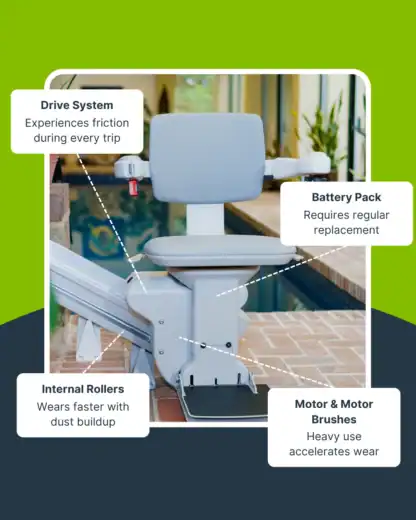
Just like mileage on a vehicle, a stairlift’s lifespan is affected by how often it runs. A stairlift used once a day or less when someone goes out the back door will experience significantly less wear than one used ten times a day as an integral part of daily activities. Heavy use accelerates the wear on the motor’s brushes, the gearbox, and the battery charging cycles.
Stairlift Type and Design
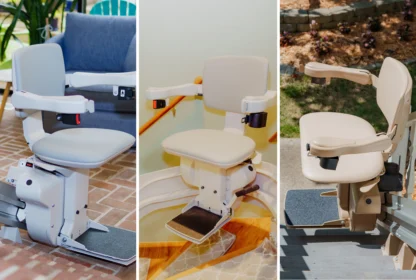
The complexity of the machine plays a role in its longevity. Straight Stairlifts generally have a simpler design with fewer moving parts. Because the rail is a straight line, there is less friction and torque on the motor as it travels. Curved Stairlifts are custom-built to twist and turn with your specific staircase. However, negotiating those turns requires a more complex drive system and flexible internal components, which can face slightly more mechanical stress over time.
To help you compare, here is a breakdown of how design influences durability:
| Feature | Straight Stairlifts | Curved Stairlifts |
| Rail Design | Standardized straight track; minimal friction. | Custom-bent to fit specific angles; increased friction on turns. |
| Motor Strain | Consistent, low-load travel. | Variable load; motor works harder to push/pull through bends. |
| Leveling System | Fixed seat angle. | Active leveling system (mechanical or electronic) to keep the seat flat while the rail climbs. |
| Durability Outlook | High. Fewer moving parts mean fewer potential points of failure. | Moderate to High. Extremely durable, but requires more precise maintenance to ensure smooth travel on turns. |
| Popular Models | Bruno Elan, Bruno Elite Straight | Bruno Elite Curved, Handicare Freecurve, Harmar Helix |
While a curved lift like the Handicare 4000 involves more complex engineering than a standard straight model, professional installation ensures that the rail is calibrated perfectly. This precision prevents unnecessary wear on the gears, ensuring that even complex custom lifts can serve you reliably for a decade or more.
User Weight and Load Capacity
Every stairlift has a maximum weight capacity, typically ranging between 300 lbs and 400 lbs, depending on the model. Consistently operating a stairlift at or near its maximum weight limit forces the motor and batteries to work harder on every upward trip. Over years, this extra strain can shorten the life of the drivetrain compared to a unit that is operating well below its capacity.
Home Environment
Just like with furniture, the environment in which your stairlift lives can influence its lifespan. It’s important to take care of your home to maintain your stairlift, as dust, pet hair, and humidity are the silent enemies of machinery.
Dust and—in homes with pets, fur and dander—can accumulate on the lubricated rail. As the lift travels, this debris can get pulled into the internal rollers, causing friction and premature wear.
For outdoor stairlifts, or indoor lifts in non-climate-controlled areas, extreme temperature fluctuations can degrade battery performance and cause plastic components to become brittle faster than in a stable indoor climate.
How Maintenance Impacts Stairlift Lifespan
The single biggest difference between a lift that dies in 5 years and one that lasts 15 is maintenance. Regular servicing can diagnose problems early and avoid-long term damage. Neglecting a stairlift until it breaks is the surest way to shorten its life.
Routine Professional Servicing
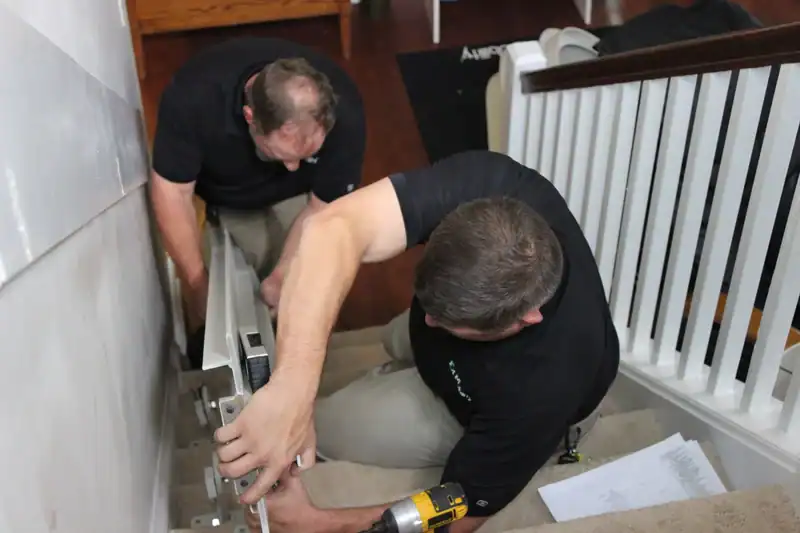
Just as you wouldn’t drive a car for a decade without an oil change, you shouldn’t run a stairlift without an inspection. A service visit from a 101 Mobility technician includes:
- Deep Cleaning: Removing dust and debris from inside the chassis.
- Lubrication: Ensuring the rack and pinion gears move smoothly to reduce friction.
- Safety Checks: Verifying that obstruction sensors and emergency stops are responsive.
- Diagnostics: Checking the motor and circuit board for early signs of failure.
Battery Replacement Cycles
Stairlifts run on battery power (continuously charging from the rail) to ensure they work even during a power outage. These batteries are the most frequent part to wear down. You should expect to replace your stairlift batteries every 2 to 5 years, depending on usage.
Replacing a battery is a standard maintenance task, not a sign that the whole lift is failing. However, delaying battery replacement can strain the motor, leading to more expensive repairs down the road.
Stairlift Troubleshooting Resources
Sometimes a beep or a pause isn’t a catastrophe; it’s just a notification. Looking for resources to diagnose your own problem? Start with these resources:
- Why Is My Stairlift Beeping?
- Do Stair Lifts Need Regular Maintenance?
- How to Power Mobility Products in a Power Outage
- Can You Put a Stairlift Outside?
When Should You Repair vs. Replace a Stairlift?
Even the best maintained stairlift will ultimately reach its end. But it can be hard to know when exactly that is. If your stairlift breaks down, does it make sense to pour money into a fix, or should you start fresh?
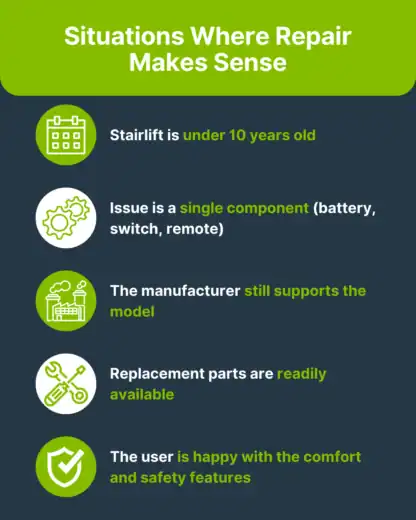
Situations Where Repair Usually Makes Sense
- The lift is under 10 years old.
- The issue is an isolated component (e.g., a dead battery, a worn switch, or a remote control failure).
- The manufacturer still supports the model with readily available parts.
- You are happy with the lift’s comfort and safety features.
Signs It May Be Time to Replace Your Stairlift
- Frequent Breakdowns: If you are calling for service every few months, the repair costs will quickly outweigh the monthly cost of a new, reliable unit.
- Obsolete Parts: If the manufacturer has discontinued the model, finding parts may become impossible or prohibitively expensive.
- Outdated Safety Features: Older lifts may lack modern safety standards like obstruction sensors or retractable seatbelts.
- Changing Mobility Needs: If the user’s condition has changed—for example, if they now require a heavy-duty model or a swivel seat that operates automatically—modifying an old lift is often impossible. Replacing it with a model that fits the current need is the safer choice.
Think it’s time to replace your stairlift? Our team is ready to help. Contact 101 Mobility for your free consultation to help you find the perfect stairlift or accessibility solution for your home.
Does Buying from a Professional Extend Stairlift Lifespan?
The lifespan of a stairlift is determined the moment it is installed. Which means how—and by whom—it’s built matters.
Buying online or from an out-of-the-box manufacturer might seem cheaper upfront, but DIY installations pose a huge risk of premature equipment failure. If the rail is misaligned by even a fraction of an inch, the gears will grind on every trip. If the charging station isn’t wired correctly, the batteries will cook.
When you buy from a professional partner like 101 Mobility, you are getting:
- Precision Installation: Factory-trained technicians ensure the rail is perfectly calibrated, reducing mechanical stress.
- Manufacturer Warranties: Most manufacturers void their warranty if the product is not installed by a certified dealer.
- Local Support: We are your neighbors. If something sounds “off,” a local technician can catch the problem early, usually preventing a catastrophic failure.
Maximize the Lifespan of Your Stairlift with Professional Support
A stairlift is a machine, but it provides something human: independence. To protect that independence, you need a partner who can ensure your equipment is safe, reliable, and ready for the long haul.
At 101 Mobility, we don’t just install lifts; we support the families who use them. Whether you need a new installation or an assessment of an existing unit, we are here to help you age in place with confidence.
Ready to ensure your home remains your sanctuary? Schedule your free in-home consultation with a 101 Mobility expert.
Frequently Asked Questions About Stairlift Lifespan
How long do stairlift batteries last?
Stairlift batteries typically last between 2 and 5 years. Their lifespan depends on how often the lift is used and whether the lift is properly “parked” at a charging point after every use.
Can a stairlift last longer than 15 years?
Yes, we have seen premium units last nearly 20 years. However, this is only possible with diligent annual maintenance and a clean indoor environment. After 15 years, finding replacement parts becomes very difficult.
Do used stairlifts have shorter lifespans?
Generally, yes. You don’t know the maintenance history of a used lift. However, a certified pre-owned lift purchased from a professional dealer like 101 Mobility has been inspected and serviced, offering a more reliable lifespan than a unit bought from a stranger online.
How often should stairlifts be serviced?
We recommend an annual service for most homes. If the lift is used very heavily (more than 10 times a day), a check-up every 6 months is safer.
Is maintenance required to keep the warranty valid?
For many manufacturers, yes. Proof of professional installation and occasional maintenance is often required to claim warranty coverage on major parts like the motor or gearbox.