Portable vs. Modular Wheelchair Ramps in Baton Rouge
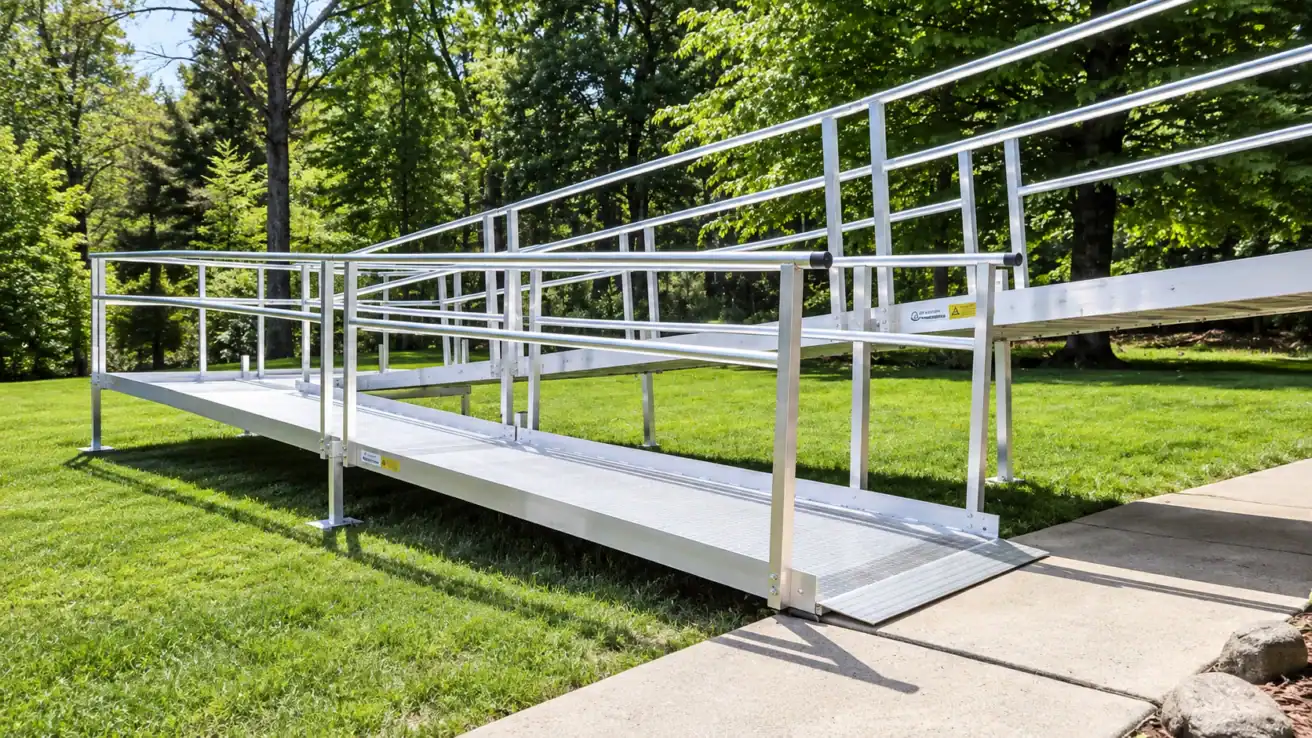
There are two main considerations for a portable versus modular wheelchair ramp in Baton Rouge. First, how much rise does the ramp need to cover? Second, how long does the ramp need to be? For a moveable or short-term route, a portable ramp would be a good option. For a configured route that is needed for frequent use, a modular ramp would be a better option.
Looking at Port Allen, Plaquemine, Brusly, Baton Rouge and Baker, I consider the landing, the doorway, the mobility device, the available approach, storage, and how frequently someone will use the entrance. The goal at 101 Mobility of Baton Rouge is to provide a ramp that fits the actual routine rather than automatically choosing the largest system.
There are three different options: temporary, movable, and permanent.
I don’t use the words temporary and portable interchangeably.
Temporary is used to describe the length of time access will be needed.
Movable refers to the functionality of the equipment.
Permanent describes long-term use of the entrance.
Those questions can lead to different recommendations.
| Decision Factor | Portable Multi-Fold Ramp | Aluminum Modular Ramp | Threshold Ramp |
|---|---|---|---|
| Best starting point | Ramp needs to move or be stored | Entry needs a configured route for regular use | Barrier is a small doorway transition |
| Frequency of use | Occasional or situation-dependent use may fit well | Frequent daily use may favor an installed route | Regular doorway use with a small rise |
| Storage | Needs a practical place when not deployed | Normally remains configured at the entry | Remains at the threshold |
| Landing/layout planning | Still required at both ends | Major part of the design | Focused mainly on the doorway transition |
| Duration | Can suit shorter-term needs | Can serve long-term needs and may also be installed temporarily in some situations | Depends on whether the threshold is the lasting barrier |
For example, a family may only need access for several months, but if the ramp must be used multiple times every day and no one can deploy and store a portable unit, an installed modular configuration may still deserve consideration.
The reverse is also true. I would not recommend a larger modular system merely because it is more substantial if a portable wheelchair ramp in Port Allen solves the actual problem with less equipment.
Duration matters, but daily handling matters too.
Multi-Fold Ramp Use Cases and The Storage Trade Off
When the priority is portability, that is where the Multi-Fold Ramp comes in handy. The 101 Mobility Multi-Fold Reach Ramp folds in both dimensions (length and width) for easier transport and storage when compared to a fixed ramp.
Like any fixed ramp, there are a number of factors that would lead me to consider a Multi-Fold Ramp for accessibility over steps, raised landings, or vehicle related access. These would have to include sufficient length for the ramp, degree of rise, position of the landing, and type of surface across which the mobility device traverses.
In Louisiana, being “portable” with a multi-fold ramp has created some interesting trade-offs.
Who is setting it up?
Where is it being stored?
How often is it being moved?
Can the user position it consistently?
Does deploying it impact the door, walkway, driveway, or other household access?
Folding a ramp to a more compact size does not eliminate the need for storage.
For a family that uses an accessibility ramp several times a day, just the act of transporting, positioning, using, and then ultimately storing the ramp may be a burden. In these situations, a trade-off for portability means more work.
As with a fixed ramp, I evaluate both ends of the adjustable ramp. The lower end has to accommodate the device and the upper end of the ramp has to align with the landing or doorway.
Adjustable length does not mean adjustable measurement.
Aluminum Modular Ramp Tradeoffs and Installed Route/Landing Layout
When circumstances call for me to temporarily create a permanent route rather than a temporary single-section route spanning an obstruction, an Aluminum Modular Ramp is the answer.
The system can be designed with various lengths of ramp sections, landings, and railings that span the length of the system.
This flexibility is useful but also leads to a more complex design, requiring more tradeoffs to be made on my end and thus more information on your part before I can give a definitive solution.
For a modular ramp in Plaquemine or Port Allen, I take into consideration:
total vertical clearance,
lateral clearance,
landings at the top and the bottom,
the door and its swing,
the number of turns to the door,
any adjacent walkways or drives,
the mobility device used,
the anticipated number of trips,
The landings are the most important part.
Adequate vertical clearance is only a start. Upon completion of travels, the user must be able to leave the device, open the door, and enter the building in an unimpeded manner.
Adequate connectivity to an approach at the bottom of the ramp is also essential.
Modular can also mean temporary. 101 Mobility cites that most modular systems can be installed, and removed, when the need is no longer there. Because modular systems provide a permanent solution, it can also be worthwhile to consider them when the need has an end date.
It’s pretty clear there are tradeoffs here. So, if your portable ramp will do the job, I will not suggest a full blown modular system. More doesn’t always mean better.
When Even A Simple Product Works
Often, simulations such as a portable vs modular ramp are incorrect, because the ‘barrier’ is smaller than either of those systems.
If the problem is just a step with a transition, I decide whether Rubber Threshold Ramps would work.
The current model of the threshold ramp at 101 Mobility works for inclines of up to 2 inches.
This is why I always check the incline.
I consider the following when dealing with a small threshold:
the height of the transition
the width of the doorway
whether the doorway swings into the ramp
what is beyond the doorway
the way the mobility device comes into contact with the doorway and what happens immediately after entering the house
Sometimes a product designed to be small enough to address a small threshold is the best solution.
If so, I will refuse to suggest building a larger system when it is not needed.
However, a threshold ramp certainly can not address a failure of a larger step, multiple step changes, bad alignment, or other issues after the doorway.
The system should be in the same order of magnitude as the failure.
What Happens After You Set it up?
After we set up the ramp, I see what the complete system looks like.
When shopping for a portable ramp, you need to consider how the ramp will sit against an upper level surface, how the mobility device will interact with the ramp, and how the ramp can be deployed and removed without adding an obstruction.
I also want to ensure the household has an idea of where the ramp will be stored and how the system will be maintained.
For a modular ramp, we look at the approach, the number of sections, the number of turns, the connection to the landing, handrails, and upper landing and doorway connections.
The door still has to operate properly.
The mobility device still has to travel the route.
Other members of the household still have to understand how the entry is modified.
If issues with the equipment or the need for service and support arises in the future, contact 101 Mobility.
Begin your decision consideration process for a Port Allen, Plaquemine, Brusly, Baton Rouge, or Baker portable ramp, modular ramp system, or threshold solution for a low-rise entryway by scheduling a free in-home consultation. We will measure the rise, and review the landing and doorway, and consider the length of time the system will be used and the expected frequency of use of the system, to determine the optimal solution for the house.
FAQ: Portable Ramp vs. Modular Ramp
What is the primary distinction between a portable ramp and a modular ramp?
A portable ramp is a system designed for transport and/or storage, and a modular ramp is a system that, when installed, uses ramp sections and platforms to connect the sections. The differences have to do with the rise and run, the duration and frequency of use, landing length, storage, the mobility device, and the overall layout of the entrance.
Is a portable ramp better for a temporary need?
It depends. A portable ramp might be the best option for someone who can easily deploy and store the ramp and for someone going over a small incline. But it could be more suited for a temporary modular installation for sloped routes that frequently include landings and turns.
Can a modular wheelchair ramp be removed later?
Absolutely. Many modular aluminum ramp systems are designed to be quickly installed and removed when they are not needed any longer. So, duration is not actually the most important determining factor. Entry layout and daily routine also come into play.
How will I know if a Multi-Fold Ramp will work at my steps?
The height of the riser and the length of the ramp, the surface of both the upper and lower landings, door width and height, mobility device, how the ramp will be moved and stored, and the number of steps are all associated with and affect the threshold and rise. The answers to all of these questions are necessary to determine if our multi-fold ramps will work for you.
When does a threshold ramp make the most sense?
A threshold ramp may make the most sense when the approach to the doorway has a maximum incline of 2 inches and the door and the mobility device clear the threshold when the ramp is in the deployed position.
Should a modular ramp be used just because it is more permanent?
A barrier solution should function the best and be the easiest. A portable or threshold ramp may do the trick without creating any problems for the user regarding storage and handling or use on the route. So the installation of a larger modular system may not be necessary.
About the Author
Jonas Boutte is the owner of 101 Mobility of South Louisiana and has hands-on training from accessibility-equipment manufacturers including Bruno, Harmar, Stiltz, Staying Home, EZ-ACCESS, National Ramp, and others. He helps Baton Rouge-area families evaluate ramps, stairlifts, platform lifts, home elevators, and other accessibility solutions based on their homes, mobility needs, and everyday routines.