When I Recommend a Harmar Highlander II or Bruno VPL: Vertical Platform Lift Planning in Westwego
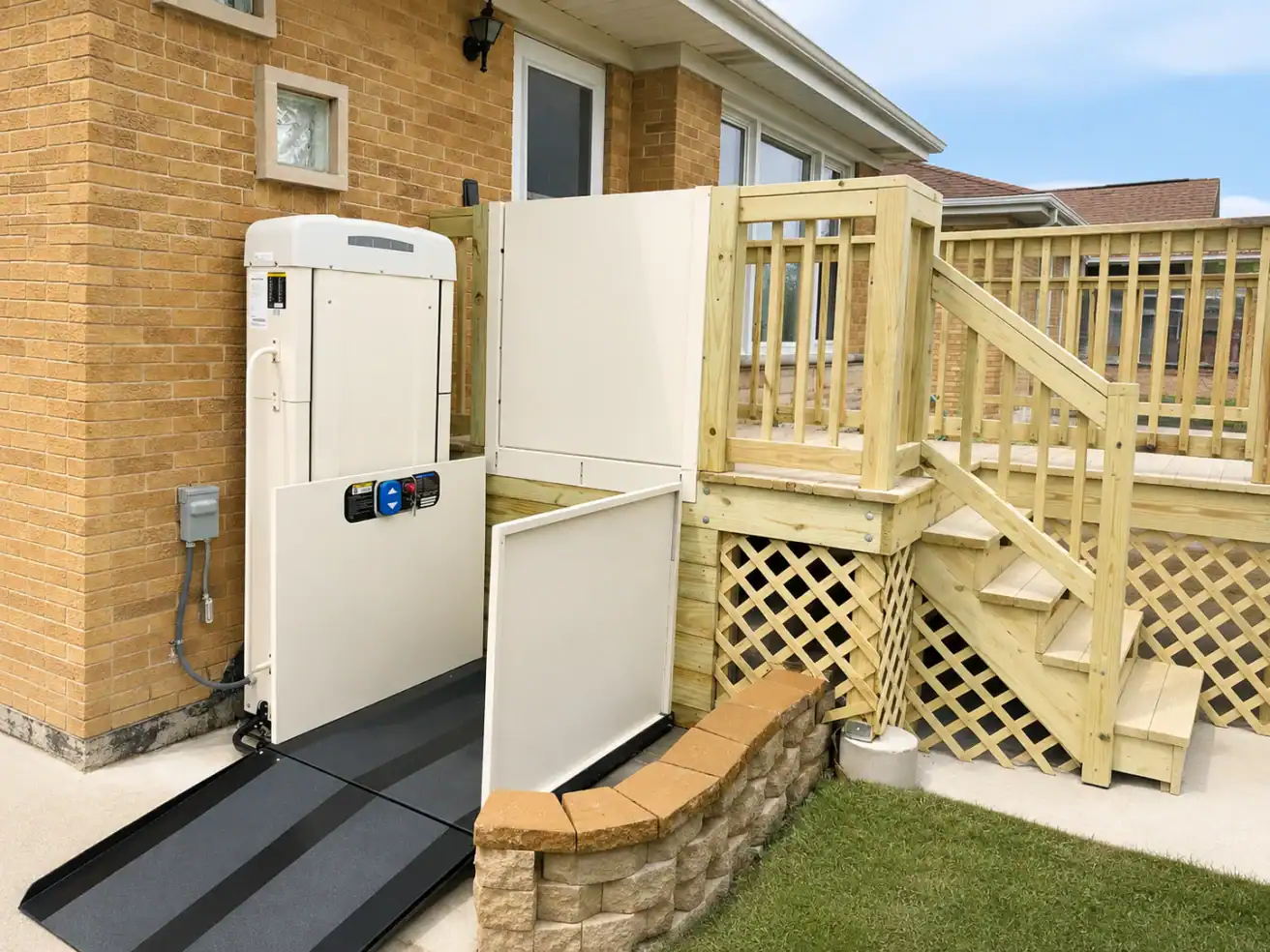
When I look at vertical platform lift planning in Westwego, I rarely start by asking whether the Harmar Highlander II or Bruno VPL is the better product.
I start with the home.
How high is the raised entry? How much usable space is available? Where does the wheelchair need to enter and exit? Can the upper landing accommodate the chair comfortably? How exposed is the equipment to rain and weather? And what happens if the power goes out?
Those details determine whether a vertical platform lift makes sense — and which configuration is worth considering.
For many Westwego homes with elevated porches, decks, or other raised entrances, a wheelchair platform lift can be an effective ramp alternative when a properly designed ramp would require more horizontal space than the property comfortably provides.
When Vertical Platform Lift Planning in Westwego Points to a Lift Instead of a Ramp
A ramp and a vertical platform lift solve the same basic problem in different ways: getting someone safely between two elevations.
A ramp accomplishes that by spreading the elevation change across a longer horizontal route. A vertical platform lift moves the wheelchair and user vertically within a much smaller footprint.
That distinction matters at homes where the entrance is several feet above grade but the yard, driveway, walkway, property line, or landscaping leaves limited space for a long ramp system.
Ramp vs. Vertical Platform Lift
| Site Condition | Ramp May Make More Sense | VPL May Make More Sense |
|---|---|---|
| Plenty of open horizontal space | ✓ | |
| Significant elevation with limited yard space | ✓ | |
| Homeowner prefers a non-powered access route | ✓ | |
| Direct wheelchair travel to a raised porch | ✓ | |
| Difficult ramp turns or switchbacks | ✓ | |
| Electrical equipment is undesirable | ✓ | |
| Compact footprint is a priority | ✓ |
There is no universal winner.
A good recommendation depends on the home, the person using the equipment, and how that entry needs to work every day.
The Six Site Factors I Check Before Recommending a Porch Lift in Westwego
1. Vertical Travel
The first measurement is the distance between the lower approach and the finished upper landing.
That measurement immediately narrows the equipment options.
The Harmar Highlander II is available in configurations ranging from lower-rise applications through models with lifting heights up to 171 inches.
The Bruno VPL includes different model ranges for shorter and taller applications, including models designed for travel above 10 feet.
The important point is not choosing the model with the greatest possible travel. It is choosing equipment appropriately matched to the actual elevation.
2. Lower and Upper Landing Space
A lift needs more than enough room for the tower and platform.
I also look at where the wheelchair will be before entering the lift and where it needs to go after reaching the upper landing.
That means evaluating:
- clear approach space
- wheelchair turning room
- the porch or landing dimensions
- door location
- handrails or columns
- steps and other obstructions
- the path between the lift and home entrance
A lift can reach the correct height and still create an awkward installation if the landing does not support comfortable wheelchair movement.
3. Gate and Wheelchair Approach Direction
This is one of the most important details in raised entry access planning.
Does the wheelchair enter at the bottom and continue straight ahead at the top? Does it need to exit toward the side? Does the existing porch force a 90-degree approach?
Those questions can change which platform configuration makes sense.
Bruno, for example, offers multiple platform arrangements, including straight-through, same-side, and 90-degree adjacent configurations on applicable models.
That flexibility can be especially valuable when the doorway, porch railing, stairs, or property layout limits where the lift can be positioned.
4. Wheelchair Size and Everyday Maneuvering
I want to know what will actually be riding on the platform.
A manual wheelchair, large power wheelchair, scooter, and wheelchair with a caregiver standing nearby can create different space requirements.
Both the Harmar Highlander II and Bruno VPL are listed with 750-pound capacities, but capacity is only one part of suitability.
Platform dimensions and entry geometry matter just as much.
| Product | Selected Planning Characteristics |
|---|---|
| Harmar Highlander II | 750-lb capacity; 36″ × 48″ platform on lower-travel models and 36″ × 54″ on higher-travel models; multiple lifting-height configurations |
| Bruno VPL | 750-lb capacity; available platform sizes include 36″ × 48″, 36″ × 54″, 36″ × 60″, and 42″ × 60″; multiple entry and exit configurations |
A larger platform is not automatically better. It has to fit the available site while giving the wheelchair user practical room to enter, ride, and exit comfortably.
5. Weather Exposure and Drainage
Outdoor equipment needs to be planned as outdoor equipment.
The Bruno VPL includes weather-resistant coating and controls, while vertical platform lifts intended for exterior installations should be selected and installed for the conditions they will face.
At a Westwego property, I also look beyond the lift itself.
Where does rainwater move? Is the lower landing in a low area? Does roof runoff discharge near the proposed lift? Will water collect around the base?
The objective is to create a usable access route, not simply place equipment beside a porch.
Site preparation, drainage, and equipment location should therefore be considered together.
6. Electrical Power and Outage Planning
Power requirements should be discussed before installation.
The Harmar Highlander II uses a 115V AC power supply with a 15-amp circuit requirement, and a battery backup UPS is available as an option.
Bruno offers AC-powered and battery-backed DC configurations depending on the model.
For someone who relies on the lift as a primary wheelchair entrance, backup-power options deserve more attention than they might for an occasionally used lift.
The right setup depends on the chosen model, site electrical conditions, and how critical the lift is to everyday entry and exit.
Harmar Highlander II vs. Bruno VPL: Which Do I Recommend?
I would not choose between the Harmar Highlander II and Bruno VPL based on brand name alone.
I would compare the home against the configuration options each product provides.
I may look closely at the Harmar Highlander II when:
- the project requires one of its specific travel-height configurations
- its platform dimensions fit the available site
- a straightforward vertical access route works well
- its available gate, control, and backup-power options fit the project
I may look closely at the Bruno VPL when:
- several platform dimensions need to be considered
- a straight, same-side, or 90-degree arrangement would help solve a difficult landing
- the project needs a compatible battery-backed configuration
- the upper and lower approach geometry requires more configuration flexibility
Neither list makes one product universally superior.
The best wheelchair platform lift is the one that fits the user, wheelchair, entrance, landing, travel height, and daily routine.
Quick Decision Chart
| If This Describes the Home… | My Planning Direction |
|---|---|
| Raised porch with plenty of open yard | Compare both a ramp and VPL |
| Raised porch with very limited horizontal space | Give a VPL serious consideration |
| Door sits beside the lift rather than directly ahead | Evaluate side-exit or 90-degree configurations |
| Large power wheelchair is used daily | Verify platform dimensions and maneuvering space first |
| Lift will be the user’s primary entrance | Give extra attention to reliability, controls, and backup power |
| Installation will be exposed to weather | Plan equipment rating, drainage, landing surface, and protection together |
| Landing is small or obstructed | Solve landing geometry before choosing the lift |
Why Landing and Gate Alignment Matter as Much as Lift Height
One of the easiest mistakes in platform-lift planning is concentrating only on vertical rise.
Reaching the porch is not enough.
The wheelchair user still needs to exit the platform, clear the gate, maneuver across the landing, and reach the door comfortably.
The U.S. Access Board’s guidance on elevators and platform lifts also reinforces the importance of accessible entry, exit, platform operation, and the surrounding route when platform lifts are used in settings subject to accessibility standards.
Residential requirements vary by project and jurisdiction, so applicable local code and installation requirements should always be confirmed during planning.
What I Look at During a Westwego Home Assessment
When someone contacts 101 Mobility of New Orleans about a porch lift in Westwego, I want to understand the entire path — not just the steps.
A site assessment typically includes:
- Measuring the rise.
We determine the actual vertical travel required.
- Measuring usable space.
We evaluate the lower approach, lift footprint, upper landing, doorway, and wheelchair maneuvering area. - Checking the travel path.
We look at how the user approaches, enters, exits, and continues into the home. - Reviewing equipment configurations.
This is where products such as the Harmar Highlander II and Bruno VPL can be compared against the site. - Evaluating power and outdoor conditions.
Electrical access, drainage, weather exposure, and backup-power needs can affect the final recommendation.
That process is why I generally recommend evaluating the home before deciding on a specific lift online.
Specifications narrow the choices. The site determines whether those choices actually work.
FAQs About Vertical Platform Lifts in Westwego
Is a vertical platform lift better than a wheelchair ramp?
Not automatically. A ramp can be an excellent solution when adequate horizontal space is available. A vertical platform lift becomes especially useful when the entrance is elevated but the property does not have practical room for the ramp length or turns that would otherwise be required.
Can a vertical platform lift be installed outdoors?
Yes. Outdoor-rated vertical platform lifts are available. The installation should account for weather exposure, drainage, landing surfaces, electrical requirements, and the manufacturer’s requirements for the selected equipment.
Can a platform lift work during a power outage?
That depends on the model and configuration. Some vertical platform lifts offer battery backup or battery-powered versions. If the lift is the wheelchair user’s primary way into and out of the home, outage planning should be discussed before the equipment is selected.
How much space does a wheelchair platform lift require?
There is no single measurement that works for every project. Required space depends on the platform size, entry and exit configuration, tower location, gates, lower approach, upper landing, and the wheelchair user’s maneuvering needs.
Is Harmar or Bruno better for a Westwego home?
Either may be appropriate. I compare travel height, platform dimensions, approach direction, landing configuration, power options, weather exposure, and the wheelchair being used before making a recommendation.
Plan the Entry Before Choosing the Lift
A vertical platform lift can solve a difficult raised entrance without requiring the footprint of a long ramp, but the lift itself is only one part of the solution.
The best installations begin with the complete access route: approach, platform, gate, upper landing, doorway, weather conditions, power, and daily wheelchair use.
If you are comparing a Harmar Highlander II, Bruno VPL, ramp, or another accessibility option for a Westwego home, book a free consultation with 101 Mobility. We can evaluate the entrance, measure the site, and recommend an accessibility solution built around how the home actually needs to function.
About the Author
Jonas Boutte is the owner of 101 Mobility of South Louisiana and an accessibility specialist with hands-on training from manufacturers including Bruno, Harmar, Stiltz, EZ-ACCESS, National Ramp, and others. He helps Greater New Orleans families choose practical ramps, platform lifts, stairlifts, home elevators, and other accessibility solutions based on their home and everyday mobility needs.