Harmar Highlander II or Bruno VPL: Vertical Platform Lift Planning in New Iberia
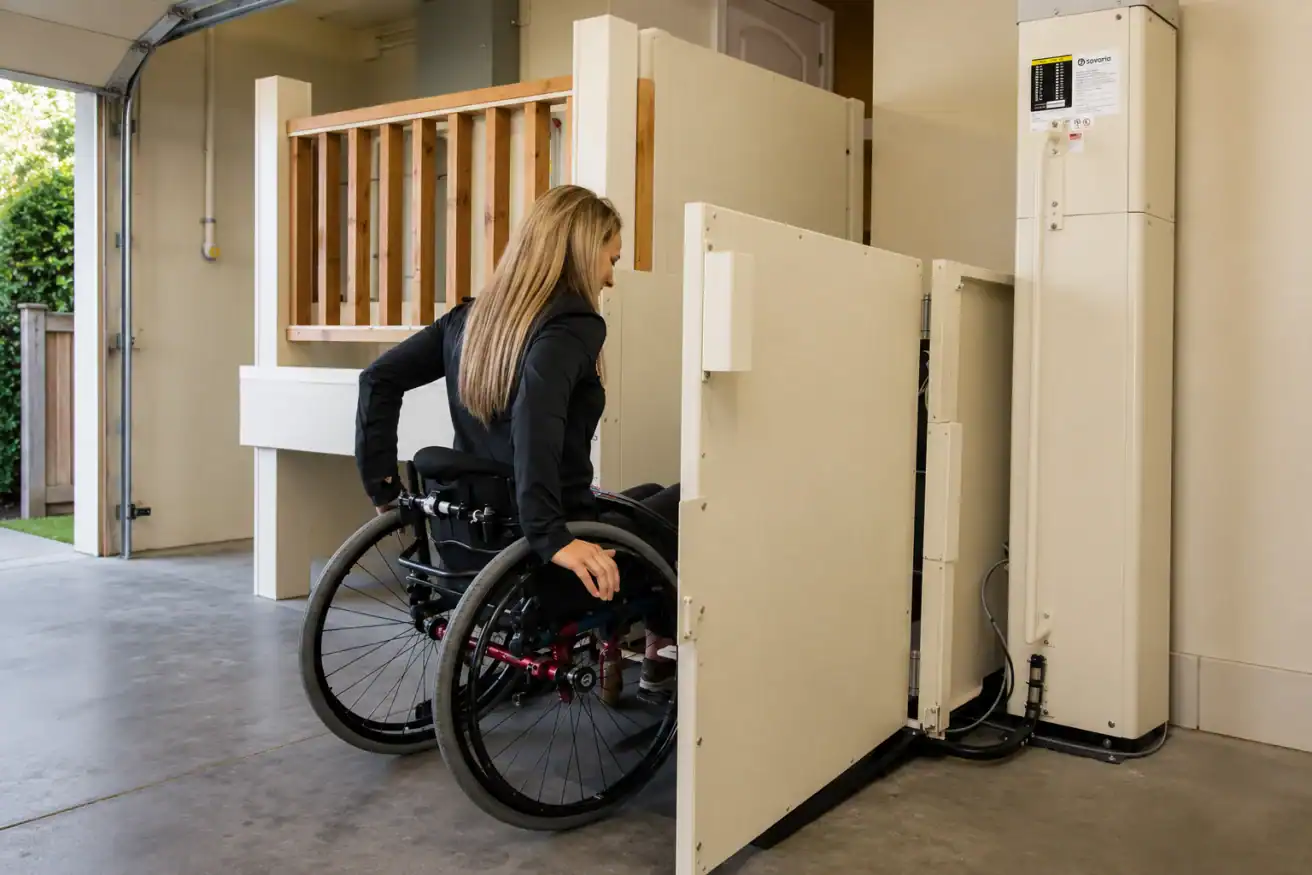
When I approach vertical platform lift planning in New Iberia, I do not start by deciding that the Harmar Highlander II or Bruno VPL is automatically the better lift.
I start with the entry.
How high is the porch? How much space is available between the driveway or walkway and the door? Where does the wheelchair need to enter and leave the platform? Is there enough room at the upper landing? How exposed will the lift be to Louisiana weather? And how will the person use the entrance every day?
Those details tell me much more than a product name alone.
For a raised porch or entry where a ramp would take up too much space, both the Harmar Highlander II and Bruno VPL can provide practical raised entry access. The right choice depends on how the lift needs to fit the property and the person using it.
When I Consider a Vertical Platform Lift for a New Iberia Home
A vertical platform lift moves a wheelchair, power chair, scooter, or user vertically between two elevations. At a home, that often means traveling from ground level to a raised porch, deck, or entry landing.
I usually explore this type of solution when:
- The entrance sits several steps above ground level.
- The person uses a wheelchair or power chair regularly.
- There is limited space for an appropriately planned ramp.
- A long ramp would interfere with a driveway, walkway, gate, or yard.
- The household wants a direct route between ground level and the entry.
- Everyday entry and exit need to become easier to manage.
That is why a wheelchair platform lift can be a particularly useful ramp alternative at homes where the rise is significant but horizontal space is limited.
Harmar Highlander II vs. Bruno VPL at a Glance
Both products are designed to solve the same basic problem: moving a wheelchair user between different elevations without requiring the long footprint of a ramp.
The more useful question is how each one fits the home.
| Planning Factor | Harmar Highlander II VPL | Bruno VPL |
|---|---|---|
| Raised porch access | Strong option | Strong option |
| Outdoor applications | Available | Available |
| Multiple lift heights | Available across models | Available across models |
| Platform/gate configurations | Multiple options | Multiple options |
| Power considerations | Standard power with backup options available | AC and battery-backed configurations available depending on model |
| Best choice | Depends on site layout and required configuration | Depends on site layout and required configuration |
I do not choose between these products from this table alone. I use the home assessment to determine which configuration works better.
The 6 Factors I Review During Vertical Platform Lift Planning in New Iberia
1. Raised-Entry Height
The first measurement is the vertical distance the lift actually needs to travel.
A porch a few feet above grade creates a different installation than a substantially higher landing. Both Harmar and Bruno offer VPL configurations for different lifting heights, so I match the equipment to the actual rise rather than choosing more lift than the home needs.
This is one reason an on-site assessment matters. The height of the porch affects the lift model, gate arrangement, and overall layout.
2. Available Space and Ramp Run
One of the biggest reasons I consider a porch lift in New Iberia is limited ground space.
A ramp gains elevation gradually. As the entry gets higher, the route can require considerably more horizontal space once landings and direction changes are included.
That space may compete with:
- driveways
- sidewalks
- landscaping
- side-yard access
- parking areas
- gates
- drainage paths
A VPL travels vertically instead. Where usable ground space is limited, that smaller footprint can make it easier to create a practical accessible route.
That does not mean a lift is automatically better than a ramp. It means I compare both options based on the property.
3. Gate and Wheelchair Alignment
The lift cannot simply fit beside the porch. The user also needs a comfortable way to approach it, enter it, leave it, and continue through the doorway.
I look closely at the direction of travel.
For example, can the wheelchair roll straight onto the platform and straight toward the door at the top? Does the layout require a turn? Does a porch railing or existing gate interfere with that path?
Both Harmar and Bruno offer configuration choices that can help address different entry and exit arrangements. The important part is matching the configuration to the real wheelchair route.
A lift that technically fits but creates awkward maneuvering is not the result I want.
4. Landing Space
The upper landing deserves as much attention as the lift itself.
When the platform reaches porch level, there needs to be enough usable space for the wheelchair user to exit and move toward the door without becoming boxed in by railings, walls, furniture, or the door swing.
I check:
- available maneuvering area
- direction of platform exit
- door location
- door swing
- porch railings
- gates
- thresholds
- the route into the home
The goal is not simply to reach porch height. The goal is to create a usable path all the way into the home.
5. Weather Exposure
Outdoor equipment in South Louisiana needs to be planned with exposure in mind.
I look at whether the proposed lift location is:
- fully exposed
- partly protected by a porch roof
- near roof runoff
- located where water collects
- exposed to wind-driven rain
- positioned near landscaping or irrigation
Both the Harmar Highlander II and Bruno VPL have options intended for outdoor use. But product suitability is only part of the planning.
The surrounding site matters too. Drainage, placement, and keeping the travel path clear all affect how practical the installation will be over time.
6. Power and Everyday Use
I also ask how important the entrance is to the user’s normal routine.
Is this the primary way someone leaves the house every day? Do they use a power wheelchair? Is someone else usually home? How important is continued lift operation during a power interruption?
The Harmar Highlander II uses household electrical power and offers a backup power option. Bruno offers different power arrangements depending on the selected VPL model, including configurations with battery backup.
Rather than treating backup power as a simple feature comparison, I look at how the customer actually uses the entrance.
For someone who relies on the lift as a primary daily route, power planning deserves more attention than it might for an occasionally used secondary entrance.
When I May Recommend the Harmar Highlander II
The Harmar Highlander II VPL is one option I consider when the project needs flexibility across different lifting heights and platform configurations.
Depending on the installation, its available platform, gate, control, and backup-power options can help us adapt the lift to the property rather than forcing the property around one standard configuration.
I may lean toward exploring the Highlander II when:
- The required travel height points toward one of its available configurations.
- Outdoor durability is important.
- The entry needs specific gate or platform planning.
- The user needs a straightforward wheelchair route.
- Backup-power capability is important to the household.
That recommendation still depends on measurements and the surrounding entry layout.
When I May Recommend the Bruno VPL
The Bruno VPL is another strong option for residential wheelchair access.
Bruno offers multiple platform sizes, entry and exit arrangements, lifting heights, and power configurations across the VPL line. Those choices can be useful when I am working around an existing porch, gate, walkway, or landing.
I may explore Bruno more closely when:
- A particular platform arrangement works especially well with the entry.
- The home requires a certain approach or exit direction.
- Battery-backed operation is important.
- The available Bruno configuration matches the porch height well.
- The existing landing geometry works naturally with the lift.
Again, the product comes second to the layout.
VPL or Ramp: Which Makes More Sense for a Raised New Iberia Entry?
Before recommending either Harmar or Bruno, I first make sure a VPL is the right category of solution.
A wheelchair ramp may still be the better choice when there is enough space for a gradual accessible route and the homeowner prefers a solution without a powered lifting system.
A VPL becomes especially worth considering when the required ramp would consume too much usable space.
| Situation | Option I Would Explore First |
|---|---|
| Low rise with plenty of open approach space | Ramp |
| Higher porch with limited yard or driveway space | VPL |
| Everyday wheelchair access with a direct vertical route | VPL |
| Plenty of room for a gradual route | Ramp |
| Ramp would interfere with parking, gates, or circulation | VPL |
| Household prefers a non-powered route and has sufficient space | Ramp |
This comparison is why I rarely recommend a product before seeing the property.
The best accessibility solution is the one that works with the entire route—not simply the porch.
What I Check Before Recommending Either Lift
When 101 Mobility of Lafayette evaluates a New Iberia entry, I want to understand how the person moves from the outside of the property all the way into the home.
My planning checklist includes:
- The starting route. Where does the user arrive—from a vehicle, driveway, sidewalk, or garage?
- The entry rise. How much vertical travel is actually required?
- Available ground space. Would a ramp fit comfortably without creating another obstruction?
- Wheelchair dimensions. Does the user’s mobility device have enough space to approach, board, turn if necessary, and exit?
- Platform orientation. Which direction should the wheelchair enter and leave?
- Upper landing. Is there sufficient space between the lift, railings, and doorway?
- Door access. Can the user move from the platform to the door comfortably?
- Weather and drainage. Will water flow or exposure affect where the equipment should be positioned?
- Power. What power arrangement fits the installation and the user’s daily needs?
- Long-term use. Is this a temporary mobility challenge or part of a longer-term accessibility plan?
Looking at these factors together helps me compare Harmar and Bruno based on the home rather than simply comparing feature lists.
Frequently Asked Questions
Is a vertical platform lift the same as a porch lift?
The terms are often used interchangeably in residential applications. A vertical platform lift can be installed beside a raised porch or entry so a wheelchair or power-chair user can move vertically between ground level and the landing.
Can a vertical platform lift be installed outdoors in New Iberia?
Yes. Both the Harmar Highlander II and Bruno VPL have configurations suitable for outdoor applications. The final plan should also account for the installation location, weather exposure, drainage, electrical requirements, and surrounding landing conditions.
Is a vertical platform lift better than a wheelchair ramp?
Neither option is universally better. A ramp can work very well when adequate horizontal space is available. A VPL may make more sense when the entry is relatively high or a ramp would take up too much driveway, walkway, yard, or circulation space.
Which is better: the Harmar Highlander II or Bruno VPL?
Both can be strong residential accessibility options. I compare the required lift height, available platform space, entry and exit direction, gates, power needs, weather exposure, and daily wheelchair route before recommending one.
Can I stay in my wheelchair while using a VPL?
Yes. That is one of the main purposes of a wheelchair platform lift. The user can remain in a wheelchair or compatible mobility device while traveling between elevations, provided the selected equipment and configuration are appropriate for the user and device.
Start With the Entry, Not the Product
When I compare the Harmar Highlander II and Bruno VPL for a New Iberia home, I am not looking for a universal winner.
I am looking for the lift that fits the porch height, available space, wheelchair route, landing, weather exposure, power needs, and everyday routine.
Sometimes that leads to Harmar. Sometimes Bruno provides the better configuration. And sometimes the site assessment shows that a ramp or another accessibility solution would make more sense.
If you’re considering vertical platform lift planning in New Iberia, book a free consultation with 101 Mobility of Lafayette. We can evaluate the entry, compare the available options, and help you determine which solution fits your home and daily mobility needs.
About the Author
Jonas Boutte is the owner of 101 Mobility of South Louisiana and an accessibility specialist with hands-on manufacturer training across stairlifts, vertical platform lifts, ramps, home elevators, and other mobility equipment. He helps customers compare solutions based on their homes, mobility needs, and long-term goals.
Learn more about Jonas Boutte.