Wheelchair Ramp vs Vertical Platform Lift in Youngsville: Which Entry Solution Fits Best?
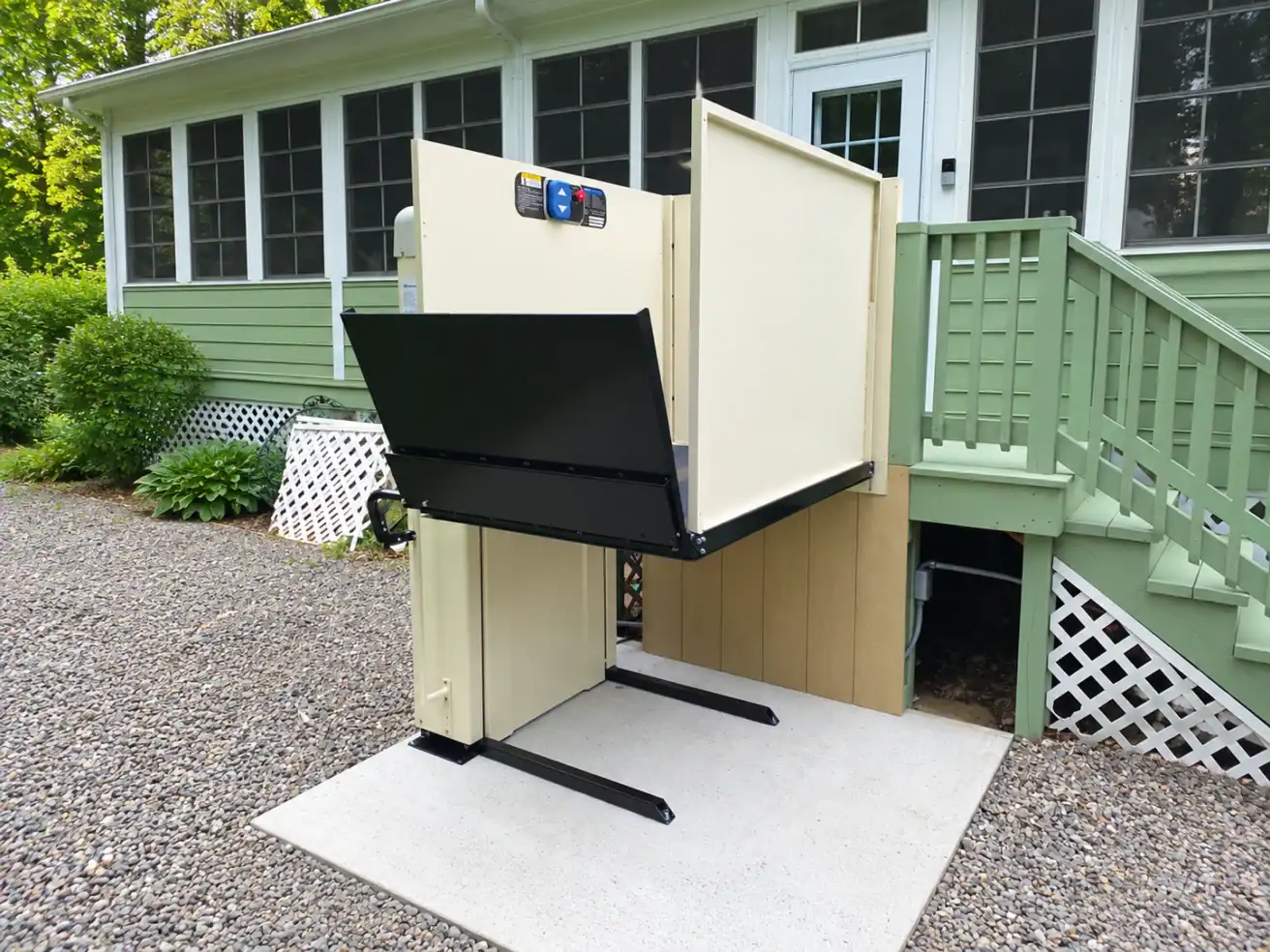
A wheelchair ramp vs. vertical platform lift decision usually comes down to rise and available run. If the rise is under roughly 30 inches and the property has enough usable horizontal space, a ramp usually wins. Above that, the ramp gets long quickly, and a vertical platform lift often becomes the more practical option.
At 101 Mobility of Lafayette, I start by measuring the entry rather than choosing the equipment first.
That approach works whether the house is in Youngsville, Broussard, Milton, Maurice, or Abbeville.
The math is the same.
The property is not.
Start With the Math: How Much Ramp Does the Rise Require?
For planning purposes, 101 Mobility uses the familiar 1:12 ramp guideline.
That means every inch of vertical rise requires about one foot of ramp run.
A 12-inch rise needs about 12 feet of ramp.
A 24-inch rise needs about 24 feet.
A 30-inch rise needs about 30 feet.
And that is before the space needed for landings is considered.
The table below uses a 1:12 ramp ratio and 5-foot planning landings. The footprint shown assumes a straight layout. A modular ramp can turn or switch back, which changes the shape of the footprint but does not eliminate the required ramp length.
| Rise | Ramp Run at 1:12 | Planning Landings | Approx. Total Straight Footprint |
|---|---|---|---|
| 1 ft. | 12 ft. | 2 | 22 ft. |
| 2 ft. | 24 ft. | 2 | 34 ft. |
| 2.5 ft. | 30 ft. | 2 | 40 ft. |
| 3 ft. | 36 ft. | 3 | 51 ft. |
| 4 ft. | 48 ft. | 3 | 63 ft. |
| 5 ft. | 60 ft. | 3 | 75 ft. |
| 6 ft. | 72 ft. | 4 | 92 ft. |
These are planning numbers, not a substitute for measuring the property or determining the requirements that apply to a specific installation.
The useful part is what the numbers show.
A one-foot rise can be relatively easy to solve with a ramp when there is enough room.
At a three-foot rise, the ramp itself requires roughly 36 feet of run before accounting for landings.
At five feet, you are already looking at about 60 feet of actual ramp.
That is where the property begins making the decision for us.
When Does a Wheelchair Ramp Usually Make More Sense?
A ramp is usually the first option I consider when the rise is relatively low and the property has enough room for the route.
An aluminum modular ramp can be arranged using sections and platforms rather than requiring one uninterrupted straight line.
That gives us flexibility.
A ramp may make more sense when:
- The rise is under roughly 30 inches
- There is a deep, usable area for the required run
- The route does not block the driveway or primary walkway
- The user benefits from continuous rolling access
- The doorway and upper landing can be approached comfortably
- A powered lift is not necessary
The first point is not an absolute cutoff.
A ramp can work above 30 inches.
The issue is what happens to the footprint as the rise increases.
At 30 inches of rise, the basic ramp run is already about 30 feet. If the property has plenty of room, that may still be reasonable.
If the lot, parking area, or entrance does not provide that room, the ramp begins requiring turns and additional landings.
That is when I compare the other option.
When Does a Vertical Platform Lift Usually Make More Sense?
A vertical platform lift moves the user and wheelchair or scooter vertically rather than sending them along a long horizontal ramp.
That difference is why the footprint can be much smaller.
I usually give the VPL a stronger look when:
- The entry rise is above roughly 30 inches
- Available horizontal space is restricted
- A long ramp would interfere with the normal use of the property
- The user needs to remain in a wheelchair or scooter
- The doorway and landing work better with a compact vertical route
- Several ramp runs and landings would be necessary
This does not mean a VPL automatically wins because the porch is high.
It still needs a workable lower approach and upper landing.
The mobility device needs to fit the platform.
The user needs enough room to enter and leave the lift.
The lift also needs to work with the doorway instead of solving the rise and leaving another obstacle at the top.
How Much Does a Ramp or Platform Lift Cost?
Price makes this comparison look very uneven at first.
Current wheelchair ramp pricing starts around $1,000 installed for residential modular ramp systems. Ramp cost is heavily influenced by length, so a higher rise generally means more ramp material, more platforms, and a higher installed price.
A standard residential VPL currently runs about $12,000 to $18,000 installed according to 101 Mobility’s dedicated vertical platform lift pricing guide.
That makes the ramp the less expensive option when both products fit the property.
I would recommend the simpler ramp in that situation.
But cost alone cannot create more yard.
If the entry requires 48 or 60 feet of ramp run and the property cannot physically accommodate it, the less expensive product does not solve the access problem.
That is when the more expensive VPL can become the practical option because it uses vertical travel instead of a long horizontal route.
The decision is not simply:
Which product costs less?
It is:
Which product can actually create a usable route to the door?
What Else Do I Measure Besides Rise?
Rise gets most of the attention because it determines ramp length.
It is not the only measurement I need.
Available Run
I need to know how much usable horizontal space actually exists.
Open grass does not automatically equal usable ramp space.
A route can be affected by:
- Driveways
- Walkways
- Landscaping
- Porch shape
- Parking
- Gates
- Drainage areas
- The approach to the doorway
A switchback can reduce the depth required for a ramp, but it creates a wider layout and adds landing space.
Upper and Lower Landings
The user has to get onto the ramp or lift at the bottom and move toward the door at the top.
That requires usable space at both ends.
A VPL with no practical lower approach does not work.
Neither does a ramp that reaches porch height but leaves no useful room at the door.
Door Swing
A door that swings into the same space used by a wheelchair can change the recommendation.
I want to know how the person approaches the door, where the wheelchair sits while the door opens, and how the ramp or lift connects to that movement.
The Mobility Device
A manual wheelchair, power wheelchair, and scooter do not use exactly the same amount of space.
Turning room matters.
So does whether the user moves independently or receives assistance from another person.
Those dimensions belong in the decision.
Youngsville Is Not the Only Part of the Lafayette Area With This Decision
This article started as a Youngsville ramp-versus-lift guide, but the same decision applies throughout the Lafayette market.
I use the same process in Youngsville, Broussard, Milton, Maurice, and Abbeville:
Measure the rise.
Measure the usable run.
Look at the doorway.
Look at the mobility device.
Then compare the complete route.
The answer can be different from one house to the next even when the porch height is identical.
One property may have enough open run for a straightforward modular ramp.
Another may force that same ramp across parking, a walkway, or another part of the normal entry route.
That second property may make a platform lift more practical.
What Happens After Installation?
After installation, I look at the route again.
For a ramp, I review how the ramp sections, platforms, upper landing, and doorway work together.
The customer should be able to see how the complete path connects from the lower approach to the house.
For a VPL, the customer needs to understand the normal operation of the equipment and how to enter and exit the platform at each landing.
I also look beyond the person using the equipment.
Can other members of the household still use the entrance?
Does the door open normally?
Does the wheelchair have enough turning room?
Does the driveway or walkway still function the way the household needs it to?
For powered equipment, ongoing maintenance and repair should also be part of the plan. Our service and support team remains available after installation for applicable equipment maintenance and repairs.
Frequently Asked Questions
Is a ramp or a lift cheaper?
A modular wheelchair ramp starts around $1,000 installed, while a standard residential vertical platform lift currently runs about $12,000 to $18,000 installed. A ramp is usually the less expensive option, but its price and footprint increase as the required length increases.
How much ramp do I need for a 2-foot rise?
At a 1:12 planning ratio, a 24-inch rise needs about 24 feet of ramp run, plus the space required for landings. The final layout may be straight, L-shaped, or switchback depending on the property.
When does a vertical platform lift make more sense than a ramp?
A VPL often makes more sense when the rise is above roughly 30 inches and the property does not provide enough usable horizontal space for a practical ramp route. The doorway, landings, mobility device, and electrical/site requirements still need to be evaluated.
Can a wheelchair user stay in the chair on a vertical platform lift?
Yes. A vertical platform lift is designed to move the user together with an appropriate wheelchair or scooter on the platform. The device dimensions and available maneuvering space should be evaluated before selecting the lift and platform configuration.
Does a 3-foot rise really need 36 feet of ramp?
At a 1:12 planning ratio, yes. A 36-inch rise corresponds to approximately 36 feet of actual ramp run, before adding landing space. That is why relatively small increases in porch height can create a much larger ramp footprint.
How do I know whether a ramp or VPL will fit my Lafayette-area home?
Start by measuring the total rise and usable horizontal space, then evaluate the upper and lower landings, doorway, mobility device, and normal entry route. A free in-home consultation lets us measure those conditions and compare the two options at the actual property.
If you are comparing a wheelchair ramp and vertical platform lift in Youngsville, Broussard, Milton, Maurice, or Abbeville, start with the measurements rather than the product. We can evaluate the rise, available run, doorway, landings, and mobility device during a free in-home consultation and explain which option fits the route.
About the Author
Jonas Boutte is the owner of 101 Mobility of South Louisiana and serves customers throughout Lafayette and surrounding Acadiana communities. He has hands-on training from accessibility-equipment manufacturers and helps families evaluate ramps, platform lifts, stairlifts, home elevators, and other mobility solutions based on the person, property, and everyday route.