What I Check Before Recommending a Bathroom Product
A shower transfer system in Baton Rouge has to match the bathroom and the transfer being performed. I start with doorway clearance, fixture spacing, tub or shower geometry, toilet position, transfer direction, and caregiver space. A compact transfer product may solve the problem, but only when the complete movement can happen within the existing room.
For homes in St. Gabriel, Prairieville, Gonzales, and Baton Rouge, I focus on the transfer rather than creating a generic bathroom-safety checklist. At 101 Mobility of Baton Rouge, I want to know where the person starts, where they need to finish, and what physical barriers sit between those two points.
| Transfer Question | What I Check | Why It Changes the Recommendation |
|---|---|---|
| How does the person enter the bathroom? | Doorway clearance and first turn | Equipment still has to reach the bathing area |
| Where does the transfer start? | Toilet, wheelchair, chair, or another position | Different systems depend on different starting points |
| Where is the tub or shower? | Fixture relationship and entry direction | Determines whether a sliding or rolling system can work |
| Which direction does the person move? | Left, right, forward, or along a transfer route | Product configuration has to match the movement |
| Where does the caregiver stand? | Working space beside the user and equipment | Equipment cannot occupy all of the assistance space |
| Is the existing bathing area still workable? | Threshold, tub wall, shower opening, and surrounding space | Determines whether equipment is enough or a larger change is needed |
Doorway, Fixture Spacing, and Transfer Direction Are the First Constraints
The shower is not the first thing I measure.
The person has to enter the bathroom, position for the transfer, and reach the bathing area before the shower equipment becomes useful.
I start at the doorway.
Can the person and any mobility equipment get through the opening? Is there enough space to make the first turn? Does the door swing into an area needed for the transfer?
Then I look at the relationship between the fixtures.
For some transfer systems, the location of the toilet relative to the tub matters directly. For a rolling system, the route between the starting point and the shower becomes more important.
Transfer direction also matters.
A product that can be assembled for a left-hand or right-hand transfer may solve one bathroom arrangement but not another. I do not want to choose a product and then ask the family to adapt the entire routine around it.
Caregiver space is another constraint. If physical assistance is part of the established routine, I need to account for where that person will stand, move, and operate the equipment.
The equipment and the caregiver cannot occupy the same working space.
When ShowerGlyde SG-2 Can Solve a Tub or Shower Transfer
The ShowerGlyde SG-2 is designed around a specific bathroom relationship: the toilet and tub are adjacent.
That is important.
The system uses a bench that slides across the tub, with longer rails extending over the toilet area. It can be assembled in left- or right-hand configurations.
101 Mobility lists the SG-2 as height-adjustable for tubs up to 19.5 inches, with optional extension legs available for tubs up to 25 inches. Its published weight capacity is 330 pounds.
Those specifications help me determine whether a ShowerGlyde in Baton Rouge belongs on the shortlist, but the product still has to work with the bathroom.
I look at:
- The relationship between the toilet and tub
- Which side the transfer needs to occur from
- Tub height
- Space around the toilet
- Position of the tub controls
- Door and fixture interference
- Caregiver working space
If the toilet and tub do not have the relationship the SG-2 is designed around, I would not try to force that product into the room.
That is one of the practical limitations of transfer equipment.
A specialized product can work very well for the layout it was designed to address, but a more expensive or more feature-rich transfer system does not correct incompatible bathroom geometry.
When a Rolling Transfer System Changes the Route
A rolling transfer system creates a different planning question.
The transfer route is no longer limited to moving from one fixture to an adjacent bathing surface. The equipment itself needs a route through the bathroom.
The Roll-In Shower Buddy Lite SB6C is a lightweight, compact mobility aid intended to assist transfers into and out of roll-in showers.
For someone evaluating Shower Buddy in Louisiana, that means I look beyond the shower opening.
Where does the user begin?
Can the rolling system reach that point?
What doorway does it cross?
Can it turn into the bathroom?
Is there enough clear floor area to approach the roll-in shower?
What happens after bathing?
A rolling transfer system can change the route because the chair moves with the person.
That can reduce the need for one type of transfer at the shower itself, but it does not eliminate doorway, turning, or caregiver-space requirements.
If the system cannot pass through the bathroom doorway or cannot maneuver around the toilet or vanity, then its usefulness inside the shower does not solve the complete transfer problem.
The starting point and the destination both have to work.
When a Larger Accessible-Shower Project Is the Better Long-Term Answer
Sometimes the transfer product is not the main answer.
If the existing tub wall, shower threshold, doorway, fixture layout, and caregiver space create several connected barriers, adding another transfer device may leave too many of those problems in place.
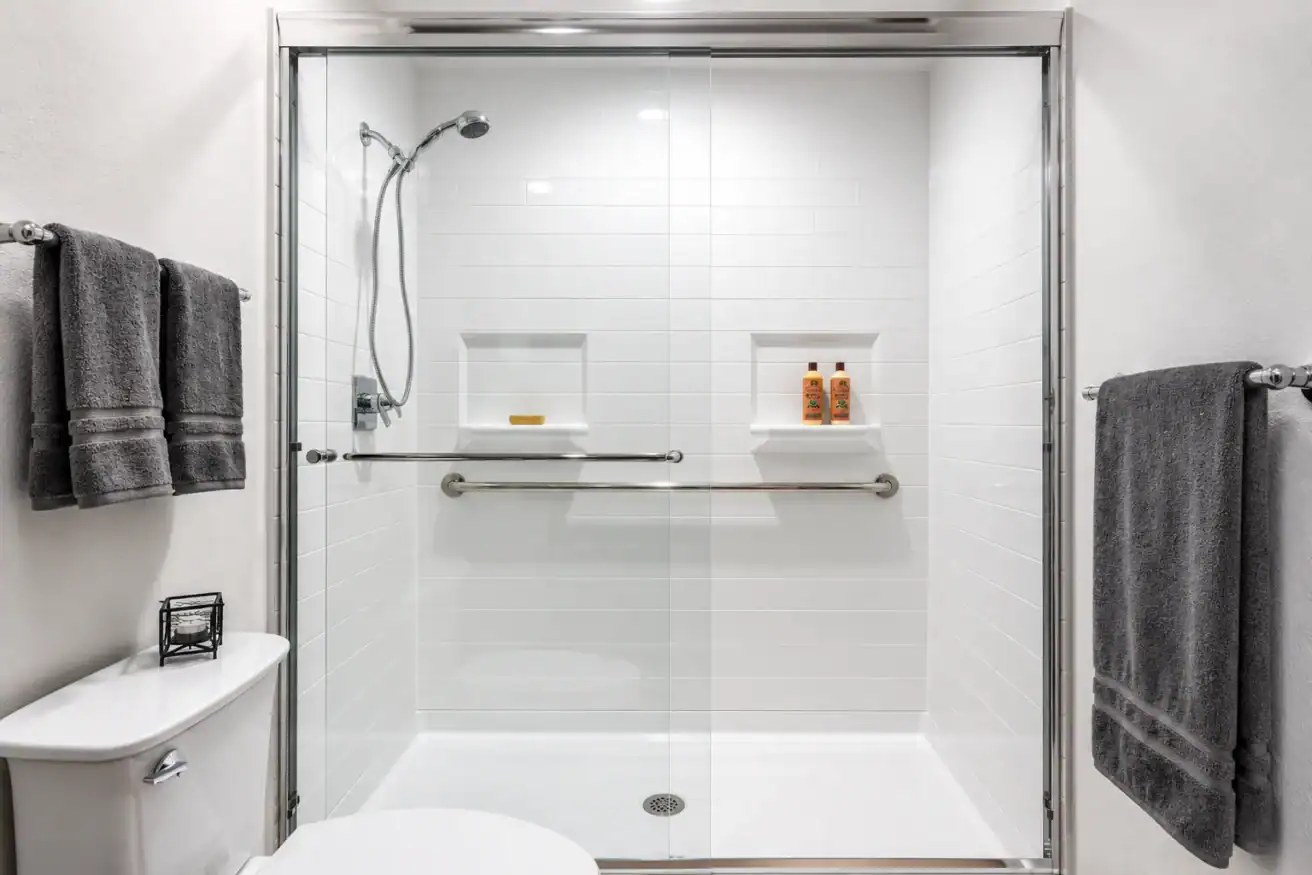
That is when I may compare a larger bathing-area change such as the Bestbath Multi-Piece Accessible Shower.
The current Bestbath system is a 60-inch by 30-inch multi-piece shower. It offers center, left, and right drain configurations and threshold-height options from 0.75 inches through 2 inches. Beveled and traditional threshold options are also available.
Those choices provide more flexibility when planning an accessible shower in St. Gabriel, but a configurable shower is still a larger project than adding transfer equipment to an existing bathing area.
I would not recommend replacing a workable bathing area simply because a larger project offers more options.
If the transfer can be addressed by an SG-2 or another suitable transfer system and the rest of the bathroom functions well, that may be the more practical answer.
I start looking harder at an accessible-shower project when the bathing area itself remains the obstacle.
That may include situations where:
- The existing tub geometry does not work with the required transfer
- The shower entrance does not work with the mobility equipment
- The fixture arrangement prevents the selected transfer system from functioning
- Caregiver working space remains inadequate
- A transfer product would solve only one of several connected barriers
The goal is to solve the actual access problem without making the project larger than it needs to be.
What Happens After Installation or Setup?
After a shower-transfer product is installed or set up, we go back through the transfer.
For the ShowerGlyde SG-2, we review how the bench moves along the rails, where it locks, how the selected seat configuration works, and how the left- or right-hand setup relates to the bathroom.
For a rolling system such as the Roll-In Shower Buddy Lite SB6C, I want the household to understand the complete route from the starting position to the shower and back again.
We also review caregiver positioning when assistance is part of the routine.
The bathroom should still have enough usable space for the transfer that was planned before the equipment arrived.
For a larger shower modification, we review how the final entry, threshold, fixtures, seating, and supporting equipment relate to the bathing routine.
Our service and support team remains available after setup or installation for accessibility-equipment questions, maintenance, and repairs.
If you are evaluating shower-transfer equipment in St. Gabriel, Prairieville, Gonzales, or Baton Rouge, start with a free in-home consultation. We can measure the doorway and fixture spacing, review the transfer direction and caregiver position, and determine whether a transfer product or a larger shower modification fits the bathroom better.
FAQ: Shower Transfer Equipment
What should I measure before choosing a shower transfer system?
Start with the doorway, first interior turn, fixture spacing, bathing-area opening, transfer direction, and available caregiver space. The measurements need to describe the complete transfer route rather than only the tub or shower.
When does the ShowerGlyde SG-2 make sense?
The ShowerGlyde SG-2 may make sense when the toilet and tub are adjacent and the transfer matches the system’s sliding-bench design. I also check tub height, transfer direction, surrounding fixture clearance, and caregiver space before recommending it.
Does the ShowerGlyde SG-2 work with every bathtub?
No. The tub, toilet relationship, tub height, transfer direction, and surrounding space all need to fit the system. 101 Mobility lists the SG-2 for tubs up to 19.5 inches, with optional extension legs for tubs up to 25 inches.
When would I consider a Roll-In Shower Buddy Lite SB6C?
I would consider the Roll-In Shower Buddy Lite SB6C when the bathing area is a roll-in shower and a rolling transfer route fits the bathroom. Doorway clearance, turning space, the approach to the shower, and caregiver positioning still need to be evaluated.
When should I consider an accessible shower instead of transfer equipment?
An accessible-shower project may make more sense when the existing bathing area creates several connected barriers that a transfer product cannot resolve. I look at the tub or shower geometry, threshold, doorway, fixture positions, caregiver space, and long-term transfer routine.
Can a transfer product solve a bathroom that is too tight for a caregiver?
Not always. A transfer product still needs usable operating and caregiver space. If equipment occupies the area where assistance has to occur, I would evaluate another configuration or a larger bathroom modification rather than forcing the product into the room.
About the Author
Jonas Boutte is the owner of 101 Mobility of South Louisiana and has hands-on training from accessibility-equipment manufacturers including Bruno, Harmar, Stiltz, Staying Home, EZ-ACCESS, National Ramp, and others. He helps Baton Rouge-area families evaluate bathroom-accessibility products, transfer equipment, ramps, lifts, stairlifts, home elevators, and other mobility solutions based on the person, home layout, caregiver needs, and everyday routine.