Caregiver Support in Abbeville During Summer: Mobility Equipment That Helps Daily Routines

Summer can make caregiving more complicated than expected. Family members may rotate in and out, normal routines shift, appointments change, and one caregiver often ends up doing more lifting, guiding, and hands-on support at home.
That is why summer caregiver support in Abbeville should focus on making daily routines safer and easier to manage. The right mobility equipment can help reduce strain during transfers, improve stability in key areas of the home, and make care feel more consistent even when schedules are not.
Why summer caregiving can feel harder at home
During the summer, families often deal with changing coverage, visitors, school breaks, and travel plans. Even when extra help is available, not every helper knows the safest way to assist with transfers or mobility needs.
That can create problems like:
- Inconsistent transfer techniques
- More physical strain on one primary caregiver
- Rushed movement between bed, chair, toilet, or shower
- Greater fall risk during busy or disrupted routines
- Delays in getting the home set up for safer care
When a loved one needs regular hands-on assistance, a better setup can make a meaningful difference day after day.
Summer caregiver support in Abbeville starts with safer daily routines
Many caregiving challenges are not caused by a lack of effort. They come from trying to manage physically demanding tasks without the right support in place.
For families providing home care support, summer is a smart time to step back and ask a few practical questions:
- Are transfers becoming harder?
- Is one person doing most of the lifting?
- Are bathroom routines taking longer or feeling less safe?
- Is the current setup working for everyone helping with care?
If the answer to any of those is yes, it may be time to look at caregiver mobility equipment that can make daily care more manageable.
Where caregivers usually feel the most strain
Bed-to-chair and chair-to-toilet transfers
Transfers are one of the biggest physical demands in home caregiving. Repeated lifting, pivoting, and repositioning can put stress on both the caregiver and the person receiving care.
If someone has limited weight-bearing ability, balance issues, or fatigue, transfers can quickly become unsafe without proper equipment.
Bathroom support and tight spaces
Bathrooms are one of the hardest rooms to navigate safely. Small layouts, slippery surfaces, and awkward positioning can make routine care much more difficult.
Even a short transfer into or out of the bathroom may require more support than families expect.
Moving through entryways and thresholds
Home care does not happen only in the bedroom. Caregivers often help with entry access, porch steps, uneven surfaces, and transitions between rooms. These small barriers can slow routines and increase risk.
Mobility equipment that can help daily care
The best solution depends on the person’s mobility level, the caregiver’s role, and the layout of the home. A consultation helps match the equipment to the routine instead of guessing.
Patient lifts for safer transfers
A patient lift in Abbeville may be worth considering when manual transfers are becoming physically demanding or unpredictable. Patient lifts can assist with common moves such as bed-to-chair or chair-to-commode transfers and can help reduce the lifting burden on caregivers.
This type of solution may be especially helpful when:
- One caregiver is providing most of the assistance
- The individual has limited standing ability
- Transfers require repeated repositioning throughout the day
- Manual lifting is creating safety concerns
For families exploring patient handling options, this is often one of the most important categories to review.
Transfer aids and support equipment
Not every situation calls for the same level of equipment. Depending on the person’s strength and stability, transfer support may also include equipment designed to improve positioning, assistance, or movement during routine care.
The goal is the same: better transfer safety and less strain during repeated daily tasks.
Bathroom and in-home accessibility updates
Caregiver support often improves when equipment is paired with home updates that remove obstacles. That may include changes that make it easier to access key areas of the home, navigate transitions, or create more usable space for assistance.
These improvements can help caregivers work more efficiently while helping the individual move with more confidence and comfort.
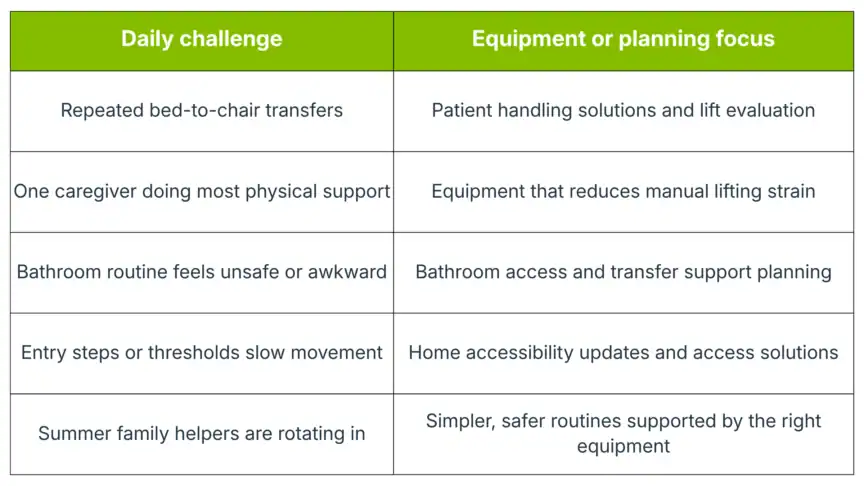
Quick guide: common caregiving challenge and possible equipment focus
How to know when it is time to plan equipment
Families often wait until a difficult transfer, near fall, or caregiver injury makes the need obvious. It is better to plan earlier.
Look for signs like:
- Transfers taking more time than they used to
- Caregivers needing to “catch” or steady someone more often
- Increasing fatigue after routine care tasks
- Concern about handling care when family schedules change
- Avoiding certain parts of the home because they are harder to manage
If daily care feels harder this summer than it did a few months ago, that is enough reason to start the conversation.
What to look for when choosing caregiver mobility equipment
The right recommendation should reflect real daily use. That means looking at more than a product name.
A good plan should consider:
- The individual’s current mobility level
- How often transfers happen each day
- Whether one person or multiple family members help
- The size and layout of the home
- Where the biggest strain or safety issue happens now
- How easy the equipment will be to use consistently
The best result is not simply adding equipment. It is creating a routine that feels safer, smoother, and more sustainable.
FAQs
What kind of mobility equipment helps caregivers the most?
It depends on the routine. Families often start by looking at transfer-related solutions, patient handling equipment, and accessibility updates that reduce physical strain in the areas where care happens most often.
When should a family consider a patient lift?
A patient lift may be worth discussing when manual transfers are becoming difficult, tiring, or less predictable for either the caregiver or the person receiving care.
Can mobility equipment help with temporary summer caregiving changes?
Yes. When family schedules shift, the right equipment can make routines easier to repeat safely and more manageable for different helpers involved in care.
Is transfer safety only a concern for full-time caregivers?
No. Even part-time family helpers can run into transfer safety issues if a loved one needs regular assistance with standing, repositioning, or moving between surfaces.
Make summer care safer and easier to manage
If summer routines are putting more pressure on daily caregiving, now is a good time to review what could make care safer at home. The right equipment can help reduce strain, support better transfers, and make day-to-day care more manageable for everyone involved.
Explore local solutions through 101 Mobility Lafayette and learn more about patient handling solutions. When you are ready, Book a Free Consultation to discuss the home setup, care routine, and next best step.