Outdoor Accessibility Inspection in St. Martinville: What I Check After Summer Storms
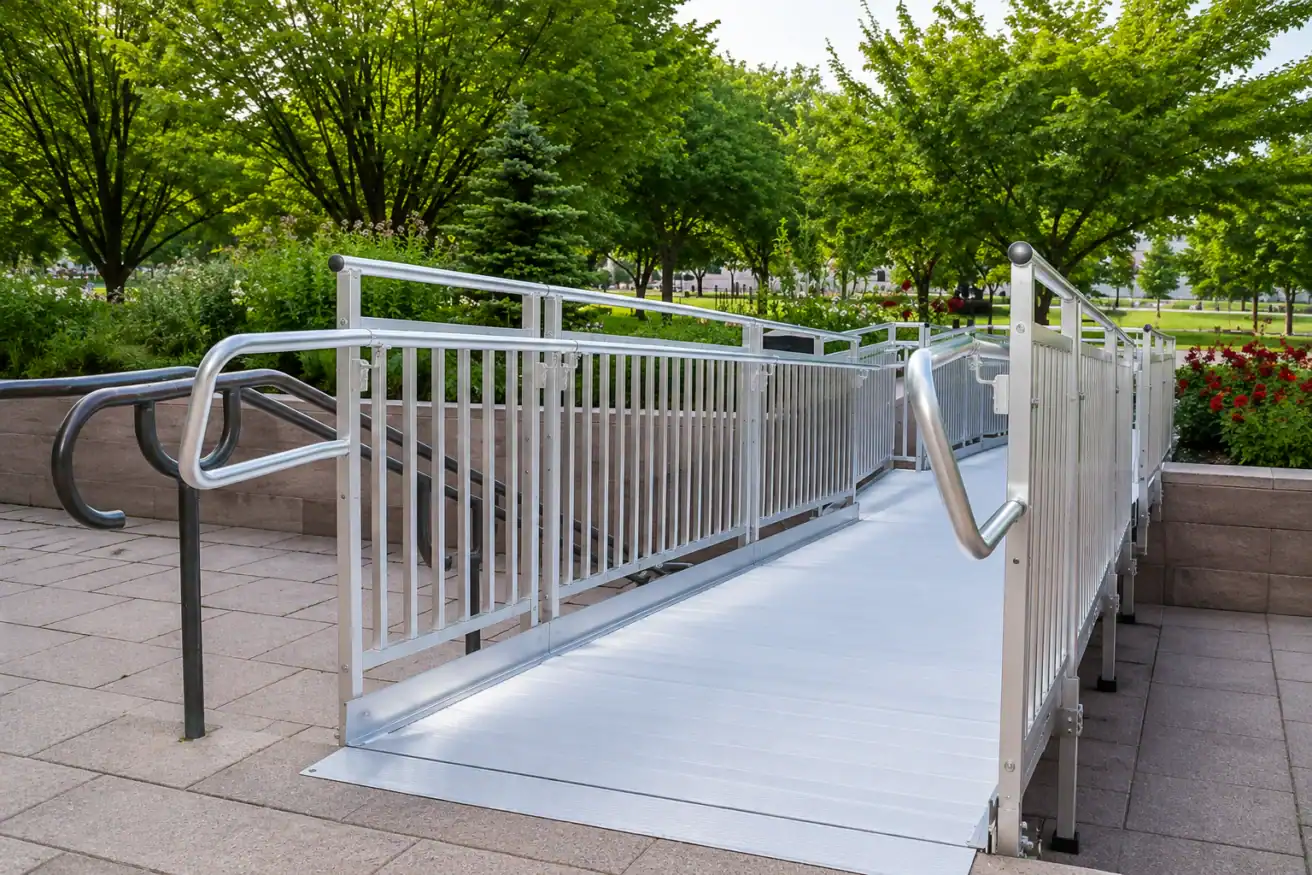
After a significant summer storm, my outdoor accessibility inspection in St. Martinville starts with the complete route, not just the ramp or lift. I look for standing water, debris, unstable approaches, blocked landings, gate problems, visible equipment changes, and anything else that could make the normal path to the door harder to use.
A ramp or platform lift may be functioning normally while the area around it has changed.
That is why I treat a storm access check as an inspection of the entire accessible entry route.
Key Takeaways
- Check the approach, equipment, landings, and doorway after significant storms.
- Standing water and debris can interfere with an otherwise usable ramp or platform lift.
- Ramp inspections should include the surface, handrails, approaches, landings, and drainage.
- Platform lift checks should include boarding areas, gates, controls, drainage, and visible signs of damage.
- If something has shifted, been damaged, or operates differently than normal, I recommend having it evaluated before relying on it again.
What Should I Check After a Summer Storm?
You do not need to disassemble equipment or troubleshoot electrical components yourself.
Start with a visual check of the route you normally use.
| Inspection Area | What I Look For |
|---|---|
| Approach | Mud, branches, debris, standing water, erosion, or unexpected surface changes |
| Ramp surface | Leaves, dirt, debris, visible damage, or anything interfering with the rolling or walking surface |
| Handrails | Visible damage, obstruction, or anything that appears different from normal |
| Landings | Standing water, furniture, planters, branches, or other objects reducing maneuvering space |
| Lift platform | Water, debris, visible damage, or an obstructed boarding area |
| Lift gates | Clear opening and closing path and normal alignment |
| Controls | Normal response without visible water or damage around the control area |
| Power area | Obvious damage, exposed wiring, or abnormal conditions |
| Lighting | Adequate visibility along the normal route |
| Doorway | A clear route from the landing through the entrance |
If something appears damaged, unstable, or different from normal, I would rather have it checked than ask a family to guess.
Why Do I Inspect the Entire Accessible Route?
Outdoor accessibility equipment only solves one part of the trip.
When I evaluate an entrance through 101 Mobility of Lafayette, I look at the route somebody actually uses.
That might begin at the driveway, parking area, garage, or sidewalk.
From there, the person may travel across a paved surface, reach a ramp or platform lift, move onto an upper landing, and then approach the door.
Every part has to work together.
After heavy weather, I ask:
- Has runoff carried mud or debris across the approach?
- Is water collecting where a wheelchair or scooter needs to turn?
- Is the lower boarding area clear?
- Has anything shifted into the path?
- Is the upper landing usable?
- Can the door open normally?
- Are gates clear?
- Is the route still wide enough for the mobility device?
- Does anything look different from how it normally looks?
A storm does not have to damage the equipment itself to interfere with access.
A fallen branch on a landing can matter.
So can a planter that moved into the turning area.
So can runoff that leaves mud exactly where a wheelchair needs traction.
That is why I inspect the route as a system.
What Do I Check During a Ramp Inspection?
For a ramp inspection, I begin before the wheels ever reach the ramp.
The approach
I check the transition from the driveway, walkway, or yard to the bottom of the ramp.
A properly installed ramp does not solve the complete access problem if the approach has become muddy, blocked, uneven, or difficult to maneuver across.
After a storm, I look for anything that has changed that connection.
The ramp surface
Next, I look at the surface itself.
Leaves, branches, mud, and other storm debris can interfere with normal use. I also look for obvious physical changes or damage that were not present before the weather event.
The goal is not to perform a technical structural inspection from the driveway.
It is to identify something that deserves a closer professional look before normal use resumes.
Handrails
I visually check the handrails along the route.
I want them clear and unobstructed.
Storm debris, outdoor furniture, landscaping materials, hoses, or other objects should not reduce access to the rail or narrow the usable path.
Landings
Landings deserve as much attention as the ramp run.
This is where someone may need to stop, turn, approach a doorway, or reposition a wheelchair or scooter.
I check for:
- Standing water
- Debris
- Shifted furniture
- Planters
- Branches
- Blocked doorway clearance
- Reduced maneuvering room
A clear ramp that ends at a blocked landing is not a complete accessible route.
Drainage
I pay close attention to where water has collected.
If runoff repeatedly crosses an approach or gathers around a landing, that matters to how the route functions during and after bad weather.
This is also something I look at when planning a new ramp.
101 Mobility’s Aluminum Modular Ramps include smooth continuous handrails and a slip-resistant platform, but the equipment still has to be positioned within a practical outdoor route.
For a new installation, I consider the rise, available space, landings, doorway, mobility device, approaches, and surrounding drainage before settling on the configuration.
What Do I Check Around an Outdoor Platform Lift?
A vertical platform lift solves a different space problem than a ramp.
Instead of creating a longer sloped route across the property, the platform moves between elevations more directly.
That can work well at porches, decks, garages, and other raised entrances when the site is appropriate.
After a significant storm, however, I still inspect everything around the lift.
Lower boarding area
The wheelchair, scooter, or power chair needs a clear approach to the platform.
I look for:
- Mud
- Standing water
- Branches
- Debris
- Shifted objects
- Surface changes
The lift cannot solve an approach that somebody cannot comfortably reach.
Platform
I visually inspect the platform and the area immediately around it.
I want the boarding surface clear and free from obvious storm debris or anything that could interfere with normal entry or exit.
Upper landing
At the top, I check the route between the platform and the door.
There should still be enough usable space to leave the platform and reach the entrance without navigating around storm debris or displaced items.
Gates
Gate alignment is an important part of a platform lift installation.
After severe weather, I want to see that nothing is blocking the gate and that it appears to open and close as expected.
I do not recommend forcing a gate or continuing to operate equipment that is behaving differently than normal.
Controls and visible power concerns
I am not asking a homeowner to diagnose a lift’s electrical system.
I am looking for obvious reasons not to use it.
That may include:
- Visible water exposure where it does not normally occur
- Damaged wiring
- Damaged electrical equipment
- Controls behaving abnormally
- The lift moving or sounding noticeably different from normal
If something raises a concern, stop there and have the equipment evaluated.
Drainage and service access
I also inspect the area around the base of the lift.
Water should not be collecting in the boarding area or creating an obvious access problem around the equipment.
And I still want the equipment accessible to a technician.
Landscaping, storage, storm debris, or later construction should not block the areas needed for inspection and service.
Harmar VPL400-X
The Harmar VPL400-X is one model I may evaluate for a lower-rise outdoor entry.
It is designed for applications such as exterior decks, porches, and garages and can travel up to 53 inches.
Its outdoor-use features do not eliminate the need for site planning.
Before recommending one, I still consider:
- Required travel height
- Lower approach
- Upper landing
- Platform configuration
- Gate placement
- Drainage
- Electrical requirements
- Entry and exit direction
- Future service access
The product has to fit the route.
Bruno VPL
The Bruno VPL is another option I may evaluate for an outdoor platform lift project.
Bruno offers multiple platform configurations and both AC-powered and battery-backed configurations depending on the selected model.
Again, the product name does not make the decision.
I look at the entrance.
Where does the user approach the lift?
How does the mobility device enter the platform?
Where does it leave?
How does the gate interact with the landing?
How much vertical travel is required?
Where is power available?
What happens around the equipment when it rains heavily?
Those questions determine whether the configuration works.
Ramp or Platform Lift: What Changes the Inspection?
A ramp and a platform lift can solve the same basic problem while creating very different outdoor routes.
| Site Factor | Aluminum Modular Ramp | Vertical Platform Lift |
|---|---|---|
| How elevation is handled | Uses a sloped route | Uses vertical travel |
| Horizontal footprint | Increases as more ramp length is needed | Generally more compact |
| Electrical requirement | None for the ramp itself | Required depending on model/configuration |
| Main storm concern | Long route, landings, debris, surface condition, drainage | Boarding areas, gates, controls, power area, drainage |
| Gate alignment | Usually not a primary equipment issue | Important to platform entry and exit |
| Landing space | Needed along the route and at transitions | Critical at lower and upper levels |
| Drainage | Important along approaches, runs, turns, and landings | Important around the lift and boarding areas |
| Service access | Ramp remains visually accessible for inspection | Technician access should be preserved around equipment |
| Best starting question | Is there room for a practical ramp route? | Can the lift connect both landings correctly? |
I do not choose an outdoor accessibility solution from this table alone.
I still need to understand the person using it, the mobility device, the dimensions of the property, the entrance, and how the route works every day.
The same principle applies after a storm.
Do not only ask, “Is the ramp still there?”
Ask, “Is the route still usable?”
When Should I Call for a Professional Inspection?
Not every summer thunderstorm means your ramp or lift needs professional service.
A quick visual check is usually the first step.
I recommend contacting a professional when you notice something that suggests the equipment or surrounding route may have changed significantly.
Examples include:
- Visible shifting or movement
- Damaged ramp components
- Damaged or obstructed handrails
- A gate that no longer operates normally
- Repeated or unusual standing water around the equipment
- Erosion or surface movement affecting the approach
- Visible electrical damage
- Lift controls responding abnormally
- Unusual lift movement or sounds
- Damaged landings
- Storm debris that appears to have struck the equipment
- Any condition that makes you unsure whether the route is ready for normal use
The important distinction is between a visual storm access check and professional equipment maintenance.
I want you to notice the problem.
I do not want you taking apart a lift to diagnose it.
If the equipment needs service, our service and support team can evaluate the system properly.
Why Does Installer Expertise Matter Outdoors?
Outdoor accessibility work involves more than positioning equipment beside a set of steps.
Measurements matter.
So do approaches, landing dimensions, gate alignment, drainage, power planning, exposure, and future service access.
That is why one piece of feedback from 101 Mobility customer Mark P. stands out. He described receiving a professional response and said the installer demonstrated a “high level of expertise.”
That expertise matters before installation because the equipment has to work with the property.
It matters afterward because outdoor equipment continues to exist in a changing environment.
Landscaping changes.
Outdoor furniture moves.
Drainage patterns become more noticeable during heavy rain.
Storms leave debris behind.
A thoughtful installation makes those conditions easier to inspect and manage instead of creating another obstacle around the equipment.
Frequently Asked Questions
What should I check after a storm around an accessible entrance?
Check the entire route for standing water, debris, mud, blocked landings, visible equipment damage, gate problems, unstable approaches, lighting problems, and anything else that appears different from normal. Include the path from the driveway or walkway to the entrance, not just the ramp or lift.
Can aluminum modular ramps stay outdoors?
Yes. Aluminum modular ramps are designed for outdoor accessibility applications. The surrounding approach, landings, drainage, and route still need to remain usable after heavy weather.
Can a vertical platform lift be installed outdoors?
Yes. Outdoor-capable platform lifts are available. The Harmar VPL400-X and Bruno VPL line both include options suitable for exterior applications. The correct lift still depends on travel height, platform configuration, gates, power, available space, landings, and site conditions.
Can I use my platform lift after a power outage?
A power outage by itself does not automatically mean the lift has been damaged. However, if the outage occurred during severe weather and you notice flooding, water exposure, damaged wiring, unusual operation, or another abnormal condition around the lift, I recommend having it evaluated before relying on it again.
How often should I visually check an outdoor ramp or lift?
I recommend a visual check whenever something may have changed the route, such as a significant storm, heavy rainfall, high winds, flooding, nearby construction, or landscaping work. Routine professional maintenance should follow the recommendations for the specific equipment.
Why does drainage matter around a ramp or platform lift?
Drainage affects the approaches and landings people actually use to reach the equipment. If water repeatedly pools where a wheelchair or scooter needs to travel, turn, board, or exit, the route deserves another look.
Check the Route, Not Just the Equipment
After a strong summer storm in St. Martinville, I want you to look at the complete accessible route.
Start where you normally approach the home.
Follow the path to the ramp or lift.
Check the landing.
Look at the doorway.
Look for water, debris, movement, obstruction, or anything else that has changed.
If everything looks and operates normally, that visual check gives you a much better picture than looking at the equipment alone.
If something does not look right, do not guess.
And if you are planning a new ramp or platform lift, we can evaluate the same factors before installation so the solution fits the entrance, property, mobility device, and daily route from the beginning.
Book a Free Consultation with 101 Mobility of Lafayette to discuss your outdoor accessibility needs in St. Martinville.
About the Author
Jonas Boutte | 101 Mobility of South Louisiana
Jonas Boutte is the owner of 101 Mobility of South Louisiana and serves St. Martinville and communities throughout the Lafayette area. He works with individuals, families, and caregivers to evaluate ramps, platform lifts, stairlifts, home elevators, and other accessibility solutions based on the person, the property, and how the space is used every day.