How to Choose the Right Accessibility Solutions in Chalmette for Your Home

Choosing the right accessibility upgrade is not just about picking a product. It is about solving the right problem in the right way for your home.
Some Chalmette homeowners need safer stair access. Others need a better way to enter the home with a wheelchair or walker. Some are planning ahead and want aging in place solutions that will still work as mobility needs change.
The best choice depends on three things: your home layout, your current mobility needs, and your long-term goals. Here is how to compare your options with confidence.
Start With the Problem You Need to Solve
Before comparing products, identify the daily barrier that is making your home harder to navigate.
Ask:
- Is the main issue stairs inside the home?
- Is the challenge getting in and out of the house safely?
- Does the user stay seated in a wheelchair or scooter?
- Is the goal short-term recovery or long-term independence?
- Do you want a practical solution now or a more permanent upgrade for the future?
When you start with the problem, the right solution becomes much easier to narrow down.
Common Accessibility Solutions Chalmette Homeowners Consider
Here is a simple breakdown of the most common options.

Stairlift vs Ramp: Which One Makes More Sense?
The stairlift vs ramp question comes up often, but these two solutions solve different problems.
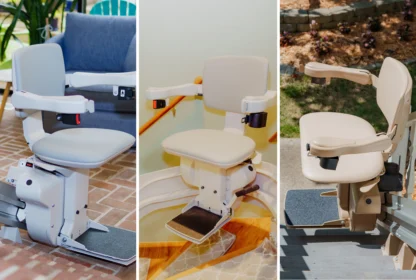
A stairlift is usually the better fit when someone can safely transfer from a walker or standing position to a seat and the main obstacle is a staircase. It can be a strong option for indoor stairs, curved stairs, straight stairs, or even certain outdoor stairways.
A ramp is often the better choice when the user needs to remain in a wheelchair or scooter, or when entry access is the biggest issue. Ramps can also help households that want easier access for multiple users, including caregivers, deliveries, and mobility devices.
Choose a stairlift when:
- The main issue is traveling up and down stairs
- The user can sit and stand or transfer safely
- Preserving as much walkway space as possible matters
- The home has straight or curved stairs that need a tailored solution
Choose a ramp when:
- The user stays in a wheelchair or scooter
- The biggest challenge is front entry, garage access, or porch access
- Smooth rolling access is more practical than seated stair travel
- There is enough space for the ramp design
Home Elevator vs Platform Lift: What Is the Difference?
The home elevator vs platform lift comparison usually comes down to how the user travels and how permanent the upgrade needs to be.
A platform lift is designed to move a wheelchair user vertically over a shorter rise, such as a porch, deck, or small elevation change. It is often a strong solution when a ramp would require too much space.
A home elevator is a larger residential mobility upgrade for multi-level homes. It is often chosen when comfort, long-term planning, and easier floor-to-floor movement are priorities.
Choose a platform lift when:
- The user remains in a wheelchair
- The vertical rise is modest
- The goal is access to an entry, porch, or garage
- Space is too limited for a ramp
Choose a home elevator when:
- The home has multiple levels that need regular access
- Long-term aging in place is a major goal
- The homeowner wants a more integrated interior solution
- Carrying people or items between floors is part of daily life
How Home Layout Affects the Right Choice
Even the best product can be the wrong fit if it does not match the structure of the home.
Straight stairs vs curved stairs
A straight staircase may allow for a more straightforward stairlift solution. A curved staircase, landing, or turn usually requires a custom approach.
Limited entry space
If the front entry has a short rise but limited room, a platform lift may make more sense than a ramp.
Multi-level homes
For homes where the bedroom level, living area, and daily-use spaces are separated by stairs, a stairlift or home elevator may be more practical than trying to redesign daily routines around one floor.
Indoor vs outdoor access
Some homes need help at the front steps, back patio, or garage entry as much as they need help inside. Outdoor access can call for a ramp, platform lift, or outdoor stairlift depending on the configuration.
Think Beyond Today’s Need
It is smart to solve the current challenge. It is even smarter to ask whether the same solution will still work a few years from now.
That is why aging in place solutions should be part of the conversation from the beginning.
If a homeowner is planning ahead, questions like these matter:
- Is mobility expected to stay the same, improve, or decline?
- Will wheelchair use become more likely later?
- Is this a temporary recovery situation or a long-term home modification?
- Does the household want the least invasive option now or the most future-ready option?
A short-term fix can be appropriate. But in some cases, choosing a more scalable solution now can prevent another major change later.
What to Expect From a Mobility Consultation
A professional mobility consultation helps turn a confusing product search into a clear recommendation.
During a consultation, the goal should be to assess:
- Home layout
- Stair configuration
- Entry elevation
- Device dimensions if a wheelchair or scooter is involved
- User strength, balance, and transfer ability
- Safety concerns
- Long-term accessibility goals
That process matters because the right solution is rarely one-size-fits-all. A good recommendation should fit the space, the person using it, and the outcome the family wants.
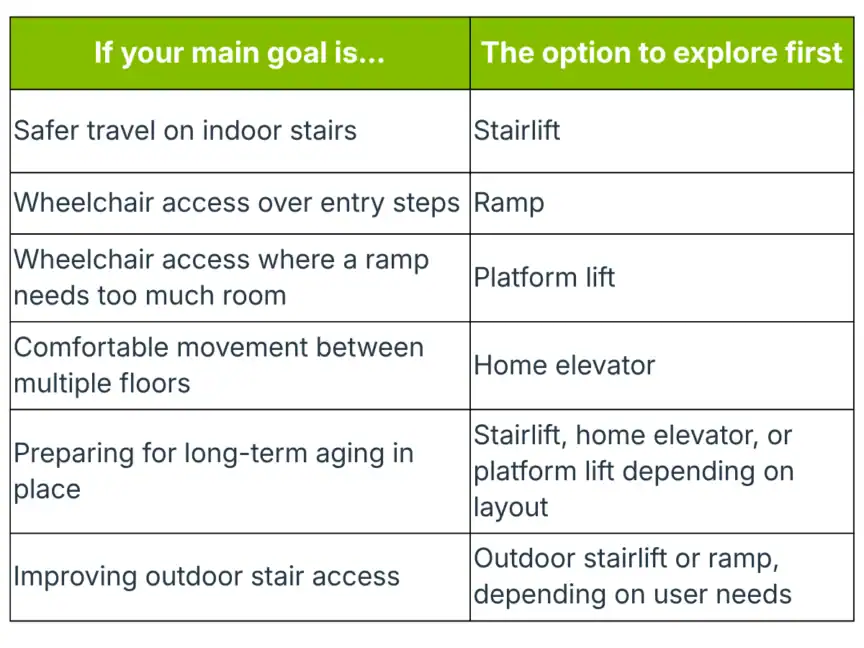
Quick Comparison Chart
Practical Examples
A homeowner with a straight indoor staircase and good transfer ability may lean toward a stairlift.
A wheelchair user who needs safer access from the driveway to the front door may be better served by a ramp or platform lift.
A family planning long-term accessibility in a two-story home may want to compare a stairlift with a home elevator based on how often each floor is used and whether wheelchair access is part of the future plan.
FAQs
What is the best accessibility solution for a multi-level home?
It depends on how the home is used and whether the person can transfer safely. Stairlifts often help when stairs are the main challenge. Home elevators may be better for long-term, whole-home access. Platform lifts can help when wheelchair access is needed over a shorter vertical rise.
Is a ramp always better for wheelchair users?
Not always, but it often is a strong first option for entry access. If the vertical rise is too great or space is limited, a platform lift may be the better fit.
How do I know whether I need a stairlift or a home elevator?
A stairlift is usually best when one person needs help using stairs and can transfer to a seat. A home elevator may make more sense when long-term multi-floor access, convenience, or broader household use is the goal.
Are aging in place solutions worth planning before mobility gets worse?
Yes. Planning early gives homeowners more options and more time to choose a solution that fits both the home and future needs.
What happens during a mobility consultation?
A specialist reviews the home layout, mobility needs, safety concerns, and long-term goals, then recommends a solution designed for that situation rather than a generic product.
Choosing among accessibility solutions in Chalmette does not have to feel overwhelming. Once you match the solution to the layout, the user, and the long-term goal, the path becomes much clearer.
If you are comparing a stairlift vs ramp, weighing a home elevator vs platform lift, or simply want expert guidance on the right next step, the best place to start is with a professional mobility consultation.
Book a Free Consultation or learn more about local solutions through 101 Mobility New Orleans.