How to Choose the Right Accessibility Solution for Your Brusly Home
Choosing the right accessibility upgrade is not just about picking a product. It is about finding the solution that fits your home, supports safe daily movement, and still works as your needs change over time.
For many families in Brusly, the best choice depends on three things: the layout of the home, the user’s mobility needs, and the long-term goal. Some households need easier entry at the front door. Others need a safer way to move between floors. In some cases, the right answer is simple. In others, it takes a closer look at how the space is used every day.
If you are comparing accessibility solutions Brusly homeowners commonly consider, here is how to narrow down the right fit.
Start With the Problem Your Home Needs to Solve
Before comparing products, define the access challenge clearly.
Ask:
- Is the main issue getting into and out of the home?
- Is there a staircase that has become difficult or unsafe?
- Does the user rely on a wheelchair, scooter, or walker?
- Is this a short-term recovery need or part of a long-term plan?
- Is the goal basic access, or full mobility throughout a multi-level home?
The more clearly you identify the problem, the easier it becomes to rule options in or out.
For example, a small doorway threshold may call for a simple ramp solution. A steep porch entry may require a modular ramp or platform lift. A two-story home with an upstairs bedroom may point to a stairlift or elevator instead.
Common Accessibility Solutions for Brusly Homes
Different products solve different access problems. Here is a practical look at the most common options.
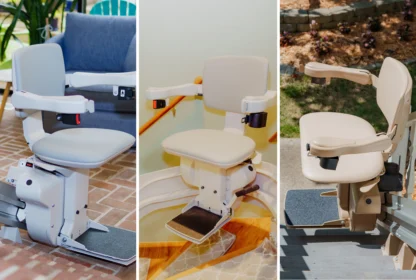
Stairlifts
A stairlift is designed for people who can safely transfer into a seated position and ride between floors on a motorized chair.
A stairlift may be a strong fit when:
- The user does not use a wheelchair on the stairs
- The staircase is the main barrier inside the home
- The goal is safer daily movement between levels
- The home layout does not justify a larger remodeling project
Stairlifts are often one of the most direct ways to improve safety in a multi-level home without changing the structure of the house.
Ramps
Ramps create smoother access over steps, thresholds, porches, and entry points. They are especially useful when a user needs to remain in a wheelchair or scooter, or when a walker needs a more gradual transition.
A ramp may be the right fit when:
- There is a step or raised entry at a doorway
- Step-free access is needed
- The user relies on a wheelchair, walker, or scooter
- Indoor or outdoor threshold changes create a tripping hazard
Some homes may only need a small threshold ramp. Others may benefit from a larger modular ramp system for porch or garage access.
Platform Lifts
A platform lift raises a wheelchair user vertically from one level to another without requiring a long ramp run.
A platform lift may make sense when:
- The rise is too high for a practical ramp
- Yard or porch space is limited
- The user needs to stay in a wheelchair during travel
- The home has a deck, porch, or garage entry with vertical elevation change
This can be a smart middle ground when a ramp would take up too much room.
Home Elevators
A home elevator is usually the most comprehensive option for multi-level access inside the home.
A home elevator may be worth considering when:
- Long-term accessibility is the priority
- Multiple floors need to remain fully usable
- The homeowner is planning for aging in place
- Comfort, convenience, and future resale appeal matter alongside accessibility
This is often a bigger investment, but it can be the best fit for households thinking beyond the immediate need.
Stairlift vs Ramp: Which One Makes More Sense?
This comparison comes up often, but the answer usually depends on where the barrier is and how the user moves.

In simple terms, use a stairlift when the challenge is stairs and the user can transfer safely. Use a ramp when the challenge is an entry point, threshold, or step and step-free access is needed.
Home Elevator vs Platform Lift: What Is the Difference?
These two options are sometimes grouped together, but they solve slightly different problems.

A home elevator vs platform lift decision usually comes down to scale. If the goal is full-house accessibility over the long term, an elevator may be the better path. If the goal is solving one specific elevation change, a platform lift may be more practical.
A Simple Way to Match the Right Solution to Your Home
Here is a quick-reference chart to make comparison easier.
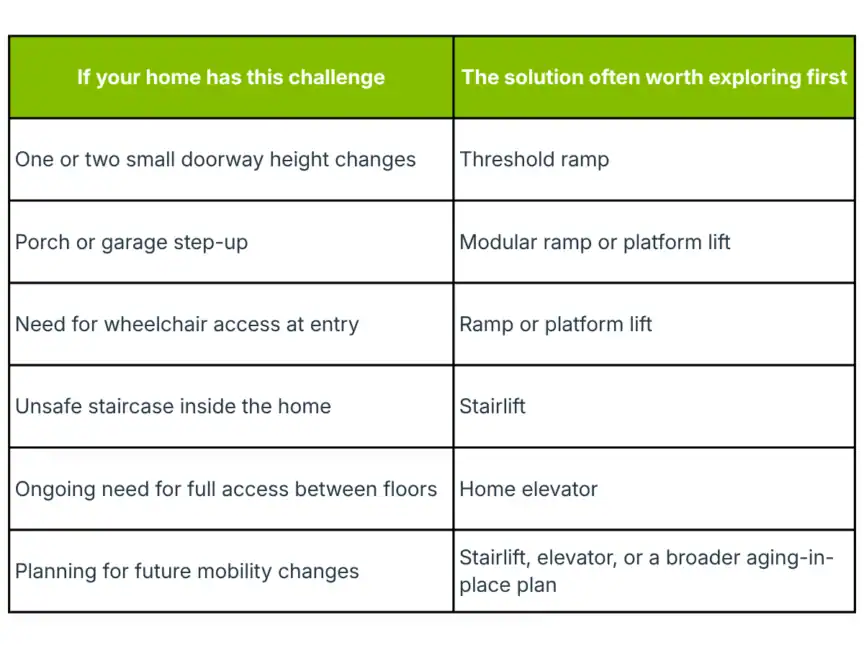
This kind of chart is helpful for starting the conversation, but it does not replace an in-home assessment.
Why a Mobility Consultation Matters
A good recommendation depends on more than the product category. It depends on measurements, turning space, doorway clearance, staircase design, transfer ability, and how the solution will work in everyday life.
That is why a mobility consultation is often the most important step in the process.
A consultation can help answer questions like:
- Will a ramp fit the available space?
- Is the rise too steep for a practical ramp design?
- Can the user safely use a stairlift?
- Would a platform lift solve the problem with less footprint?
- Is it smarter to address today’s issue only, or plan for future mobility changes now?
For homeowners and families, this makes decision-making clearer and reduces the risk of choosing a solution that does not fully fit the home.
To explore local options, visit the 101 Mobility Baton Rouge location.
Planning for Today and the Years Ahead
Some families are solving an immediate need after a health event or a recent mobility change. Others are planning ahead so the home remains usable and comfortable for years.
That is where aging in place solutions become especially important.
A short-term fix can solve one issue now, but a broader plan can prevent another disruption later. For example:
- A ramp may improve entry today
- A stairlift may keep upper floors usable longer
- A home elevator may support a longer-term forever-home strategy
Thinking ahead does not always mean choosing the biggest project. It means choosing the solution that supports both current safety and future usability.
Frequently Asked Questions
What is the best accessibility solution for a home with front steps?
It depends on the height of the entry, available space, and whether the user needs to stay in a wheelchair or scooter. In many cases, a ramp or platform lift is the first option to evaluate.
Is a stairlift better than a ramp?
Not necessarily. In a stairlift vs ramp comparison, a stairlift is usually better for an indoor staircase, while a ramp is usually better for entry access and step-free movement.
When does a platform lift make more sense than a ramp?
A platform lift often makes more sense when the vertical rise is significant and there is not enough room for a safely sized ramp.
Should I consider a home elevator for aging in place?
In some homes, yes. If long-term access to multiple floors is important, a home elevator can be a strong part of an aging-in-place strategy.
What happens during a consultation?
A specialist reviews the home layout, the user’s mobility needs, the problem areas, and the long-term goal. From there, they can recommend the option that best fits the space and use case.
Take the Next Step
The right accessibility upgrade should make daily life safer, easier, and more workable for the person using it and for the family supporting them.
If you are comparing options for your Brusly home, the best next step is to get expert guidance based on your actual layout and mobility needs. Book a Free Consultation to discuss the right path forward.