How to Choose a Stairlift Installer You Can Trust: A Guide to the Best Stairlift Brands

Quick Takeaways:
- The installer matters as much as the brand — poor installation can compromise both safety and warranty coverage.
- Well-known brands include Bruno and Acorn, but which fits your home depends on your staircase and usage needs.
- A locally owned franchise installer offers accountability and follow-through that national online sellers cannot match.
- Ask any installer five specific questions before booking — the answers reveal more than any marketing claim.
- An in-home assessment before quoting is non-negotiable; any company that skips it is not worth your time.
You have already done the hard work of deciding a stairlift is the right choice. Now comes the part that determines whether that decision actually pays off: finding the right person to install it. The best stairlift brands on the market will not perform at their best without a skilled, certified technician handling the job. Now comes the part that decides whether it pays off: finding the right person to install it. Even the best stairlift won’t perform at its best without a skilled, certified technician handling the job. Here’s how to find one you can count on.
Whether you are researching your options independently or helping a family member make a confident choice, the process of evaluating an installer deserves as much attention as picking the product itself.
Why the Installer Matters as Much as the Brand
A stairlift is not complicated hardware to ship in a box. It is a load-bearing, safety-critical piece of equipment that must be fitted to your specific staircase, anchored properly, and calibrated for reliable daily use. The same Bruno or Acorn model installed by a certified local technician versus a third-party subcontractor can produce completely different results over time.
National online wholesalers can ship a stairlift to your door, but installation is another matter. Many direct-to-consumer brands require you to coordinate a separate contractor, or they rely on third-party installers with limited local accountability. When something needs adjustment six months later, the chain of responsibility gets murky fast.
A locally owned installation company has its name and reputation attached to every job. If the rail needs adjustment or the seat mechanism needs service, they are reachable and invested in the outcome. That accountability is built into the relationship from the first in-home assessment.
What to Look for in the Best Stairlift Brands
When comparing stairlift brands, the factors that matter most are not always the ones featured prominently in product marketing. Here is what actually determines long-term satisfaction:
- Rail engineering and construction quality — cast aluminum rails hold up better than fabricated steel over time, particularly for curved staircase applications.
- Warranty length and coverage — look for separate warranties on the product and the installation labor. A strong product warranty paired with a weak labor warranty is a yellow flag.
- Weight capacity range — standard models typically handle up to 300 lbs, but several brands offer heavy-duty options up to 400 lbs or higher.
- Straight vs. curved stairlift capability — not every installer is equipped to handle curved rail fabrication; confirm before getting a quote.
- Indoor vs. outdoor models — if you need a lift for an exterior entrance, verify the brand offers a properly weatherized unit.
- Parts availability — older or discontinued models can become difficult to service. Stick with manufacturers that have established domestic supply chains.
Here is how the top brands stack up at a glance:
| Brand | Known For | Best Fit | Weight Capacity |
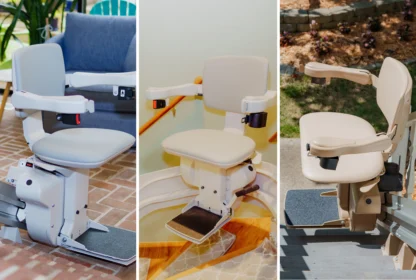
| Bruno | Engineering durability, wide model range | Straight and curved stairs, indoor and outdoor | Up to 400 lbs |
| Acorn | Brand recognition, slim rail design | Standard straight staircases | Up to 285 lbs |
| Harmar | Heavy-duty capacity, platform lifts | Higher weight needs, vertical platform applications | Up to 600 lbs |
For a deeper brand comparison, see 101 Mobility’s breakdown at Bruno vs. Acorn Stairlifts.
Five Questions to Ask Any Stairlift Installer Before You Book
A short conversation before scheduling an assessment can tell you a great deal. These five questions cut past the sales talk:
1. Are your technicians manufacturer-certified?
Certification from the manufacturer means the installer has been trained on that specific product line and has demonstrated competency. It also typically preserves the product warranty. Ask which brands they are certified for and whether that covers the model you are considering.
2. Do you install and service locally, or do you subcontract?
A company that sends out its own employees is different from one that dispatches subcontractors. Local technicians who work for the same company have a stronger stake in the quality of each job and are easier to reach for follow-up service.
3. What does your warranty cover on the installation itself?
Product warranties cover defective parts. Installation warranties cover how well the unit was fitted to your home. Ask specifically: how long is the labor warranty, what does it cover, and how do you initiate a service call if something needs adjustment?
4. Can you provide references or reviews from customers in my area?
A stairlift installer should have a local track record. Ask for area-specific reviews or references rather than national aggregate ratings. Local reviews tell you more about the team that will actually show up at your door. See how 101 Mobility customers describe their experience at 101mobility.com/reviews.
5. What does your installation timeline look like after an in-home assessment?
Understand the full sequence: when can they schedule the assessment, how long does fabrication take for a curved rail, and when does installation happen? A clear, specific answer indicates an organized operation. Vague timelines are worth noting.
Red Flags to Watch for During the Quoting Process
The quoting process reveals a lot. These are the signs worth paying attention to before you commit:
- No in-home assessment before providing a quote. Accurate stairlift pricing requires measuring the actual staircase; any quote given over the phone or from a photo alone is provisional at best and misleading at worst.
- Warranties communicated verbally without documentation. A warranty you cannot reference in writing is not a warranty you can rely on.
- Urgency-based pricing tactics. “This price is only good through the end of the week” is a pressure tactic, not a business practice. A reputable company does not need to manufacture urgency.
- No local service history. If the company cannot point you to documented local reviews or describe past projects in your area, ask where their nearest permanent service location is.
- Quotes without itemization. You should be able to see what you are paying for — product, rail fabrication, installation labor, and any add-ons — separately.
Why Local Franchise Installers Outperform National Chains
There is a real difference between a locally owned franchise and a national operator that manages installations from a central call center. That difference shows up in the details:
Response time is the most obvious one. When a local technician is based in your market, a service call means same-week scheduling rather than a national dispatch queue. For a daily-use safety product, that responsiveness matters.
Accountability is the other factor. A local franchise owner has their own reputation on the line with every job. National chains measure performance in aggregate; a local owner hears about every job directly. That creates a different kind of incentive.
101 Mobility’s franchise model was built around this principle. Each location is locally owned and operated, employs its own certified technicians, and carries full product-to-installation responsibility. There is no handoff between sales and service. Learn more about what makes the model different at The 101 Mobility Difference.
When you are ready to think through pricing alongside installation options, the Stairlift Pricing Guide gives you a complete picture of what to expect.
Frequently Asked Questions
What are the best stairlift brands available in the US?
Bruno and Acorn are the two most widely recognized names in the US market. Bruno is known for engineering durability and a broad model range covering straight, curved, indoor, and outdoor applications. Acorn is a strong option for standard straight staircases with a slim rail profile. Harmar is another well-regarded brand with a focus on higher weight capacities and platform lift applications. The right brand depends on your staircase, household needs, and who is being served by the equipment.
How long does stairlift installation take?
A straight stairlift installation typically takes two to four hours on the day of installation. Curved stairlift installations require custom rail fabrication, which adds lead time — generally one to two weeks from the assessment date before the installation appointment. For a more detailed breakdown, see How Long Does It Take to Install a Stairlift?.
Does insurance cover stairlift installation?
Most standard health insurance plans and Medicare do not cover stairlift equipment or installation. Some long-term care insurance policies and Medicaid waiver programs offer partial coverage depending on the state. VA benefits may also apply for eligible veterans. For a full breakdown of coverage questions, see Does Medicare Cover Stairlifts?.
What should I expect during an in-home stairlift assessment?
A certified technician visits your home to measure the staircase, assess wall clearance, evaluate the landing space at top and bottom, and discuss your specific mobility needs. The assessment typically takes 30 to 60 minutes and results in an accurate, itemized quote. No purchase commitment is required at the assessment stage.
Is it safe to buy a stairlift online and hire a local contractor to install it?
It is possible, but this approach creates gaps in accountability that matter for a safety-critical product. Manufacturer warranties often require installation by a certified technician authorized by that brand. If a third-party contractor makes an error during installation, neither the manufacturer nor the online seller is typically responsible for the resulting repair costs. Purchasing from an authorized dealer who also handles installation keeps the full chain of responsibility in one place.
Ready to Find a Stairlift Installer You Can Count On?
Choosing the right stairlift starts with finding the right installer. A certified, locally owned provider with a documented track record in your area is the clearest indicator that the equipment will be installed correctly, serviced reliably, and backed by people who know your home.
| 101 Mobility installers are manufacturer-certified, locally owned, and ready to complete your in-home assessment at a time that works for you. No pressure, no guesswork. Schedule your free consultation today at 101mobility.com/get-free-consultation and speak with a local specialist who knows your area. |