For Referral Partners in Opelousas: How I Turn a Home Accessibility Concern into a Site Visit
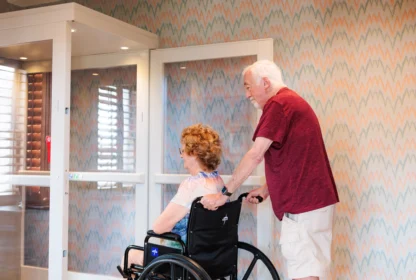
A good accessibility partner usually has a good observation of where the barriers are. This could be the entry, stairs, bathroom, or transfer route. The challenge is still determining why the space is not accessible, how the individual moves in the space, and what the best solution is.
Knowing the distinction of the barriers is critical in Opelousas, Lafayette, Carencro, Scott, and Abbeville. A therapist, the home-health team, caregiver, hospital team, or family member may have already identified the barrier at least before I make a site visit. The goal is to take that concern and develop a response that is based on the individual and the route that is realistic for the physical space.
101 Mobility of Lafayette is a great partner to work with to develop a response to a need based on what information a referral partner already has.
The Minimum Information That Makes a Referral Actionable
A referral does not need to include a complete home-accessibility assessment.
What helps the most is a clear statement of the problem.
Rather than saying, “This person needs a stairlift,” it would be more helpful to say, “The bedroom is upstairs, and the stairs are a barrier to accessing it.”
This provides the opportunity to verify the staircase to determine if a stairlift is an appropriate access solution.
The same is true for an entry. “uses a wheelchair and is not able to get over the steps” provides a lot more detail of the problem needing to be solved than just needing a ramp request.
A typical referral begins with five components:
- Information
- Main access problem
- Where the route stops working
- Mobility method
- Areas involved
- Assistance
- Timing
For example, is the person transported by someone else or do they use a walking aid, wheelchair, scooter, or other assistive device?
Further information is required for the following:
- Areas involved
- Entry, stairs, bathroom, bedroom, bed transfers, and other route segments.
- Assistance
- Does someone assist the transport on a regular basis?
- Timing
How long is this transport needed? Is it temporary or will this be an ongoing issue?
A referral for home accessibility in Opelousas does not require you to select the final solution. Just identifying the barrier can initiate this process.
Entry, Stairs, Bathroom, Transfers, and Timing
I prefer to organize referral info based on the route as opposed to a catalog of products.
Entry access
What happens between the driveway and the first usable space in the home?
How many step or level changes are involved?
What is the nature of the problem? Is it a large step and a landing? Is it a small threshold or a group of steps?
Consider a Multi-Fold Ramps system as a potential solution for some temporary or portable access issues, but I still have to do a site measurement of the landing and approach as well as the rise to determine if this type of ramp is appropriate.
Stair access
What is the shape of the stairs and landing? How will the person board or leave a stair lift?
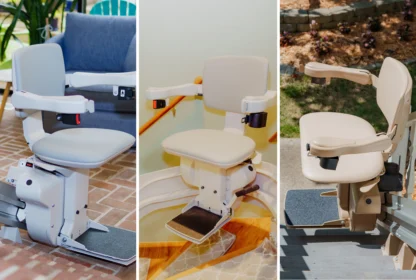
A Bruno Elan Straight Rail Stairlift is one product option for a straight staircase, but the recommendation will come after the staircase is reviewed.
Referrals that explain the bedroom and bathroom are located on the second floor are helpful since they provide context and demonstrate the importance of the stair route.
Bathroom Access
For a bathroom access concern, I need to understand the path to and access the room, the location of the fixtures, and what types of movement the client has difficulty with.
If an OT is making a home modification referral in Lafayette, the description of where the client experiences difficulties aids in my preparation for the referral visit. I will verify the conditions of the physical environment for myself before I make any equipment recommendations.
Transfers
For transfer concerns, I need to ask a series of additional questions.
Where is the transfer from? To? From the bed to the wheelchair? From the chair to another surface? Is there enough space for the transfer equipment and the person assisting the client?
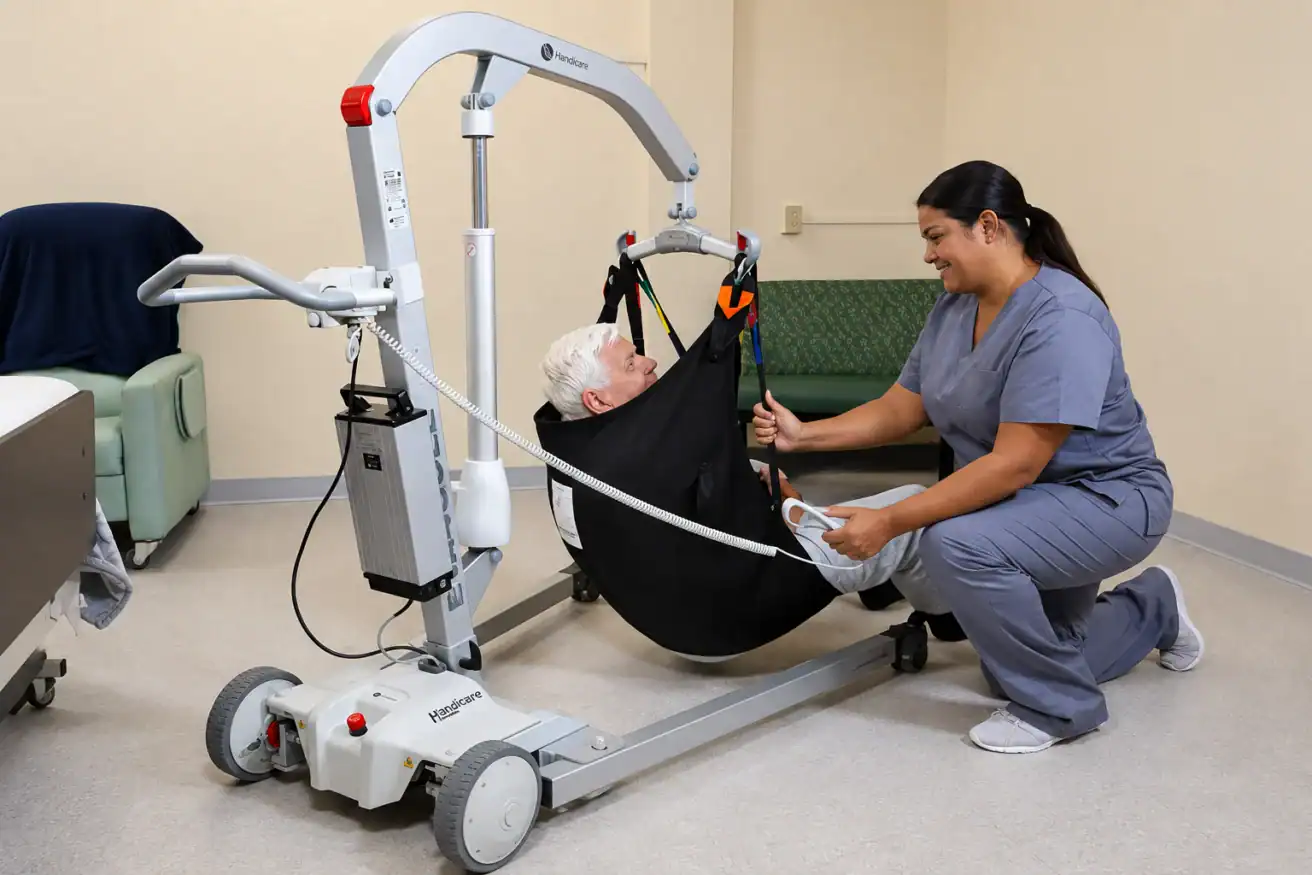
The Handicare EvaDrive is one of the patient handling solutions 101 Mobility offers, however, this solution should not be selected without understanding the route, the space, and the equipment.
Timing
Planning is very different dependent on the time allotted.
A referral made for discharge equipment would have a very different time frame compared to a family that is planning on making modifications to their home that would take several months. This would not impact the measurements or fit checks even in the time constraints of a discharge.
Photos and Measurements That Help Before the Home Visit
Photos help answer some of the questions that assist in the planning process and make for more productive meetings.
To help illustrate an approach, a photo could show the whole approach and step(s) and/or landing. A photo could show a staircase with both landings and include some space on either side. A photo could show the doorway and the relationship of the major fixtures in a bathroom.
Measurements can also be useful.
Depending on the concern, here are some useful measurements:
- Approximate width of the doorway
- Approximate number of steps
- Approximation of step rise
- Width of the staircase
- Dimensions of the landings
- Height of the threshold
- Room clearance for bed, chair, toilet, or transfer space
These photographs can be useful in preparation but will not be the final basis of my recommendation.
A photograph may prohibit the identification of obstructions. A measurement may be taken from the incorrect starting place. A staircase may seem to be simple and straight, but the top landing and handrail placement and the location of the swinging entry door may modify the positioning of the staircase.
The biggest drawback of remote referral information is that a photo and measurements may be useful to me for preparation, but they cannot take the place of an onsite evaluation of the space to determine final fit of the product.
If you are not sure which measurements to include, a set of clear photographs and a simple description of the situation are much more useful than trying to provide a technical sketch.
What I Verify Myself
The referral is a starting point for my evaluation. The onsite evaluation enables me to provide a recommendation.
I verify the dimensions that are critical for product fit. I also verify the actual pathway that is used.
When thinking about an entry, one has to look beyond the landing and each subsequent step, doorway, and first internal turn.
When looking at stairs, I measure the overall height, and check both upper and lower transfer areas.
When dealing with transfer equipment, I have to consider the usable floor space and how the equipment moves between the relevant areas.
Also, I review whether the proposed solution creates a new problem somewhere else.
That is very important.
If a simple solution resolves the barrier appropriately, I will suggest that instead of making the project longer than it needs to be. A referral may start with a specific request, however I will suggest alternatives that are more in line with the daily routine and the measurements.
Similar to above, I will suggest against equipment that meets the requirements, if it creates a significant inconvenience for the rest of the family.
A good referral process is more than just confirming the requested product. It is confirming the best option for the client’s home and the daily routine of the user.
After The Referral Is An Installation What Next?
After I have verified the home and substantially narrowed the selection of equipment, I will provide a justification and explain the purpose of the equipment.
The referral partner will not have the responsibility of managing the installation for us. Once the customer continues with the process, we will coordinate the equipment and installation or the setup as required.
Once the equipment is installed, we run you through a comprehensive training session, including overview of how the equipment works and how our clients engage with the equipment on a daily basis.
The last step is not the delivery of the equipment to the client’s home. The person and their family must understand how the solution we’ve built integrates with the path we designed.
Once equipment is installed by 101 Mobility, we offer service and support, including maintenance, equipment repairs, and the opportunity to engage with our staff for additional support.
This service empowering our referral partners to focus on the client’s apparated concern, instead of engaging with every equipment and measurement related challenge on their own.
For clients in Opelousas, Lafayette, Carencro, Scott, and Abbeville, we offer a free in-home consultation to confirm the barriers and provide a specific recommendation to address home accessibility.
FAQ: Home Accessibility Referral Process
What should I include in a home accessibility referral?
When referring, provide the main accessibility concern, the area in the home involved, the means by which the individual currently travels, any mobility aids, whether the individual requires assistance, and the timeframe in which the concern needs to be addressed. There is no need to specify the product being referred in the initial case.
Do I need to provide measurements before I refer?
No. Rough measurements coupled with photos may provide some context, but measurements that affect product fit are the only measurements verified prior to a final recommendation being made. A concise description of the accessibility concern is sufficient for us to engage in the process.
What types of photos should I take when making a referral?
Use photos that demonstrate the entire path. Examples of photos of parts of the path that are helpful, but not as helpful, are close-up shots of steps or photos of single stairs. For an entry referral, you would want to capture the approach, the steps or rise, the landing, the doorway, and the surrounding space. For a staircase referral, you would want to take photos of the entire staircase and the two landings.
Can a therapist or a home health professional send a referral for a specific product?
A referral partner can certainly identify a product or category that may be helpful, but I still assess the home and product fit before sending the referral for the installation. The physical space, path, barriers, and daily use may point to a different solution.
Can 101 Mobility help with an urgent discharge-related access issue?
Yes, timing should be included in the referral to let us know the urgency. We still need to provide adequate detail and, when it is necessary, conduct a home evaluation to determine the accessibility solution that can best fit the space and the need.
After I refer, what happens next?
We need to confirm the access concern and contact the customer or their family for a consult. We evaluate the space and take the measurements that are necessary to provide the customer with all the alternatives and options. If the customer decides to install or set-up the solution, we arrange for installation and provide product service and support after installation.
About the Author
Jonas Boutte is the owner of 101 Mobility of South Louisiana and serves customers throughout Lafayette and surrounding communities, including Opelousas. He has hands-on training from accessibility-equipment manufacturers and works with customers from the initial home consultation and recommendation through installation coordination and ongoing support.