Bath Lift or Accessible Shower: How I Compare Bathrooms in Lafayette
Product or solution options are informed by the layout of the bathing area and the nature of the transfer. I evaluate the existing bathing area, the path to it, the sit/stand location, the direction of the transfer, door clearances, and the caregiver’s position to determine if the existing tub/shower is retained or if the bathing area should be modified.
Customers from New Iberia, Breaux Bridge, Abbeville and Lafayette, typically appreciate it if I first understand the particular difficulties they have with bathing access before demonstrating sample products. As such, at 101 Mobility of Lafayette, I take them through a functional bathing access evaluation before showing sample products.
Keep the existing tub?
Yes
Main purpose
To assist in getting in and out of the tub
Transfer space required?
Yes
Threshold issue?
The tub wall remains part of the bathing situation and a step over a threshold remains
Change of scope?
Bathroom modification
Planning
Keep the existing tub and bathing situation was appropriate
Bath Lift
Keeping the existing tub was appropriate and the user can make the necessary transfer to use the bath lift.
The BathLyft is an electric bath chair that helps a person in and out of the tub.
101 Mobility mentions that the BathLyft is 26 lbs and has a back rest that can recline 53 degrees. Additionally, the sides of the chair have flaps that create side surfaces to help with transfers.
From the info. provided, I can tell what the product is capable of doing. I can not assess how well it will work in your bathroom.
My questions for a BathLyft in Lafayette include:
- Are there sufficient clearances next to the tub to facilitate the lift?
- Will the seat be within the user’s reach from the normal approach?
- Will the equipment obstruct the tub controls?
- Will the door to the bathroom obstruct the lift?
- Where will an assisting person be located?
A bath lift allows the user to continue to utilize the existing tub if there are no problems with the remaining elements of the bathroom.
It is less of a major change than the removal of the existing tub and the installation of a new one.
However, the tub wall does not actually change elevation like a regular lift. The BathLyft provides limited functionality as a lift.
The tub continues to present a barrier to fully using the bathing facility.
There are situations in which the primary barrier to tub usage is the obstruction of the tub surround, in which case, using a bath lift would be of little value.
In those cases, I would consider a more major change to the bathing facility, i.e., the installation of an accessible shower stall.
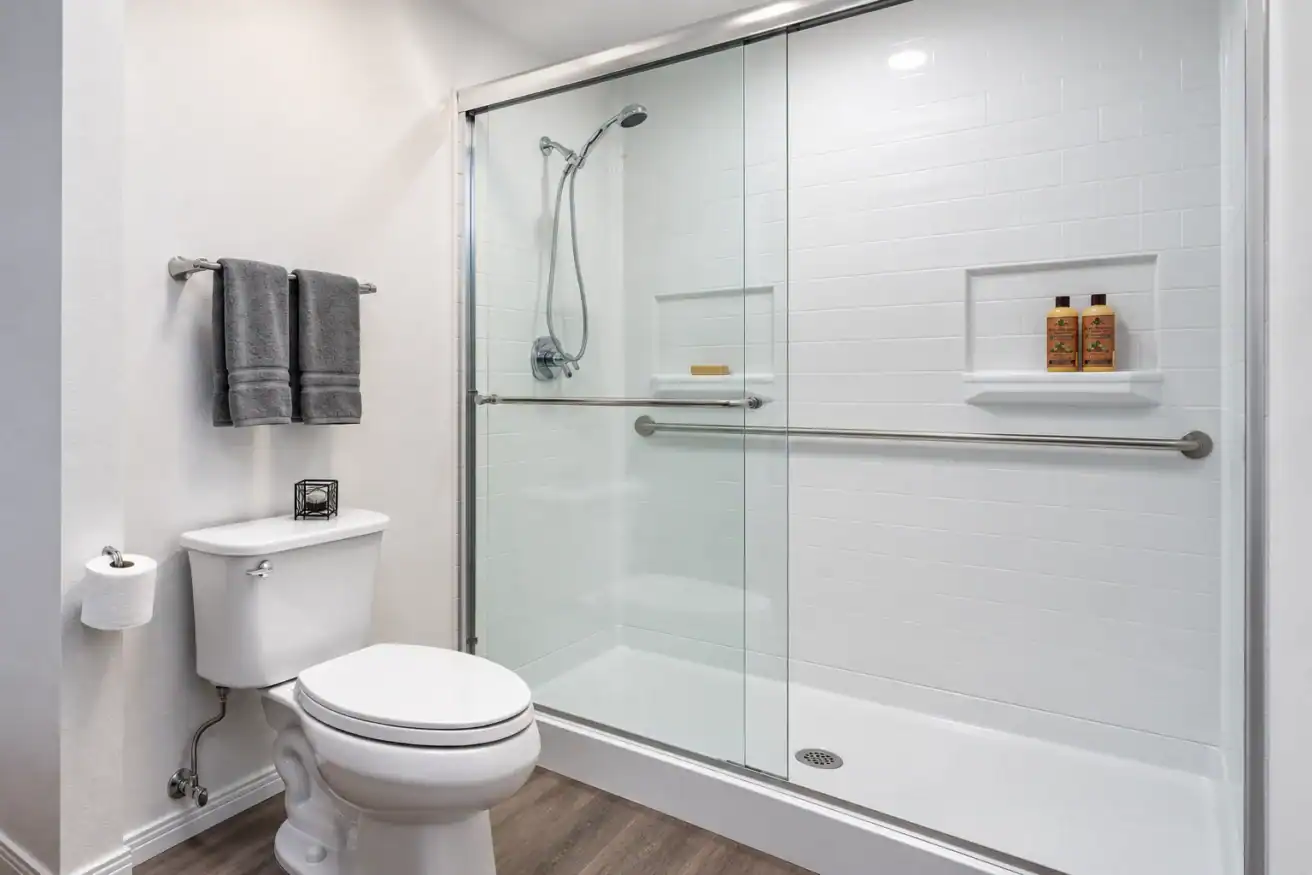
The Bestbath Multi-Piece Accessible Shower allows the user to select center, left, or right drain locations. It also allows the user to select thresholds ranging from 0.75 to 2 inches and offers various threshold designs.
With this information, fitting an accessible shower in New Iberia may be easier because the drain location, the bathroom’s square footage, the direction of the entrance, and the location and design of the other bathroom fixtures may impact the fitting of a shower in the space.
Replacing a bathing area to add configurability is more impactful than adding a BathLyft to a tub.
In most cases, replacing the bathing area to add configurability is not justified.
A BathLyft can be added to a tub if it aids in the tub-bathing routine and the bathing routine is the only concern. A configurable shower may also give the family added peace of mind if the bathing situation is expected to change in the future.
When a family is considering configuration options for the Bestbath Multi-Piece Accessible Shower, I look at the design plans to understand where the main drain is, how the person engaging with the shower staircase, and where, if at all, a shower seat is planned. A plan must consider the cared-for person and the caregiver.
Not all plans, and not the first, consider the product. Both the Bestbath and the Acadia showers terminate at the tub wall. Both require additional work to be integrated into a bathroom.
The person has to get to the bathing area within the bathroom.
I inspect the entrance to the bathing area. This includes the swing of the door, the first maneuver after I enter the room, the space around the door and the bathroom fixtures, and the space around the bathing area.
Next, I assess the transfer area.
A bathtub lift poses no issues once installed in the tub. However, there may not be adequate clear space on the side of the tub to complete the transfer. Other issues may arise from the layout of the bathroom. For example, the threshold of a shower may be lowered to accommodate a person in a wheelchair to step over to take a shower, but the shower stall may be too large and obstructive to provide an adequate approach path to the threshold.
The placement of a caregiver may also be an issue if physical assistance is required to complete the task.
I evaluate the caregiver’s available maneuvering space to determine if it will obstruct the desired path of the equipment once it is installed.
This may affect the recommendation. For example, if it is intended to retain the existing tub, I may recommend a larger shower modifi cation to provide a larger bathing area.
On the other hand, if the primary tub is too obstructive to provide a safe and acceptable area for the caregiver to assist in bathing, and there is no other bathing area to be modified, I may recommend retaining the tub and not modifying the larger bathing area.
Grab bar placement may also be recommended to accommodate bathing. However, I may recommend other modest improvements to the bathroom prior to a major renovation.
- Is a bath lift needed?
- Is assistance required to get to the bathing area?
- Is the person standing during the bathing process?
- In what direction is the person’s hand moving during the transfer?
The questions above are important because grab bars are designed to be used during a transfer in different ways. A grab bar may not be of any use if it is placed in a wrong location.
For the purposes of a bath lift, I will assume a suitable plan for a grab bar is also in place to assist in transferring to and from the bath lift.
For a walk-in shower, the position of the grab bars must be in relation to the shower entry, the seat, and controls. Also, it must be in relation to the normal bathing procedure of the person.
I will not use a grab bar to be of support in a bathing procedure to replace a design support in a layout.
The issues with the support in a bathing procedure are the same issues with a support in a bathing equipment and a bathing layout.
What to expect after the equipment is installed?
Once the equipment is installed, we will demonstrate to the family how the equipment will help them with bathing and transfers.
We will explain to the family how the equipment will assist them with bathing transfers and equipment charge and use.
Equipment charge and use is important because the battery will last for 35 transfers, according to the company.
Once the equipment is installed, we will review the normal bathing procedure and the equipment that supports it.
- What access point do you use?
- What is the relation between this access point and the anticipated movement?
- Where are the positioning aids located?
- Is the working space available to the caregiver?
- What is the final-design bathroom like?
Our service and support staff are able to answer any product-related questions following the installation and provide assistance with product-support and product-maintenance services regarding accessibility aids.
For what is concerns bath lifts and accessible showers in the New Iberia, Breaux Bridge, Abbeville, and Lafayette areas, we offer a free in-home consultation. We assess the given situation and recommend the best solution based on the available space and the caregiver’s long-term plan. This may include keeping the existing tub or changing the bathroom layout.
Bath Lift vs. Accessible Shower
What is the difference between a bath lift and a shower lift?
A bath lift raises and lowers a user into and out of a pre-existing bathtub, and an accessible shower changes the existing bathing area.
What situations typically call for the use of a BathLyft?
A BathLyft is used in a pre-existing bathtub where the user can transfer into and out of the tub, and the existing situation can also accommodate the use of a bath lift. I also look at the size and location of the tub and the available caregiver space.
Will using a bath lift eliminate the need to step over the edge of the tub?
BathLyft lowers a seat into the tub and then raises it. The tub stays in the same location. Therefore, using a bath lift does not change the obstacles created by the tub edge and the bathroom.
When would it be better to install an accessible shower?
An accessible shower may be better if the barriers created by the tub edge cannot be addressed by modifying the tub. For example, the tub edge barriers may not be addressed if more long-term modifications are required to adapt the tub entry and transfers, and if other barriers, such as the door frame, exist.
What is the threshold height for the Bestbath accessible shower?
The Bestbath Multi-Piece Accessible Shower shows that the threshold for their accessible showers ranges from 0.75 inches to 2 inches. The best option depends on the space and how the shower is used.
Should I evaluate the bathroom doorway before selecting a bath lift or shower?
Yes. I assess the doorway and first turn to determine if the user and mobility equipment, if any, can be maneuvered to the tub. I analyze all of this to determine the most appropriate product.
About the Author
Jonas Boutte is the owner of 101 Mobility of South Louisiana and has hands-on training from accessibility-equipment manufacturers including Bruno, Harmar, Stiltz, Staying Home, EZ-ACCESS, National Ramp, and others. He helps families throughout Lafayette and surrounding Acadiana communities evaluate bathroom-accessibility products and other mobility solutions based on the person, home layout, transfer routine, and long-term needs.