What a Curved Stairlift Actually Requires in Lafayette and Acadiana Homes
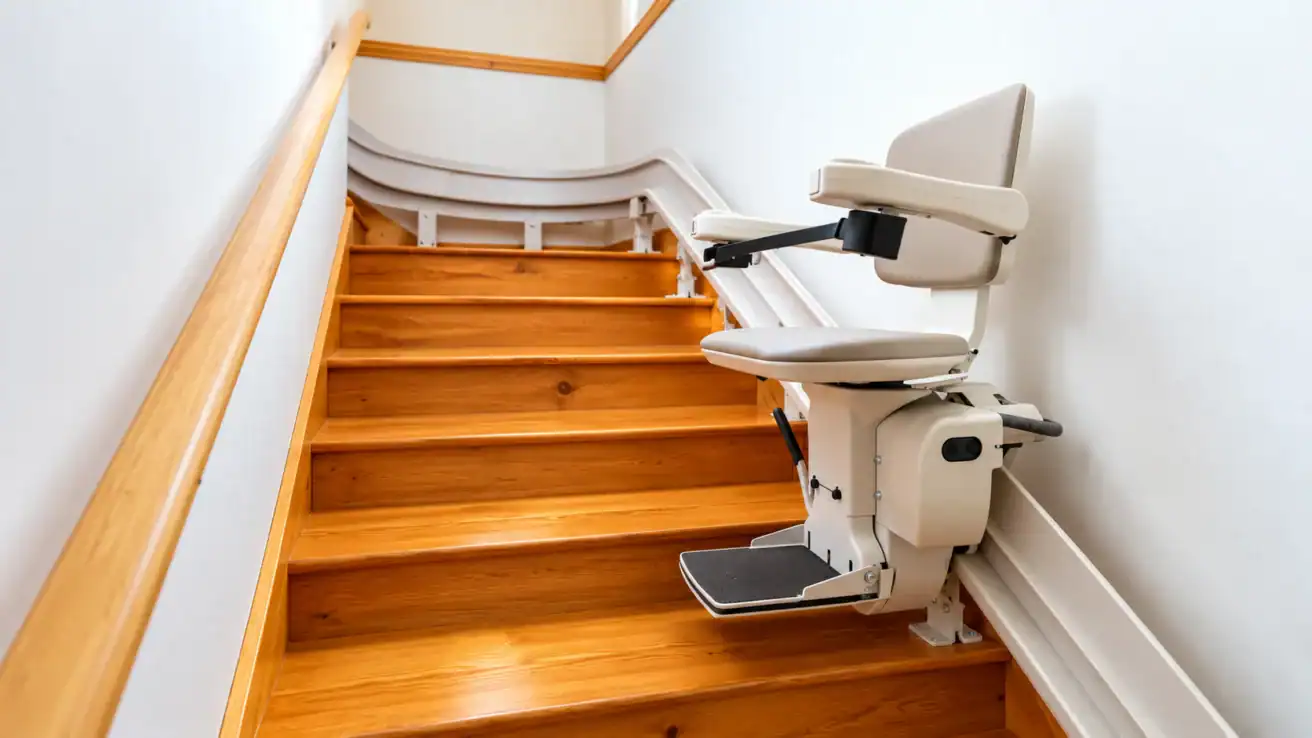
Curved stairlift rails are custom made for a staircase. Each section of a staircase must be measured in order to create a rail for that staircase. Once a measurement is taken, the rail is manufactured. The rail cannot be altered after it is made.
At 101 Mobility of Lafayette, we understand that a staircase that looks straight may actually require a custom rail. That’s why we serve Lafayette, Broussard, Youngsville, Milton, Scott, and Carencro.
Even a single change in the direction of a staircase will require a custom rail. A staircase may actually require a custom rail, even if it appears to be a straight staircase. What is important is how the rail will accommodate the stairs.
Will a Straight or Curved Rail be Required?
Depending on the layout of the staircase, a straight rail may work, but if there is a switchback in the staircase, a curved stairlift will be required.
If there is an intermediate landing, a curved rail will likely be required. A single rail will span the entire landing.
A winder staircase, in which the direction of the staircase changes, will require a custom curved stairlift.
If the staircase changes direction through an angled or wedge-shaped step, like a stairlift that changes direction through a landing, then the stairlift will also be considered a custom curved stairlift.
There is a possibility that if the staircase has two straight sections and a landing, a single continuous curved stairlift may not be required. Two straight stairlifts may be used instead.
Speed and cost are the primary considerations. There are some trade-offs. For stairlifts, the trade-off is that the user usually has to change stairlifts part way up or down, depending on the direction of travel.
If a user is unable to transfer part way up or down as described above, a cheaper stairlift will still not provide a solution.
How I Measure A Staircase for a Curved Rail
A stairlift, as opposed to a person, is able to follow a staircase with a number of bends and changes in direction. It can also follow pathways which are not straight. The start and finish of a pathway and all the changes in direction have to be calculated and recorded in order to design a curve in a stairlift rail which will follow the pathway.
While measurement of the full length of a staircase can provide a broad indication of the size of a staircase, it may not provide information about the location of changes in direction which may be 90 degrees. Landings and the point at which changes in the direction of the staircase occurs are also important.
The position, size and shape of winder steps and what occurs beyond the winder steps e.g. changes in the direction of a staircase also need to be recorded. The position and size of doors at the top and bottom of the stairs also need to be considered as do through passages e.g. hallways and obstructions.
Where a stairlift is left at the bottom of a staircase, it may obstruct a passageway e.g. a hallway. I can’t design a custom rail from a few photos. Photos show relationships between elements of a design, but they don’t inform dimensions. Dimensions are the basis for constructing a stair railing. Railing is often constructed on site, but if the dimensions for a custom rail are wrong, there is no simple way to change the shape of the rail to fit the stairs.
Why is a Curved Stair Lift More Expensive?
An 80-200% price difference between curved and straight stair lifts, respectively, is common.
One of the main reasons for the cost difference is the stair rail.
A straight railing can be made to any length to fit a staircase, while a curved rail requires a number of measurements to define the curve of a staircase.
The difference in measurements and the number of stairs landings and turns can also effect the cost of a curved rail.
A curved rail is custom, and unlike a straight rail, it often has very little value when sold on the second hand market because of the uniqueness to a single staircase.
That’s why I make sure the measurements and the layout of a staircase are finalized before I order a rail.
For the current installed-cost comparison, see 101 Mobility’s curved stairlift pricing and straight stairlift pricing.
Why Is a Curved Stairlift More Time Consuming?
A straight stairlift doesn’t require the same amount of measurement and calculation as a curved one, and can, therefore, be moved quickly. This is because the rail for a straight stairlift can be mass-produced and stocked by the stairlift company.
The process for a curved stairlift is as follows:
- Measure the staircase.
- The stairlift company approves the measurement layout and position of the stairlift.
- The measurements are sent off to the stairlift rail manufacturer.
- The rail is created and shipped.
- We install it.
Because a curved stairlift can’t always be mass-produced and stocked, the fabrication time for a custom rail can take weeks, rather than days. This becomes particularly critical when the situation is time sensitive.
If the staircase geometry permits it, I may recommend a straight stairlift rather than tell a family they need to wait weeks for a curved stairlift.
If a family is only going to need a stairlift for a short period of time, it may also be worth considering stairlift rentals rather than a long term purchase. A straight stairlift rental may also be worth considering to alleviate accessibility concerns.
I will explain these options rather than promoting a longer, more expensive option if that option is not going to be the best choice for the family.
Open-Side Staircases
When discussing homes in the Youngsville and Milton areas of Acadiana, I will also account for open side staircases.
An open-side staircase will not always prevent the installation of a stair lift. The rail will be secured to the staircase treads, not to the wall.
I analyze how the rail and mounting feet work with respect to the staircase.
I also look at:
- The position of the handrails
- Balance of the stairs
- Stair width
- Clear height at a folded chair position
- Clear width for people to walk past the rail
- Where people transfer on and off the rail at the top and bottom
- Doors and door clearances
I account for geometrical differences in stairs and rail placement. Just because a staircase is like another across town, doesn’t mean it has the same rail placement issues.
What Happens After Installation?
I look at the entire circuit the stairlift takes, even after the lift has been installed.
Transitions, especially landings and curve changes, are tested.
I review how the rail is used to leave the stairlift, and how the seat turns, if it turns, on the end rail positions.
Fold down features of the rail, if any, are reviewed.
After all this is done, I look the staircase to see if the rail was placed in the best location.
- Can other people use the stairs?
- Is the door near the chair lift operating properly?
- Is the chair in the position the family expects it to be?
We will evaluate your chair lift and side rail system at the time that the chair lift is in the position it is expected to be in.
Once we have completed the installation of the stair lift, our service and support staff is always available to you for service, maintenance, and repairs of the stair lift.
We can measure your staircase and determine if a straight or curved stair lift system is appropriate. We can explain the components of the stair lift and let you know the expected costs. Start with a free in-home consultation.
If you have additional questions regarding curved stair lifts please see our FAQ.
Can a pair of straight stairlifts be used to replace a single curved stairlift?
In some situations the answer is yes. If there is a landing separating the two sections, then straight stairlifts can be used, however the stairlift user will need to transfer between the stairlifts. Transferring between the stairlifts may not always be practical. So a landing and transfer position that allows the user to use the stairs comfortably and safely would need to be considered.
How long does it take to get a curved stairlift?
Fabricating a stairlift rail to fit a staircase is more difficult and time consuming than fabricating a rail to fit a straight staircase. Therefore, a stairlift company will take longer to produce and install a curved stairlift than a straight stairlift. The company 101 Mobility estimates it will take 4-6 weeks to produce and install a curved stairlift.
Can a stairlift be used to navigate a staircase with winder stairs?
Yes, a curved stairlift can be installed to allow a stairlift to negotiate a change in direction of a staircase with winder stairs.
About the Author
Jonas Boutte is the owner of 101 Mobility of South Louisiana and has hands-on training from mobility and accessibility manufacturers including Bruno, Harmar, Stiltz, Staying Home, EZ-ACCESS, National Ramp, and others. He helps customers throughout Lafayette and surrounding Acadiana communities evaluate stairlifts, ramps, lifts, home elevators, and other accessibility solutions based on the home, route, mobility needs, and daily use.