Outdoor Curved Stairlift for Side or Rear Stairs: What I Check Before Recommending One
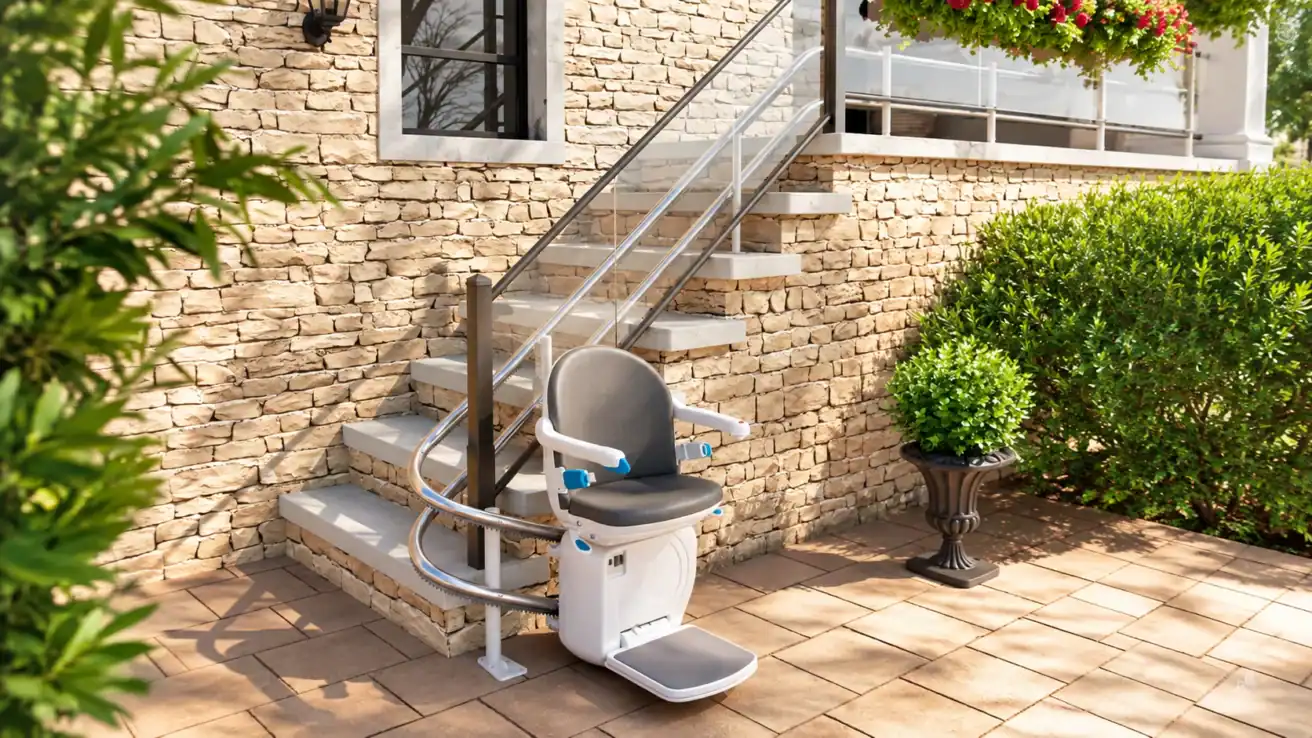
A winding staircase requires a different stairlift than a straight run. When designing an exterior stairlift for a winding staircase in New Orleans, I take into consideration the path of the entire staircase including every turn, every landing, every transfer point, drainage, weather exposure, and the location of the stairlift charging station when determining a custom curved rail and outdoor lift.
The side and rear staircases in New Orleans, Lakeview, Gentilly, Belle Chalasse, and Chalmette present this same scenario. An exterior stairlift may take you to the correct entrance, however, the staircase can still have several bends, intermediate landings, or awkward locations for boarding or exiting the stair lift.
At 101 Mobility of New Orleans, I check the exterior stair route rather than assuming that an exterior stair lift can be made to fit any exterior stairlift route.
Considerations for Weather Exposure, Drainage, and Charging
Exterior equipment dictates the choice of an exterior stairlift.
I won’t assume that every location with exterior stairs presents a uniform environment.
Is the staircase fully exposed or partially covered under an overhang? Where does rainwater puddle along the stairs and landings? Does water tend to accumulate at the bottom of the stairs? Where would the stairlift be parked when not in use?
I document these conditions as part of the site investigation.
I don’t recommend using a standard indoor curved stairlift due to weather exposure and the loss of materials used for a weather-rated stairlift.
Charging is also a consideration prior to installation.
Outdoor stairlifts are typically battery powered units that charge automatically when docked. The placement of the charging station is dependent on the design of the system. Therefore, the placement of the stairlift and the design of the charging station need to be functional to the system.
The Bruno Elite Outdoor Curved uses two 12-volt batteries and has a charging section at both docking ends of the rail installed in a weather-resistant cover along with marine-grade vinyl and weather-resistant finishes.
The Handicare outdoor curved system offers a unique approach, but the same principles apply:
I must know where the lift will park, charge and rest when not in use.
Separate from the stairlift’s weather rating, drainage is an important consideration.
Weather rated or not, I can’t ignore standing water, runoff, landing surface conditions or any of the site related conditions. These will affect the final layout of the system.
Product Options for Outdoor Curved Access
For a turning exterior staircase, when choosing an outdoor curved system, I evaluate the nature of the staircase as opposed to the model.
When considering outdoor curved systems, there are two options: the Bruno Elite Outdoor Curved and the Handicare 4000 Outdoor.
Bruno Elite Outdoor Curved
The Bruno Elite Outdoor Curved system is constructed particularly for outdoor curved stair applications.
The published features of this unit are:
- A seated position with a swivel seat.
- The capacity to fold arms, seat and footrest.
- Two wireless remote controls.
- A weather-resistant cover.
- Vinyl upholstery of marine grade.
- Two rechargeable batteries.
When docked, the system charges automatically.
The published specification on the rail states that it can install approximately 7 to 8 inches from a wall.
I’m not sure what that means in regard to outdoor staircases.
Landings must be evaluated along with the turns, the position for transfers, the stair handrails and the width of the staircase.
Handicare 4000 Outdoor
Another option is the Handicare 4000 Outdoor system.
101 Mobility classifies it for spiral, curved, and cornered staircases. The outdoor model has chrome-plated rails, UV-resistant upholstery, an anti-slip footrest, and a waterproof cover.
The indoor 4000 model is a twin-rail design with a folding chair, and the outdoor model has a twin-rail system to address the challenges of outdoor use.
This gives me an additional option if the staircase turns, but the selection remains after documenting the stairs.
I evaluate the systems based on the following types of questions:
- How does the staircase turn?
- Is there an intermediate landing?
- From which side do the user board and exit?
- Which rail system is preferable?
- How much space does the staircase have when the chair is folded?
- Where will the unit park normally?
- What is the exposure of the staircase to the elements?
- How easily accessible is the equipment for future service?
The product which fits one New Orleans exterior staircase will not necessarily be the product I recommend for another.
When a Platform Lift or Other Route is Still the Better Option
Just having a staircase which turns does not automatically provide a case for needing a custom, outdoor curved stairlift.
If the primary means of transportability for the user is a wheelchair and the user does not have the capacity to transfer from the wheelchair to the stairlift as part of the normal day to day routine, then I would focus more on accessibility without the stairlift.
A platform lift is a better option of the two when the user has to remain in a mobility device on the lower level in order to reach the upper level while the lower level provides a suitable location.
I also evaluate another usable pathway around the house.
If a side staircase has several twists and turns but another entrance displays a better location for an accessibility solution, I prefer to evaluate that path over having to custom fit a curved stairlift around the more complicated staircase.
This is important to consider because a curved stairlift is designed specifically for a staircase’s unique geometry and, unlike a straight stairlift, is a more site-specific solution.
So I like to separate two questions:
Is a curved stairlift appropriate for these stairs?
And
Is this staircase even the best solution pathway for this scenario?
Sometimes the answers to those questions are not the same.
For a house in Lakeview or Gentilly, the side stairs are probably the main access, and for houses in Belle Chasse or Chalmette, a different approach may be best. I am not making assumptions based on the parishes. I look at the access for the property and the route a person actually has to take.
What happens after the stair lift is installed?
We go over the operation of the stair lift on the installed rail.
This includes control operation, boarding and dismounting, swiveling the seat if that is a model feature, and moving the chair components if the stairway has to stay accessible to other people. I also move the stair rise remote control.
For an exterior lift, I also go over the charging position of the lift and the storage location of the supplied weather cover.
We take a further look at the transfer areas after the lift has been installed.
Top and bottom landings must be left unchanged and available to the user to navigate around the lift system. Other household members must also understand how the folding lift will change stair navigability.
Outdoor equipment remains serviceable equipment. Just because something is outdoors does not allow for a complete neglect for the inspection, repair, or maintenance that may be required.
Our service and support cover after-sales inquiries regarding accessibility equipment and the repairs and maintenance of accessibility equipment.
Side or rear stairs which turn before reaching the entrance, commencing with a free in-home consultation may be of interest to you. We can assess the stairs and note the turns, landings, transfer positions, weather exposure, surface water and drainage, charging needs and available routes and decide if a curved outdoor stairlift is the most appropriate accessibility solution.
FAQ: Outdoor Curved Stairlifts (New Orleans)
Can an outdoor stairlift be used on a staircase with a turn?
Yes. Where stairs have steps which turn or landings that are not mid-flight, a custom curved stairlift can serve the staircase. I will need to measure the stairs to prepare the rail.
Why can’t I use a straight outdoor stairlift on a staircase with a landing and a turn?
A straight stairlift is designed for a straight flight. Where the route needs to carry on around a turn or across a landing to another flight, a curved stairlift is required.
Do outdoor curved stairlifts function in wet conditions?
Yes, unlike their straight counterparts, outdoor curved stairlifts use durable components and materials to withstand the wheather. The Bruno Elite Outdoor Curved, for example, employs vinyl and finishing techniques that are resistant to the elements and include a covering. The Handicare 4000 Outdoor uses weather resistant materials and components and includes a water resistant covering and upholstery that is resistant to UV rays.
How do outdoor curved stairlifts maintain a charge?
The stairlift depends upon an on-board battery system that is recharged automatically through a system within the stairlift. The actual charging system depends upon the model of stairlift. The Bruno Elite Outdoor Curved, when docked, uses charging strips mounted on opposing ends of the stairlift rail.
What do you check before advising an outdoor curved stairlift?
I evaluate the entire stair route for access, turns, intermediate landings, top and bottom landing and transfers positions, handrails, nearby doors or gates, other stair space, weather exposure, drainage, charging and service access positions.
When would you not recommend an outdoor curved stairlift?
If other, safer options exist that do not require theuser to transfer onto the stairlift, I would not recommend that option. Other solutions, such as a platform lift or other access alternative, may fit the need and the property better.