Outdoor Stairlift for Back Steps in New Iberia: What I Consider
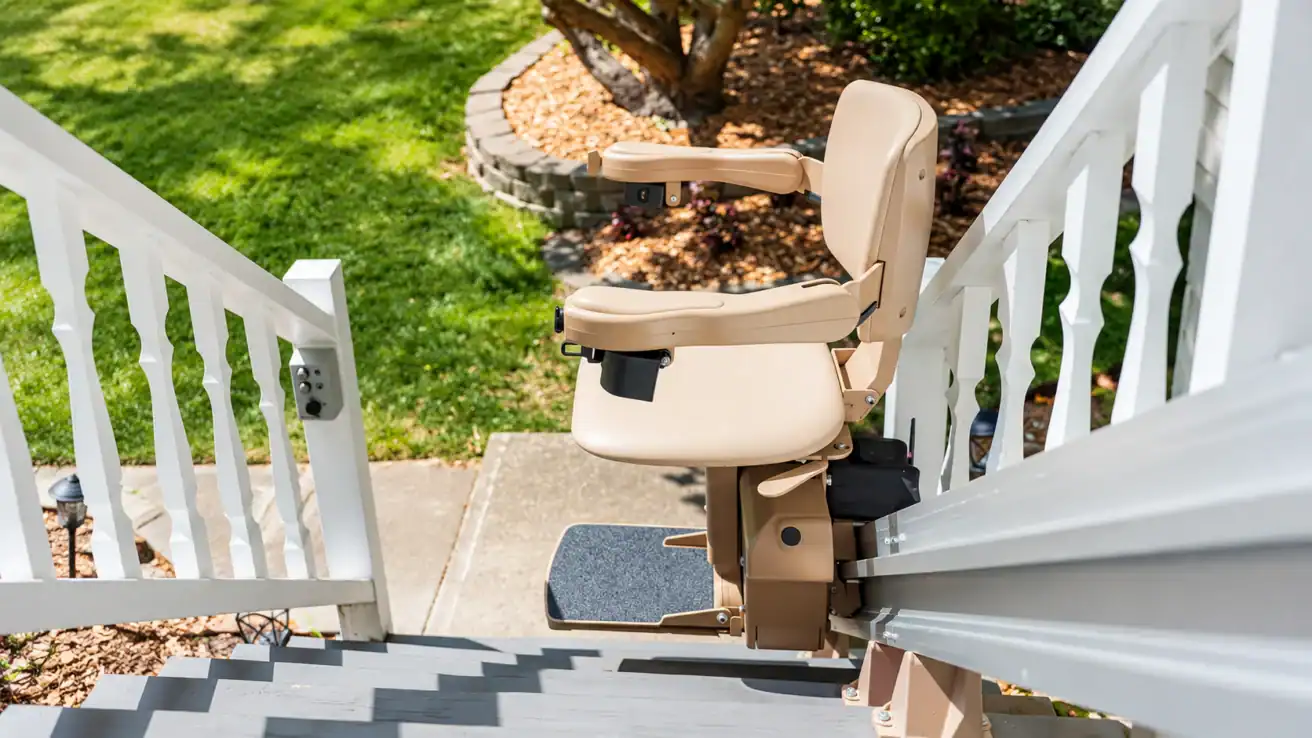
Outdoor stairlifts work well on a short, exterior staircase as long as the passenger can transfer on and off the seat at both ends of the staircase. The measurements of the stairs and the landings, the positions of the transfers, and the exposure to the elements, drainage, the proximity to a power source, and the frequency of use are all factors I consider before recommending an outdoor stairlift for a customer in Lafayette or New Iberia.
The most important consideration is the passenger’s ability to transfer onto and off of the seat. An outdoor stairlift transports a passenger in a seated position. It does not transport a passenger that remains in a wheelchair or power chair.
In New Iberia, Abbeville, Breaux Bridge, and Lafayette, I therefore ask how customers transfer onto the seat at the bottom of the stairs and how they are going to dismount at the top of the stairs. The staircase is only a single element in the assessment at 101 Mobility of Lafayette.
Stair Width, Landing Depth, and Seat-Transfer Position
The equipment must fit the stairs, but the passenger must fit the landing.
I evaluate the width of the stairs as well as the location of the rail. I also consider handrails, walls, posts, gates, doors, and any other element that restricts the available space.
I spend the same amount of time at the top and bottom.
Why Fit Factor Matters
- I check measurements of clear, usable stairs and landing passageways.
- Clear usable width and rail position makes a big difference.
- The shape of your staircase relates to whether the lift requires a custom curved rail.
- Boarding and exiting a stairlift requires a comfortable clearance area.
- The approach and departure of a stairlift user affects the design of the transfer.
- A stairlift depends on a working stairlift transfer.
- The swing of exterior doors and gates may physically block the stairlift and the transfer area.
- Having household traffic helps understand how a stairlift may physically fit, but still leave an inconvenient everyday route.
An outdoor stairlift should help make a better route rather than just fit between the first and last steps.
An example of this is a long stair flight. A ramp landing may be cramped. This is true at the top and the bottom.
That is why I don’t consider just stair width to see if an outdoor stairlift would work.
Weather, Drainage and Charging
When planning to put an exterior stairlift in, the stairlift should be designed to operated in the outdoors.
I look at the design of the product, but also evaluate the design of the site. Water collecting around a landing, roof runoff crossing a path, debris on the stairs, or a poorly located parking spot all have an effect on how useful a site is.
I look at:
- How much a staircase is exposed to the elements
- Whether part of the route is covered / partially covered
- Where water moves after rain
- Whether water collects near either landing
- Where leaves and other debris collect
- Where the lift will be parked
- How their model receives power and maintains charge
The power question relates to the product and is on a case by case basis so I assume not all outdoor stairlifts have the same power arrangement.
This relates back to comparing a weather rated stairlift in Louisiana. Weather resistance is a product requirement, but weather resistance and drainage do not eliminate the need to think about the site and surrounding area of the staircase.
I want the equipment and the site to work together.
Product Options I Compare for Straight Exterior Stairs
For straight exterior stair runs, two required products directly facilitate this comparison.
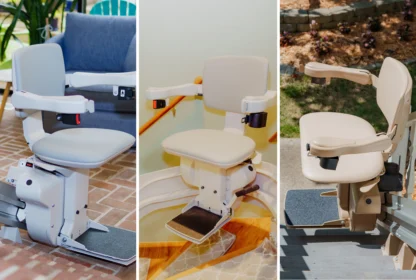
The Bruno Elite Outdoor Straight is designed exactly for outdoor stairs and includes design features unique to outdoor use, including swivel seat, protective coverings, and folding components to dock the stair lift when not in use.
The Harmar SL350OD is built for straight outdoor staircases. This model includes a fold-up seat and footrest and a seat that swivels away to accommodate outdoor use.
Based on the names, I wouldn’t be able to pick between them.
Bringing all other factors into consideration, the stair dimensions and the arrangement of the landings, the transfer position, the user fit, how much space is remaining, and the power supply, will still be important factors.
Grant’s list includes the Handicare 4000 Outdoor. The current page on 101 Mobility says that this model is a custom outdoor, curved stairlift, and therefore would not fit a straight staircase.
This does make a good distinction.
If the staircase is a straight flight of stairs, and the steps are completely straight, I would limit the comparison of stairlift models to those made for straight staircases. If the staircase has a corner or a curve or some other geometry that a straight stairlift can not serve, I would look at the outdoor curved stairlift systems.
The staircase decides the stairlift category before considering the features that decide the model of the stairlift.
When I Would Not Recommend a Stairlift
An outdoor stairlift is not always the correct solution.
The primary restriction would be if the user is unable to transfer from the wheelchair or power chair. A stairlift, in this case, does not address the issue. I would try to provide solutions from an access category that does not require a transfer that the user would not be able to do.
I’d also have second thoughts about the stairlift if a workable transfer position is not available at either the top or the bottom landing.
There are many cases where, although the lift fits on the stairs, the actual location presents many challenges. A door could open into this space. A landing that is too narrow to fit the stairlift may require the user to position the chair too close to the stairs. The chair or the rail could inhibit other family members’ normal use of the space.
“Will the stairlift fit?” is almost never the only question.
I am far more concerned about:
- Do you have a means to get to the seat?
- Can you transfer to the seat in the required position?
- Will you be able to leave the seat at the other side?
- Can the equipment you rely on before and/or after you use the stairlift be moved to where you need it to be?
- Can the other people in your home continue to use the stairs and the landing reasonably?
- Does the route continue to be safe and reasonable in normal weather conditions?
If these pieces don’t line up, I would far rather come up with a different access plan than take a stairlift that will not work as well as it should.
What About After It Is Installed?
After installing an outdoor stairlift, we will go over each step of how the stairlift is used, including:
- Operating the controls.
- Folding the components of the stairlift.
- Swivel function.
- Use of the stairlift at the lower and upper landings.
- Where the stairlift is parked.
- Outdoor barriers.
- Typical maintenance needed for the stairlift.
Case Study
Then I look at the route again.
Can members of the household still use the stairs? Does the chair park in the proposed spot? Do the doors and gates swing clear? Is space available in the transfer area for the person’s mobility aid?
Just because the stair-glide chair moves back and forth along the rail does not mean the installation is complete.
101 Mobility also provides service and support after the installation such as addressing questions about the equipment, performing maintenance, and making repairs.
For outdoor stairlift installations in New Iberia, Abbeville, Breaux Bridge, and Lafayette, we provide a free in-home consultation, with no obligation. We can measure the staircase to see if a stairlift will work, check the potential transfer positions, and determine if a straight outdoor stairlift is the best option or if a different approach may be appropriate.
New Iberia and Lafayette Outdoor Stairlift FAQ
Can outdoor stairlifts be used on back staircases?
Outdoor stairlifts can be installed on exterior staircases where the design and layout of the staircase, landings, and transfer and use positions are appropriate when the stairlift is installed.
Do stairlifts require transferring to and from the seat?
Yes, the user must transfer to and from the stairlift chair to sit on and vacate the stairlift.
What factors do outdoor stairlifts consider?
Stairwell length, width and shape. The available landing space. Positioning of the rails. What nearby doors or gates, and boarding and exiting areas, look like. I even consider the approach to each of the landings as part of my evaluation rather than just the steps.
Are outdoor stairlifts designed for use in all weather?
Outdoor stairlifts are typically designed for use in all weather, but the installation must also consider the site exposure and the movement of water/debris, with implementation having to factor in the manufacturer’s normal care requirements. I consider the product and the installed location.
Can I install a straight outdoor stairlift if my stairs turn?
A straight stairlift is intended for straight stair runs. If the staircase turns or curves or has stair case geometry that requires a custom rail, then an outdoor curved stairlift, like the Handicare 4000 Outdoor, could possibly be installed.
How do I pick the outdoor stairlift for my home?
The first step is the complimentary home assessment. I need to look at the staircase in relation to the rest of the home. Staircase width and geometry and any landings, transfer areas, exposure, the power source available and the expected use.
About the Author
Jonas Boutte is the owner of 101 Mobility of South Louisiana and has hands-on training from accessibility-equipment manufacturers including Bruno, Harmar, Stiltz, Staying Home, EZ-ACCESS, National Ramp, and others. He works with families throughout Greater New Orleans to evaluate home layouts and recommend stairlifts, ramps, lifts, bathroom-accessibility products, and other mobility solutions based on how the space needs to function.