Lift Chair or Stairlift: How I Separate Seating Trouble from Stair Trouble
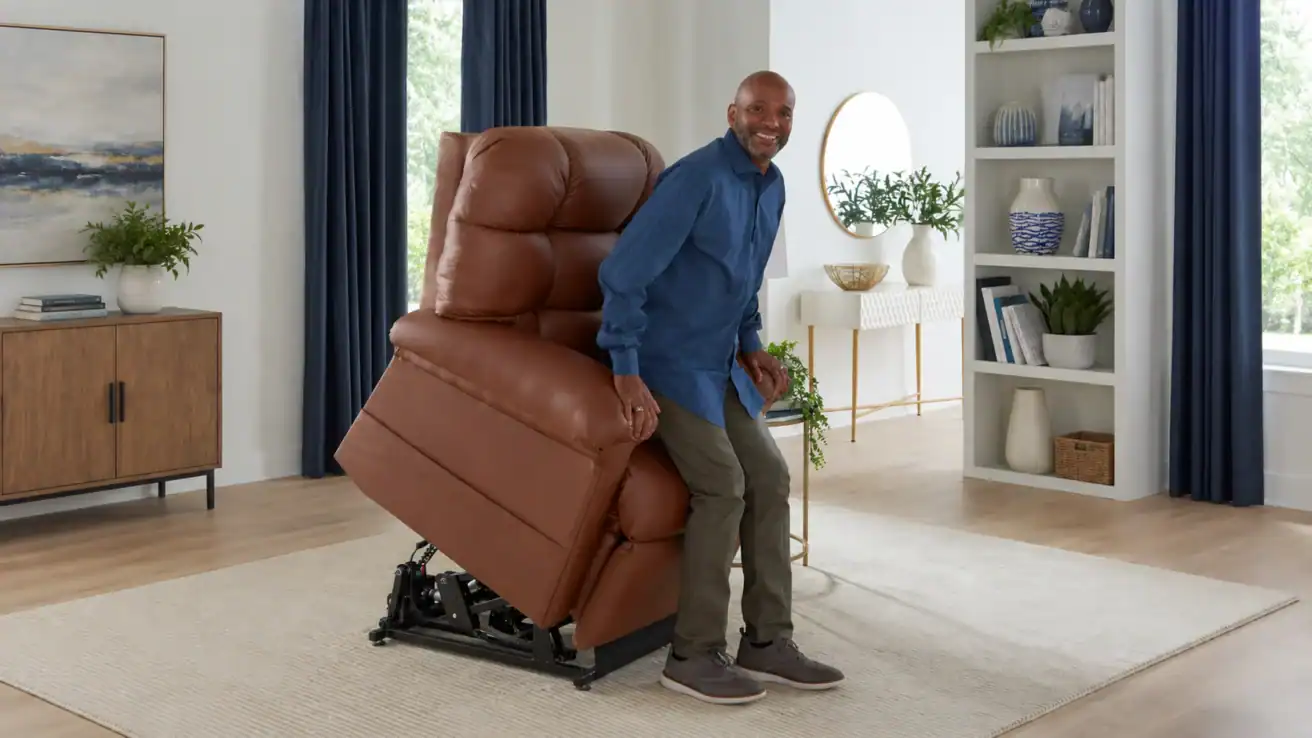
A lift chair helps with the problem of standing from a seated position. A stair lift helps with the problem of getting from one floor to another. If you experience problems standing from a seated position, a lift chair likely fits your needs. If problems arise from the act of stair climbing, a stair lift is likely the best solution.
This may seem clear cut, but because of its simplicity, families are prevented from wasting money on equipment that does not tackle the problem causing the most frustration.
For families in Zachary, Walker, Baton Rouge, Central, Denham Springs, and Livingston, I like to begin by identifying the challenge that exists along the daily commute. At 101 Mobility of Baton Rouge, once the problem is defined, I like to take a look at the solutions.
The key thing I focus on
The question I get asked the most is “What do you think I need, a lift chair or a stairlift?” The answer to that question is never about a particular brand or model.
What I want to know is what part of the day has become the hardest?
Are you having trouble getting out of the recliner in the living room?
Is stair climbing not an issue, but you have trouble lowering yourself all the way down into a normal chair?
Is the problem getting from one floor to the other, and not getting from the first floor to your bedroom upstairs?
If that’s the case, different pieces of equipment are probably needed.
| Daily Problem | What I Look At | Product Category That May Fit |
|---|---|---|
| Difficulty standing from a sitting position | Chair height, sitting routine, ability to transition sitting to standing | Lift Chair |
| Difficulty lowering into a seated position | Controlled sitting, position of chair | Lift Chair |
| Difficulty climbing a straight staircase | Stair configuration, transfer ability, landings, household traffic | Straight Stairlift |
| Difficulty reaching an upstairs bedroom or bathroom | Complete route between floors, ability to transfer | Stairlift |
| Both sitting and stairs are difficult | Where each barrier occurs and how often | Both a lift chair and a stairlift may be needed |
| Neither chair nor stairs is the real barrier | Full daily routine | VA different solution may be needed |
Lift Chairs and Stairlifts do different functions.
The distinction is important because a lift chair does not carry you upstairs, and a stairlift does not solve difficulty in standing up from the seated position in the living room.
I also want to know what happens before and after the movement that you find difficult.
If you are successful in standing up from the seated position, but then cannot reach the stairs without assistance, there may be a different route problem between those two points. If you are able to use a stairlift, but have difficulty transferring from its seat to the landing, that needs to be part of the stairlift assessment.
The product needs to fit the whole routine.
When a Lift Chair is Appropriate
A lift chair is the most appropriate for situations where someone is most challenged in transitioning from a seated to a standing position.
A power lift chair is similar a recliner in that is has a mechanism that can be controlled to bring the seat into standing position and has assistance to control lowering into a seated position.
When weighing the pros and cons of lift chairs in Zachary, I would be more concerned with the intended use case and where the chair will live.
Lift chairs require clearance space around them. I would also need to know what other mobility aids the person plans to utilize after standing, if a different piece of furniture will create a challenging transfer space, how the person plans to approach the furniture, etc.
We have several models of Lift Chairs by Golden Technologies. They have various sizes and recline options. We also have Lift Chairs by Pride Mobility. They have various models with different recline options.
Neither of these brands are cemented as superior.
The right chair has to address the space the user is in, what the user is trying to do that’s difficult, the user, and the room. A chair can have amazing features, and still be the wrong answer, when the obstacle that is the real issue is something else in the house.
The real restriction with lift chairs is that, if standing from your current chair isn’t an issue, but getting up the stairs is, replacing your recliner will not solve your main access issue and so a stairlift is a more valid solution.
A Stairlift is a valid solution to this problem.
If I can cope sitting and standing in the living room, but the problem is the stairs, I consider the staircase.
I want to find out about the stairlift in Walker, LA.
Do the stairs have turns?
Where on the stairs will the person board?
Can they get off the stairs?
Can the staircase remain in use by other household members?
Are there doors or other obstructions at the end of the stairs?
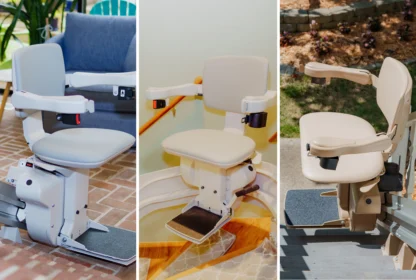
We may look at one straight staircase lift, the Bruno Elan Straight Rail Stairlift, for starters.
Bruno Elan is a straight staircase lift that comprises a rail fixed to each stair tread, and a seat that folds for arms and foot rest when not in use.
Just because the stairs are straight does not mean it will fit.
It depends on the stairs and the landings- where people transfer from one place to another, and the other household members.
I also think of what happens when the person reaches the floor. Simply getting upstairs may not resolve the barriers in the household if the bedroom or bathroom is still inaccessible. The stairs maybe just one route of many.
When They Should Not Be Seen As Separate Routes and When They Should
Having a stair lift and a lift chair in the same household may make sense, so long as they address two different barriers.
Someone might have trouble standing up from the chair they use all day and also having trouble going up the staircase to get to their bedroom.
These are two different things:
‘Sitting to standing’ in the living room
Going from the ‘first’ to the ‘second’ floor via the staircase
In this case, we can evaluate both to a certain extent.
However, I do not usually recommend two products just because two things can be helpful.
If the only real barrier is the staircase, a lift chair might be an unnecessary cost for the family. If the staircase is rarely used, and all of the important rooms are on the same floor, a stair lift might not be important, even though it is clear that it is difficult to climb the stairs.
The daily route should decide.
This is very helpful for families in Baton Rouge, Central, Denham Springs, Livingston, Zachary, and Walker, when deciding what they must tackle first. Focus on solving the movement that limits the most important activity of the individual’s daily routine.
Once that movement is solved, is there another barrier?
After Delivery or Installation?
Having a stair lift and a lift chair involves different processes during the installation, but in both cases, I want the equipment to work well in the real routine of the client.
With a lift chair, we go through how the controls work and how the chair moves. We show how the client goes in and out of the chair and how the area still can work around how the client moves.
We’ll walk you through all the ins and outs of the stairlift controls and seat/step adjustments. You’ll learn how to fold the lift and board and disembark safely at the landings. We also try to determine how other household members will continue to use the stairs.
The handover is not about powering on the equipment.
We explain how the equipment operates and what needs to be done to ensure it is in the right position. We also provide contact information to our support staff to address any issues and concerns.
101 Mobility offers service and support after the installation and delivery of Accessibility equipment to faithfully uphold our commitment to our customers and ensure that installed products function as intended throughout their service life.
For residents in Zachary, Walker, Baton Rouge, Central, Denham Springs, and Livingston, the best place to start is with a completely free in-home consultation. We provide site assessments to evaluate problem areas and determine the best solution.
FAQ: Lift Chair or Stairlift?
What is the main difference between a lift chair and a stairlift?
A lift chair is designed to assist you in moving from a seated to a standing position. A stairlift is designed to provide a means of transporting someone along a staircase. The solution entirely depends on where the challenge is located in your daily routine.
Should I buy a lift chair if I have trouble climbing stairs?
Not if climbing stairs is the challengeyou face. A lift chair is designed to help you stand from a seated position, but will provide no means to access different levels of your home.
Can a stairlift help my parent get up from a regular chair?
A stairlift helps with getting around the stairs, but it won’t assist your parent with getting up out of a regular living-room chair. They will need to find another solution to get on and off the stairlift from either of the landing stations.
Can someone need both a lift chair and stairlift?
Yes, if two separate needs exist. For example, someone may need help to get up from a chair that is often used and may need help to get around different floors of the house. I would conduct separate evaluations for both of these situations.
How do I determine if a stairlift is right for my house?
I evaluate both the person and the stairs. I look at configuration of stairs, landings, transfer through positions, clearance for other household members, and how the person will get on and off the chair.
Which of the two should I evaluate first, the stairlift or the lift chair?
Evaluate the one that disrupts your daily routine first. If you need help most with getting up out of a chair, the fix for that problem should be done first. If you need help most with getting to different floors, then make that evaluation first.
About the Author
Jonas Boutte is the owner of 101 Mobility of South Louisiana and has hands-on training from accessibility-equipment manufacturers including Bruno, Harmar, Stiltz, Staying Home, EZ-ACCESS, National Ramp, and others. He helps Baton Rouge-area families evaluate stairlifts, lift chairs, ramps, platform lifts, home elevators, and other accessibility solutions based on the home and everyday mobility needs.