Temporary Home Access After Surgery: What I Review in Central and Denham Springs
I begin with the route home to identify temporary access solutions like a wheelchair ramp to bridge the gaps between the vehicle, door, bedroom, and bathroom. The objective is to identify existing access barriers, then offer temporary solutions based on the space, the mobility aid, the type of support aid, and the expected period of use.
The beginning of the home accessibility route has a purpose when I work with communities in Central, Denham Springs, Baton Rouge, Walker, Zachary, and Livingston, as pathways can illuminate barriers that acquisition teams may gloss over.
For post surgical accessibility within Baton Rouge, I don’t assume that the front entrance is the best fit, or that all barriers are permanent. With 101 Mobility of Baton Rouge, I can evaluate the pathways that a person will actually rely on, and determine the immediate solution to the barrier.
I divide the return journey into three routes.
| Route | What I Check | How It Affects The Suggestions |
|---|---|---|
| Vehicle to Door | Steps, Rise, Landings, Surface and Doorway | Assess if equipment needs to be temporary |
| Door to Bedroom | Thresholds, Changes in Floor Level, Stairs | Assess if the sleeping area is accessible |
| Bedroom to Bathroom | Doorway, Floor Space, Transfers, Assistance Space | Assess if one of the most used routes is obstructed |
| Travel Between Multiple Levels | Shape of the Stairs, Landings, Transfer Position | Assess if steps can be made accessible on a temporary basis |
| Transfer Points | Bed, Chair, Wheelchair, Toilet, Caregiver Assistance Space | Assess if transfer equipment is required |
| Storage and Charging | Floor Space, Power Sources | Assess if temporary equipment has a proper location when not in use |
I do not assess recovery and I do not offer any medical advice. I base my suggestions on the instructions provided by the medical staff and I adjust the plan to modulate access to the home and the equipment.
When a Multi-Fold Ramp Can Solve the Immediate Entry
When the main barrier is a reasonable step at the entrance and the site offers adequate space for use of a ramp, a portable ramp may be adequate.
The Multi-Fold Ramps by 101 Mobility are portable aluminum ramps that are designed to fold for transport. Based on the configuration of the units, they can be used for stairs and some vehicle access situations as well as landings.
Portability is an excellent feature, but it doesn’t make a ramp suitable for each and every situation. Considering each of these points is necessary before recommending a ramp.
I look at the vertical differential, the available space, the top and bottom landings, the direction of approach, the doorway and threshold, the mobility device, how often the path will be used, where the ramp will be stored or moved to, and more.
For someone in Central Louisiana looking for a temporary ramp, those considerations are more important than selecting a ramp length online.
I also consider what entrance gives us the most direct access to the inside of the building. If the front entrance has several obstacles, but a garage or another entrance provides a more direct access route to the bedroom and bathroom, I will consider that alternate route rather than thinking about how we will plan around the front door.
A portable ramp may be a better choice for a short-term barrier rather than initiating a large permanent access project if the barrier is likely to only be a short-term need and a properly fitted portable solution is adequate for the route.
A Rental Stairlift is Worth Considering for Temporary Multi-Level Access
Needs don’t end at the entrance.
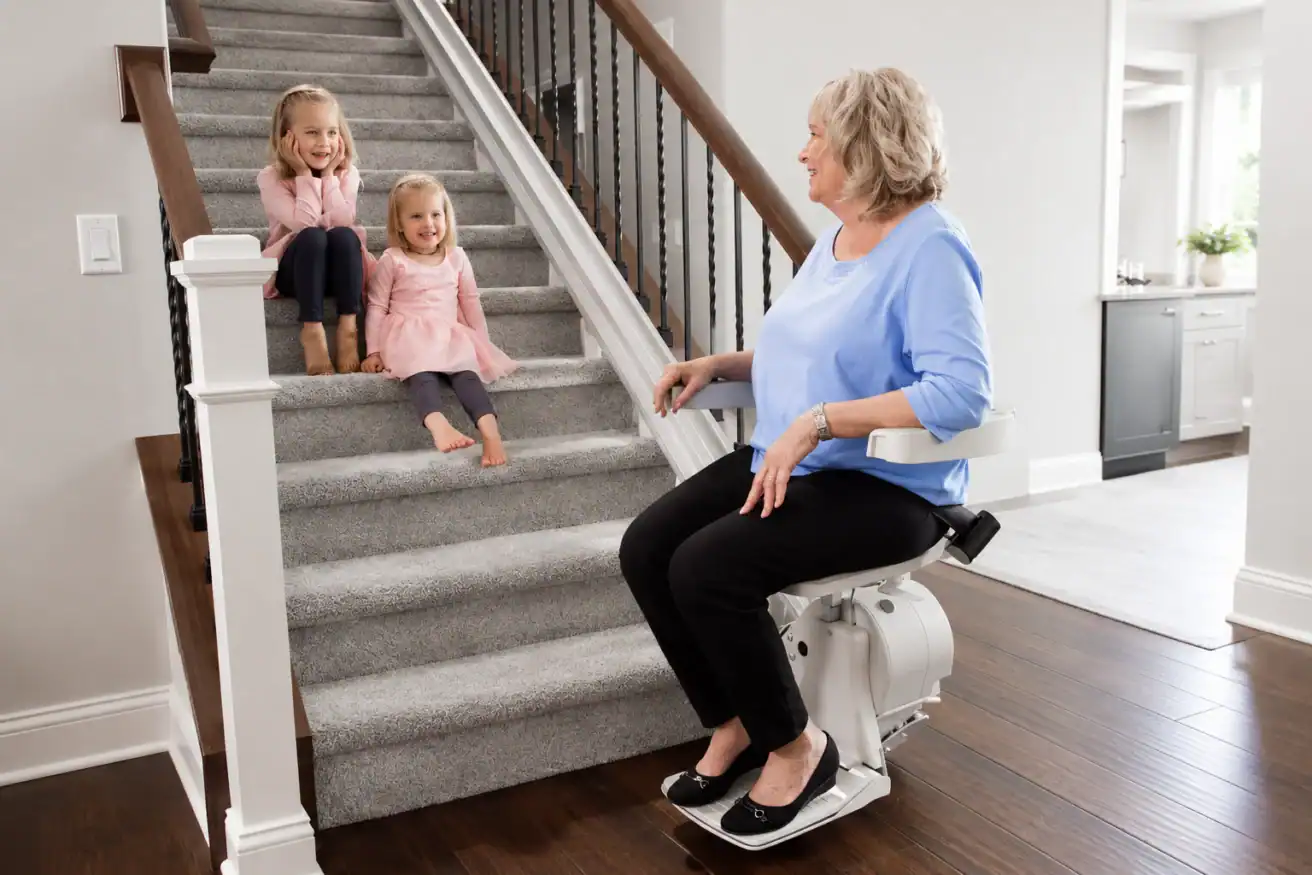
If the bedroom or bathroom is on a different floor, stairs may be the biggest barrier. I will consider a rental stairlift in that situation.
When deciding if a rental stairlift is right for a situation in Louisiana, whether a stairlift is suitable to the user and the stairs is the first issue to consider.
The shape and width of the stairs is important. Also how much space is between the door and the stairs. And, of course, how big the landing spaces are at the top and bottom.
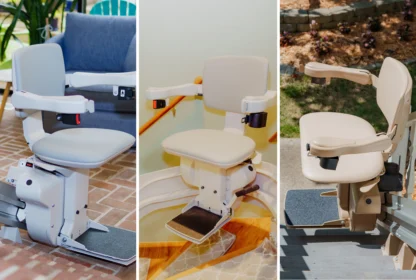
A straight stairlift is the Bruno Elan Straight Rail Stairlift. The seat folds, as do the arms and footrest. The lift is battery operated, and the battery is charged through the standing track. This unit may or may not be the stairlift rental for a particular situation.
I also need to find out if the person can use a seated stairlift as directed by the person’s care team. A stairlift means getting on and off the chair. It is a difference from a system that lifts a person and keeps them in a wheelchair.
If the stairs turn or the landings do not work, I would not force a straight stairlift into a system because the need is only temporary.
Sometimes the better short-term plan is to arrange the daily routine on one level instead of adding equipment to move to another level.
The Conversation Should Include Transfer Supports When Issues of Entries and Stairs Are Part of the Route
Once we reach the bedroom and bathroom, I also want to understand what occurs around the transfer points.
Do you need assistance when you move from the bed to the wheelchair, or from the chair to another surface? Is there enough room around the person to stand, and enough space to move the equipment? Does the equipment move through the door?
These questions are related to the physical layout of the home. I am not able to determine if a patient is clinically ready for the use of a specific patient lift or transfer method.
If a care plan dictates the use of patient-handling equipment, we would need to consider equipment such as the Handicare EvaDrive. The EvaDrive is a mobile patient lift, meaning the base width, maneuvering space, storage facility, charging, and the transfer path need to be considered when deciding if the equipment will fit.
In addition to meeting the functional criteria, a transfer may still be a poor fit for the home, depending on the amount of available space to facilitate the transfer. It all depends on the space. That is why I look at the bedroom, bathroom, doorway, and the working space of the caregiver as one transfer path.
What I Would Not Rush When the Recovery Timeline Is Uncertain
If a family is uncertain if an access need will be for weeks or months, I would not build a permanent solution for every barrier.
Temporary solutions or equipment can be great for flexibility.
If we have a portable ramp that solves our barrier for access, we don’t necessarily need to build a whole new bigger permanent system.
Short-term accessibility solutions like rental stairlifts may mean it is not necessary to purchase.
If the user can utilize a temporary bedroom on the primary level, that should perhaps be considered before architectural adjustments are made.
The opposite can also be true. If what was once thought to be a temporary solution is becoming more long-term, architecture that is more permanent may also be more appropriate.
The goal should be identifying what should be addressed in order to provide the user with a safe means to navigate the residence before they return, versus addressing all issues that can potentially be resolved later.
Every time I correct three critical barriers in a route, I would much rather delay the family’s desire for completion of six changes in order to ensure I have enough time to provide thoughtful solutions.
What Happens After Setup or Rental Delivery?
After temporary solutions are installed, we test the route for accessibility starting with how mobile devices either cross or bypass the obstruction and reach the landings.
For stairlifts, we provide instruction on the controls, folding seats, where to position the seat to charge, and best practices for entry and exit at each landing.
For transfer equipment, we provide instruction on how to use the equipment while ensuring its use is in line with the user’s established plan of care.
We also include a discussion on the temporary equipment’s storage, charging, and parking location.
Equipment brings up many questions and our service and support staff will address any equipment-related questions, including required support and maintenance for the equipment.
These decisions would be made once the temporary period is over. Possible pathways could be to remove the rental equipment, extend the rental period if needed, or decide if the need for a longer term solution has arrived.
Prioritize a free in-home consultation for Central, Denham Springs, Baton Rouge, Walker, Zachary, or Livingston. Our experts can assist with evaluating the vehicle to door, bedroom, bathroom, stair, and transfer routes to determine what changes, barriers, or hard surfaces should be addressed first when returning home.
FAQ: Access After Surgery
Which areas should be assessed first when returning home after surgery?
Check first the areas of concern in daily living. These may include: the vehicle-to-entry, entry to bedroom and bedroom to bathroom. This would include assessing steps and thresholds, doorway width, floor and landing space, mobility device, instructions/directions of the care team, and any transfer areas.
Is it always best to use a temporary wheelchair ramp to cover the steps?
This is usually not true since a temporary wheelchair ramp will only be a good solution if step height, length of the ramp space available, and the landing area in front of the doorway, the mobility device, and the daily travel route all fit the solution. It may be easier to use another entry to the home.
Is it possible to rent a stair lift for a temporary recovery period?
Stair lifts are available for rental in our equipment categories. The exact solution, local availability, fit for the stairs, and terms of the rental agreement would all need to be decided. I would assess the stairs and determine the length of time needed before suggesting a rental.
Should I buy accessibility equipment if I do not know how long it will be needed?
Not automatically. If the length of time is unknown, an accessible rental or use of an appropriate portable solution could buy you time instead of making a permanent modification. The decision should reflect how the equipment will be used, the layout of your home, and how long the need will be.
When should transfer equipment be considered?
Transfer equipment should be considered if your care plan specifies that you will need assistance with transfers and you need equipment to carry out that routine.
What should I prepare for an accessibility assessment?
You should know the date you expect to return home, the mobility equipment you will need, the pathways you need to traverse, any transportation restrictions the care team has provided, and whether you expect the need to be temporary. We can take measurements of your home during the accessibility assessment.
About the Author
Jonas Boutte is the owner of 101 Mobility of South Louisiana and has hands-on training from accessibility-equipment manufacturers including Bruno, Harmar, Stiltz, Staying Home, EZ-ACCESS, National Ramp, and others. He helps Baton Rouge-area families evaluate ramps, stairlifts, patient-handling equipment, platform lifts, home elevators, and other accessibility solutions based on the home, immediate needs, and everyday route.