Bathroom Access in Older New Orleans Homes: What I Check Before Recommending Products
I will address accessibility issues in New Orleans by looking at routes over products. Shower control may be limited by various factors such as the size of the door, the placement of the toilet, or the presence of a step. I may need to evaluate more than one bathroom in order to give the best suggestions for New Orleans, Metairie, Harahan, Gretna, and Marrero. I want to learn the route you take to get to the bathroom, how you enter, how you navigate between the fixtures, and what movements are causing problems.
At 101 Mobility of New Orleans, this route-first approach helps us determine which accessibility solution actually fits the space.
The Route Into the Bathroom Is Often the First Constraint
Bathroom planning starts before you cross the doorway.
I see each room individually and chronologically. How do you get to the doorway? With your mobility device, do you line up with the doorway? Does the door bump into you when it opens? Can you turn in the limited space?
A bathroom may have useful equipment inside and still be difficult to use if someone can’t get there.
Here is my review of that route:
| Route Checkpoint | What I Check | Why It Matters |
|---|---|---|
| Hallway Approach | Direction of travel and available passage | How the person will travel and meet up with the doorway |
| Doorway | Opening and clear surrounding space | Whether the person and their mobility device can get through |
| Threshold | Floor to Floor transition and height | May create a barrier at the entrance |
| Door Swing | Space the door takes when opening | Can be a barrier for the person and assistance |
| First turn | Space next to the opened door | A doorway still needs clear space to be usable |
| Toilet | Approach and surrounding space | Affects how the person and support can get through |
| Tub or Shower | Space of opening and edge approach | Affects how bathing can be performed |
| Assistance space | Space which other people will stand | Products must work with the routine |
I take the same approach to assess bathroom accessibility in Metairie. I don’t start with a product then try to jam it into a spot.
First, I locate the point where the route ends.
Threshold, door swing, tub or shower edge and the placement of the toilet
Small constraints can combine to make a bathroom problematic.
Thresholds
A small rise over one doorway can work against a walker, wheelchair or another mobility aid.
In such situations 101 Mobility sells Rubber Threshold Ramps (and I have installed) products designed to provide a gradual threshold rise of up to 2.”
This doesn’t mean a threshold ramp solves all issues with the bathroom. Changing the door width, door swing, turning radius, and fixture placement isn’t resolved with a threshold ramp.
Door Swing
I analyze the space in front of and behind the door.
When a bathroom door opens inward, it consumes space. If that space is limited due to the presence of a wheelchair, walker, caregiver, or transfer aid, it can significantly compromise the available space.
Tub or Shower Edge
In order to assist with bathing, I need to know what movement the person is attempting.
Does the person need to step over a tub wall? Is the transfer occurring from the toilet? Are there available clear spaces to the right and left of the bathing area? In what direction does the person need to move?
These questions are important prior to selecting shower transfer equipment in New Orleans.
Toilet Location
The location of the toilet can impact equipment recommendations.
Where the toilet is located in relation to the tub and shower can impact what equipment can be used, where support equipment can be located, and determine what space is available for a caregiver.
All fixtures must be analyzed as layout components and not as isolated objects.
Support Products vs Transfer Products
I tend to analyze bathroom equipment based on the challenges that they address.
Equipment that supports a person’s stability while standing and equipment that facilitates transference are both challenges that need to be addressed with different equipment.
HealthCraft SuperPole
The HealthCraft SuperPole is a floor to ceiling pole with a pressure fit installation between the floor and ceiling that can be installed in bathrooms or any area where a vertical support point is needed and fits within the user’s constraints.
While the SuperPole may help in some situations, I must review the placement and the floor to ceiling conditions prior to recommending it. A support pole will only be of benefit if it can be positioned where the user requires support.
The same holds true when considering grab bars for an older home. The placement needs to match the movement being supported. Increasing the number of support points does not fix an unaided and unsupported transfer.
ShowerGlyde SG-2
The ShowerGlyde SG-2 addresses a different issue.
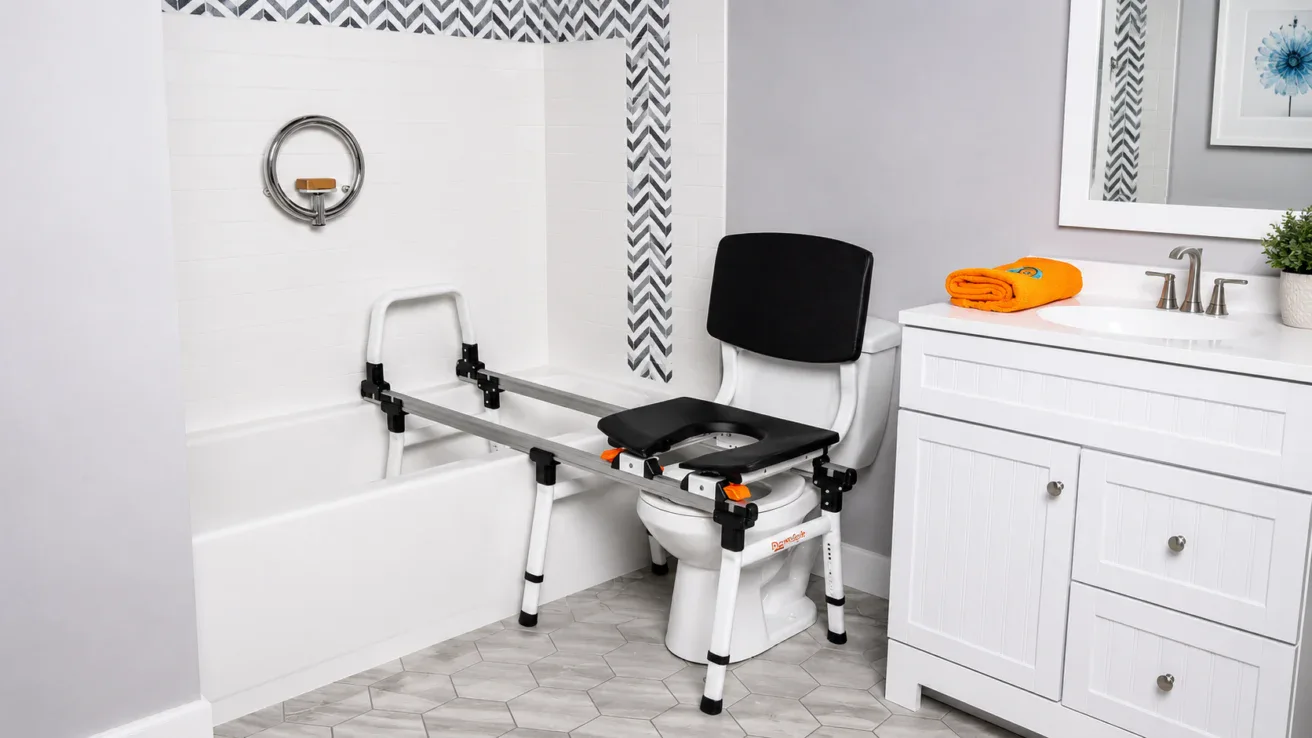
This product is intended for bathing areas where the toilet and tub are side by side. A bench that slides over the tub and has adjustable extended rails over the toilet area is included. It is also adjustable for left or right hand placement.
The description given for this product indicates the importance of measuring fixture relationships.
If the arrangement of the toilet and tub does not match the system requirements, I will not try to install that product. We will consider other alternatives.
Rubber Threshold Ramps
These products address a different barrier, a small change in elevation of a threshold.
While these products may facilitate the use of the mobility device for some people, rampping a threshold does not provide standing support or assist with bathing in a tub.
Although these various products are all classified under bathroom accessibility, they all perform distinct functions.
When More Than a Device is Needed to Modify the Room
Sometimes I would dissuade someone from getting another device.
If the doorway is problematic, the door swing intrudes into the transfer zone, the fixtures take up space, the bathing area is again problematic due to another turn, and one more device may not do enough to modify the route, then I would prefer to discuss if the bathroom needs a larger access modification.
- A support pole does not make a doorway wider.
- A threshold ramp does not make turning space.
- A transfer bench does not configure the fixtures differently.
I would look at the entire sequence.
- Can you reach the bathroom?
- Can you enter the bathroom by your chosen method of mobility?
- Can you reposition yourself and/or turn?
- Are you able to get to the toilet?
- Can you get to the bathing area?
- Is there enough space to perform a transfer?
- If someone helps you, is there usable space for a helper?
If more than one of these steps is problematic after adding an individual device, and more changes to the room need to be made, then continuing to add devices is not the appropriate solution.
The goal is to create a usable route and not simply stuff a small bathroom full of devices.
What Happens After Installation?
Following the installation or setup of the product, we check the product within the same route as the one we evaluated prior to the installation.
For threshold products, we assess how the device transitions two surfaces.
For a support product, we evaluate the product and how it will be used.
To understand how a transfer system operates, we show the components that move, adjust, or lock. We look at the remaining space around the equipment. Installation should not obstruct the doorway, path to the toilet, bathing route, or space another household member needs.
We also show how the product functions. We provide product support contact information as needed. 101 Mobility has an equipment service and support line to provide assistance with equipment and perform repairs and maintenance on accessibility equipment.
If you want to know what equipment fits in a bathroom in New Orleans, Metairie, Harahan, Gretna, or Marrero, request a free in-home consultation. We look at the clear path of the doorway, all thresholds, equipment placement, and available space and recommend the equipment or a larger space modification.
FAQ: Bathroom Access in Older New Orleans Homes
What should I address first to make an older bathroom accessible?
Think about the clear path of the doorway and opening onto the bathroom. Consider the clear path of the route to and from the toilet, bathing area, and available space for a person’s normal and/or assistive equipment.
Can an inaccessible bathroom doorway be a problem?
Yes, a bathroom may have lots of available space but an inaccessible doorway or turn may still be an issue. That is why I evaluate accessibility on the path to and within the bathroom.
Can a Rubber Threshold Ramp be used at a bathroom entrance?
A Rubber Threshold Ramp may help with a floor transition as long as certain measurements are taken. I have to measure the rise, the available space, the doorway, and the swing of the door, and I have to consider the user’s equipment. The ramp only addresses the threshold, so I need to check the others.
In what other instances would I use a HealthCraft SuperPole?
HealthCraft SuperPoles may be appropriate when there are floor to ceiling support points that align with the movements that are being assisted and as long as the room provides an appropriate space for installation.
In what other situations is a ShowerGlyde SG-2 appropriate for a bathroom?
ShowerGlyde SG-2 fits layouts that have the toilet and tub next to each other. I would need to assess the bathroom and the direction of the transfer to determine if this is a good fit.
For older bathrooms, are grab bars a sufficient accessibility upgrade?
No. Grab bars will help provide support for movements, but they will not clear a threshold, help with doorway size, turning radius, fixture placement, or change a poor transfer route.
In what situations should I consider larger bathroom modifications?
It may be more justified to consider larger modifications when several barriers exist that are connected, including having a restrictive doorway, difficulty with door swing, poor turning space, poor fixture placement, and poor transfer space. In that case, changing the room may be a more adequate solution than adding more accessories.
About the Author
Jonas Boutte is the owner of 101 Mobility of South Louisiana and has hands-on training from accessibility-equipment manufacturers including Bruno, Harmar, Stiltz, Staying Home, EZ-ACCESS, National Ramp, and others. He works with families throughout Greater New Orleans to evaluate home layouts and recommend stairlifts, ramps, lifts, bathroom-accessibility products, and other mobility solutions based on how the space needs to function.