Mobility Device Storage in Covington: How I Plan Scooter, Power Chair, and Vehicle-Lift Access
When I plan mobility device storage in Covington, I do not start by asking where there is an empty corner. I start with the entire routine: where the scooter or power chair is stored, where it charges, how the user reaches it, how it gets through the home, and how it reaches the vehicle.
Transportation adds another layer. A Bruno Out-Sider, for example, has a 350-pound capacity, while the Harmar AL100 and AL100HD are rated for 350 and 400 pounds respectively. Those numbers matter, but capacity alone does not tell me which lift fits.
I need the device, vehicle, garage, and person using the equipment to work together.
For families in Covington, 101 Mobility of New Orleans can evaluate those pieces as part of one accessibility plan.
Key Takeaways
- Good mobility-device storage supports the person’s normal daily route.
- Charging should be convenient without creating cords or equipment obstacles in frequently used paths.
- Doorways, turning areas, transfer spaces, and garage routes should remain clear.
- A vehicle lift must be compatible with both the mobility device and the vehicle.
- The best setup connects storage, charging, home access, garage access, and transportation instead of solving each problem separately.
What Should Good Mobility Device Storage Accomplish?
The largest available storage area is not automatically the best location.
I want a storage setup to make the mobility device easier to use.
That means asking:
- Can the user reach the device easily?
- Is charging practical?
- Can the device leave the storage area without difficult backing or repeated repositioning?
- Does it block a doorway, hallway, transfer space, or entrance?
- Can it reach the primary exit or garage?
- If it travels regularly, can it reach the vehicle’s loading position?
- Where will the charger and accessories stay when they are not being used?
A scooter parked neatly against a wall can still be poorly located if three other things have to be moved every time someone wants to use it.
That is why I focus on the routine.
Why Do I Start With the Daily Route?
Before recommending changes, I trace the path the person actually uses.
A typical routine may look something like this:
Living area
↓
Mobility-device storage
↓
Charging location
↓
Primary exit or garage
↓
Vehicle
↓
Vehicle lift
That simple sequence often exposes the real problem.
Maybe the scooter fits beside the garage door, but the user has to make a difficult turn to reach it.
Maybe the device charges conveniently, but the cord crosses the normal walking route.
Maybe the garage has plenty of total square footage, but not enough clear space beside the parked vehicle to position the scooter for loading.
Maybe the vehicle lift works outside but cannot be comfortably operated with the vehicle parked where it normally sits.
I look for those conflicts before recommending equipment.
I pay particular attention to transitions
The difficult part of a mobility route is often where one area meets another.
I look at:
- Door clearances
- Hallway width
- Turning areas
- Flooring transitions
- Thresholds
- Steps between the home and garage
- Storage around entrances
- Vehicle parking position
- The approach to the loading area
Improving storage only helps if the device can move between those areas practically.
How Do I Plan a Scooter or Power-Chair Charging Area?
A scooter charging area should support the routine rather than interrupt it.
I want the device to be easy to park, connect, disconnect, and retrieve.
The specific charging environment and procedure should always follow the mobility-device and battery manufacturer’s instructions.
From an accessibility standpoint, I look at these factors:
| Planning Point | What I Look For |
|---|---|
| Device position | Enough room to park without blocking a normal travel route |
| Electrical access | Practical access consistent with the manufacturer’s charging requirements |
| Approach | Room to position the scooter or power chair |
| Exit path | A practical way to leave without repeated difficult turns |
| Cord management | Cords kept out of walking, rolling, and transfer paths |
| Charger storage | A consistent place for the charger when disconnected |
| Accessories | Space for baskets, bags, cushions, or other frequently used items |
| User access | A setup that works for the person or caregiver handling the charging routine |
The charger needs its own place too.
If the charger is constantly moved from one outlet to another or its cord ends up across a doorway, the storage plan is creating another problem.
A predictable setup is easier to use.
How Do I Keep Mobility Equipment From Blocking the Home?
A scooter or power chair is rarely the only mobility-related equipment in the house.
The same area may also need to accommodate:
- A walker
- Manual wheelchair
- Transfer equipment
- Portable ramp
- Charger
- Approved spare battery or battery equipment
- Cushions
- Bags
- Baskets
- Other mobility accessories
This is where clutter can gradually become an accessibility issue.
I pay particular attention to frequently used spaces:
doorways, hallways, turning areas, transfer locations, entrances, and the route to the garage.
I want those spaces to remain predictable.
Give frequently used equipment a defined location
Equipment that does not have an assigned storage location tends to move.
The walker ends up beside the door.
The charger ends up on the floor.
The manual chair moves into a turning area.
The scooter gets repositioned every time the garage needs to be used.
I would rather assign a practical location to each frequently used item.
That does not mean every mobility aid needs its own room.
It means the organization should support movement instead of reducing it.
How Do I Plan the Garage for a Scooter or Power Chair?
For many Covington households, the garage connects home accessibility with transportation.
That makes it an important part of the plan.
I start with the vehicle’s normal parking position.
Then I ask:
- Which door does the user normally enter?
- Where does the mobility device approach the vehicle?
- Can the scooter or power chair turn in the available space?
- Are there steps or thresholds between the home and garage?
- Is there enough room beside or behind the vehicle for loading?
- Does an open hatch, tailgate, or vehicle door change the available clearance?
- Does the vehicle need to leave the garage before the lift can be used?
- Can another person assist without standing in the travel path?
- Where will the mobility device stay when it is not being transported?
Those questions can change which transportation solution makes sense.
A vehicle lift may be mechanically compatible with a vehicle and still be inconvenient if the normal loading environment does not provide enough usable room.
I check the routine with the vehicle in its normal position
This matters.
Planning everything with an empty garage can give a misleading picture.
I want to understand the route with the vehicle parked where it will actually be parked.
That is the space the user has to work with every day.
How Do I Match a Vehicle Lift to the Scooter, Power Chair, and Vehicle?
Once the home and garage route make sense, I can look more closely at transportation equipment.
101 Mobility’s Transportation + Mobility Aid Solutions include interior and exterior options for transporting wheelchairs, scooters, and power chairs.
I do not choose one by brand alone.
I compare:
- Mobility-device type
- Device dimensions
- Device weight
- Vehicle make, model, and year
- Available cargo space
- Hitch requirements when applicable
- Vehicle-specific limitations
- Loading location
- Rear clearance
- Garage clearance
- Frequency of use
- How the device will be secured
- Who will operate the lift
A compatible vehicle wheelchair lift needs to fit the whole setup.
Harmar AL-Series Vehicle Lifts
I treat Harmar’s AL-Series as a group of different lift configurations rather than one universal product.
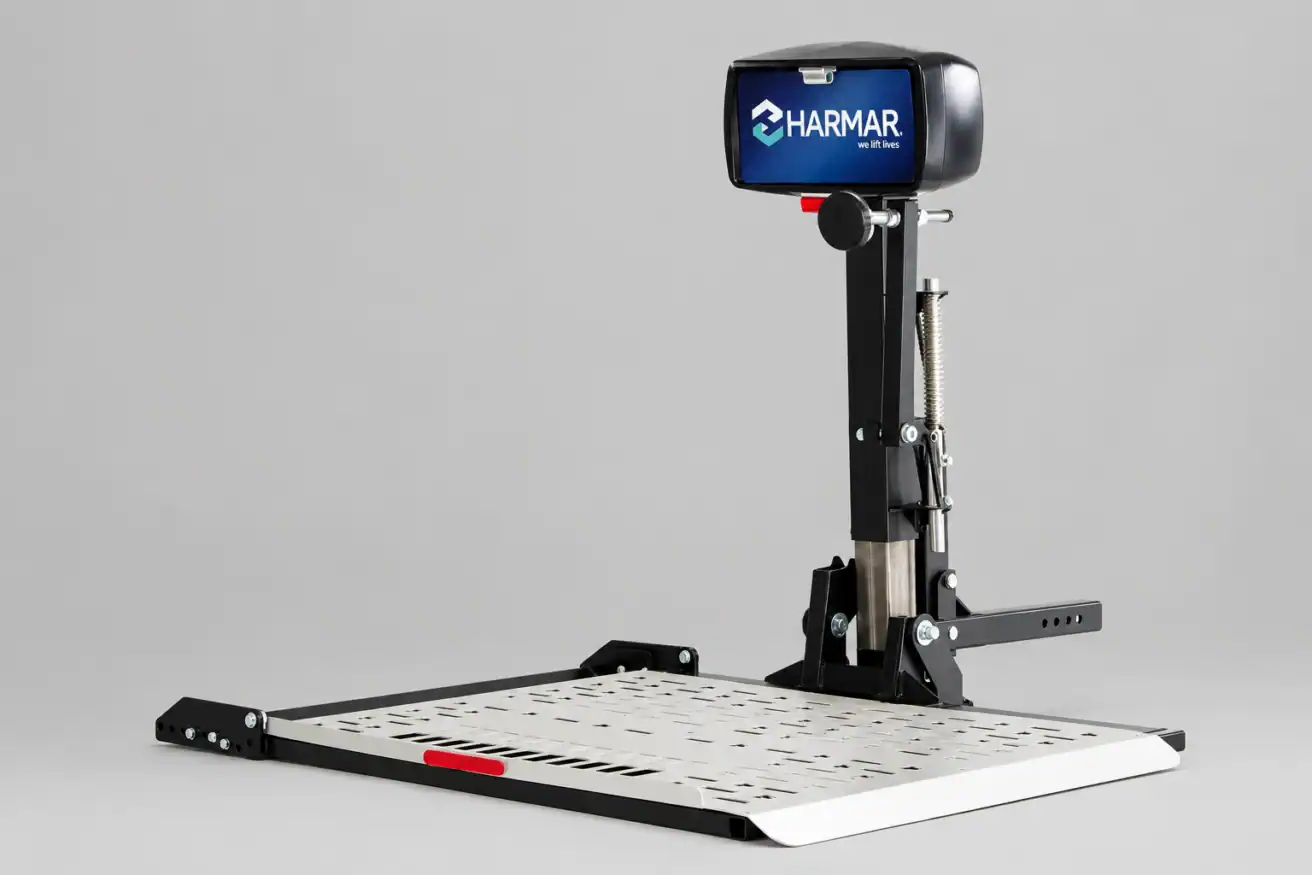
For example, the Harmar AL100/AL100HD are exterior scooter lifts.
The AL100 has a 350-pound lifting capacity.
The AL100HD increases that to 400 pounds.
Both use a platform and automatic hold-down system designed around compatible scooters.
Other Harmar AL-series models serve different device and vehicle combinations, including configurations intended for power chairs.
That is why saying, “I have a scooter, so I need a Harmar lift,” is not specific enough.
I still need to know exactly which scooter and exactly which vehicle.
Bruno Out-Sider
The Bruno Out-Sider takes an exterior-platform approach for compatible scooters, power wheelchairs, and other mobility devices.
Its current specifications include:
- 350-pound capacity
- 28.5-inch platform width
- Class II or III receiver hitch requirement
- Compatibility with several vehicle types, subject to the specific vehicle and mobility-device combination
Because the device travels outside the passenger compartment, this type of lift can preserve interior cargo space.
That can be useful.
But I still need to consider what happens behind the vehicle.
Is there enough space to lower the platform?
Can the mobility device approach it?
Does the garage allow that process, or will loading normally happen in the driveway?
Does the rear hatch need regular access?
How will the user secure and operate the system?
The lift is only one component.
Harmar AL-Series vs. Bruno Out-Sider: What Do I Compare?
There is no universal winner.
I compare the specific device, vehicle, user, and loading environment.
| Planning Question | Harmar AL-Series | Bruno Out-Sider |
|---|---|---|
| Product approach | Multiple models and configurations | Exterior platform lift |
| Device type | Depends on selected AL model | Compatible scooters and power chairs |
| Example capacity | AL100: 350 lb; AL100HD: 400 lb | 350 lb |
| Exterior transport available? | Yes, with applicable models | Yes |
| Vehicle compatibility required? | Yes | Yes |
| Hitch compatibility relevant? | Yes for applicable exterior models | Yes, Class II or III receiver hitch required |
| Device dimensions matter? | Yes | Yes |
| Device weight matters? | Yes | Yes |
| Interior cargo space used? | Depends on selected model | No device storage inside cargo area when using exterior platform |
| Garage/loading clearance important? | Yes | Yes |
| Primary decision | Which AL model matches the device and vehicle? | Does the Out-Sider match the device, vehicle, hitch, and loading environment? |
This is why I would not recommend a vehicle lift from a photo of the scooter alone.
My vehicle-lift decision path
Identify the mobility device
↓
Confirm dimensions and weight
↓
Identify the exact vehicle
↓
Review compatible lift configurations
↓
Check hitch or interior-loading requirements
↓
Review garage and loading clearance
↓
Consider who will operate the lift
↓
Choose the configuration that works with the complete routine
A product can meet the weight requirement and still be the wrong choice for the vehicle or user.
My Mobility Equipment Organization Checklist
When I review mobility device storage in Covington, this is the sequence I use.
1. Choose the primary storage area
Identify where the scooter, wheelchair, or power chair will normally stay when it is not being used.
2. Plan charging
Choose a charging setup consistent with the manufacturer’s instructions while keeping the normal travel route clear.
3. Walk the actual route
Follow the path from the living area to the mobility device, primary entrance, and garage.
Do not evaluate the storage area by itself.
4. Assign supporting equipment
Give walkers, manual chairs, chargers, bags, cushions, and other regularly used equipment a practical location.
5. Check the garage with the vehicle parked
Evaluate doors, thresholds, steps, turning room, loading clearance, and access around the vehicle.
6. Compare transportation equipment
Match the scooter, wheelchair, or power chair to the vehicle and appropriate lift configuration.
7. Test the complete routine
My final question is not:
Does everything fit?
It is:
Can the person move from home to mobility device to vehicle without repeatedly rearranging the environment?
That is the better test.
When Do I Recommend a Professional Mobility Assessment?
A professional assessment becomes especially useful when several parts of the routine are interacting.
I would look at the complete setup when:
- A new scooter or power chair is being purchased
- The household is changing vehicles
- The user is having difficulty loading the device manually
- Multiple mobility devices share one storage area
- The route to the garage is narrow
- Steps or thresholds separate the home and garage
- The caregiver repeatedly has to move equipment
- The household is comparing several vehicle-lift options
- The current lift no longer fits a new mobility device
- The vehicle-lift setup works technically but is difficult to use in the normal parking location
At that point, the question is no longer simply where to store the scooter.
It becomes a complete accessibility and transportation problem.
Frequently Asked Questions About Mobility Device Storage in Covington
Where should a mobility scooter be stored at home?
I recommend a location that supports the scooter’s normal daily route, provides appropriate access for charging according to the manufacturer’s instructions, and leaves enough space to approach and move the device without blocking important doorways or travel paths.
Where should I create a scooter charging area?
Choose a location that meets the device and battery manufacturer’s charging requirements and allows practical electrical access. Keep charging equipment and cords out of commonly used walking, rolling, and transfer paths.
Can I store a power chair or scooter in my garage?
Possibly, but I would first check the manufacturer’s storage and environmental requirements for the specific device and battery. I would also evaluate temperature exposure, moisture, charging requirements, security, and the route between the garage and home.
How do I know which vehicle lift fits my scooter?
Start with the scooter’s exact dimensions and weight, then match those specifications to the vehicle and lift. Vehicle make, model, year, hitch requirements, lift capacity, platform dimensions, rear clearance, and the user’s loading routine can all affect compatibility.
Is a Harmar AL-Series lift or Bruno Out-Sider better?
Neither is universally better. Harmar offers several AL-series configurations for different devices and vehicles. The Bruno Out-Sider is an exterior platform option for compatible scooters and power chairs. I would choose based on the exact mobility device, vehicle, loading location, available clearance, and user.
Does a vehicle lift solve my mobility-device storage problem?
Only part of it. The vehicle lift handles transportation. You still need a practical place to store and charge the device, a clear route through the home or garage, enough room around the vehicle, and a loading process the user or caregiver can manage.
Plan the Entire Route, Not Just the Equipment
The best mobility device storage in Covington makes the full routine easier to manage.
I want to know where the device stays.
Where it charges.
How it reaches the garage.
Where the vehicle parks.
How the device gets into loading position.
And which transportation equipment actually fits both the mobility device and the vehicle.
Sometimes reorganizing the route solves part of the problem.
Sometimes a different storage location makes more sense.
And sometimes the next step is comparing a Harmar AL-series lift, Bruno Out-Sider, or another transportation configuration.
The right answer should come from the complete routine.
If you are trying to organize a scooter or power chair, improve garage access, or determine which vehicle lift fits your mobility device and vehicle, Book a Free Consultation with 101 Mobility of New Orleans.
About the Author
Jonas Boutte | 101 Mobility of South Louisiana
Jonas Boutte is the owner of 101 Mobility of South Louisiana and an accessibility specialist serving Covington and communities throughout the Greater New Orleans area. With hands-on manufacturer training that includes Bruno and Harmar, he helps individuals, families, and caregivers evaluate mobility equipment, home layouts, and transportation options based on how they need to move through everyday life.