Outdoor Accessibility in Laplace: Safer Routes From the Driveway to the Door

Outdoor access problems often start before anyone reaches the front door. A cracked walkway, a slick surface after rain, a steep transition from the driveway, or poor lighting at the entry can turn a routine trip into a daily challenge.
That is why outdoor accessibility in Laplace should be evaluated as one complete route. The goal is not just to make one step easier. It is to create a safer, smoother path from where someone arrives all the way into the home.
For older adults, people recovering from surgery, wheelchair users, and families planning ahead, the most effective improvements usually begin with the basics: driveway access, walkway safety, ramp installation where needed, better lighting, and easier entry at the door.
Why outdoor accessibility matters in Laplace
Outdoor access is part of everyday life. It affects getting the mail, leaving for appointments, welcoming guests, and simply moving in and out of the home with less stress.
In Laplace, outdoor routes also need to hold up to regular rain, wet surfaces, and changing conditions. Even small issues can become bigger hazards outside, especially when mobility is limited.
A safer route should help with:
- More stable footing
- Smoother wheelchair or walker movement
- Easier transitions between surfaces
- Better visibility in early morning, evening, or bad weather
- Less strain for family members and caregivers
Start with the full route, not just the front step
Many homeowners focus on the front door first. In reality, access problems often begin farther out.
Driveway and parking area
The driveway is the starting point. If it is sloped, narrow, uneven, or broken, simply getting out of a car can feel unsteady.
Look for:
- Enough space to open a door fully
- A stable place to stand or transfer
- Minimal cracks or surface damage
- A manageable transition from the driveway to the walkway
When evaluating driveway access in Laplace, the question is simple: can someone arrive, exit the vehicle, and begin moving toward the house safely?
Walkways and transitions
Walkways should feel predictable. That means fewer lips, gaps, loose materials, and uneven joints.
Common problems include:
- Raised concrete edges
- Loose pavers
- Gravel that shifts underfoot
- Narrow paths
- Puddling or poor drainage
- Abrupt height changes between surfaces
This is where walkway safety becomes a major part of everyday independence.
Entry approach and threshold
The final few feet often create the biggest obstacle. A short stoop, steep step, awkward porch layout, or heavy exterior door can interrupt an otherwise manageable route.
The right fix may involve a ramp, a landing adjustment, improved handrails, or easier door access.
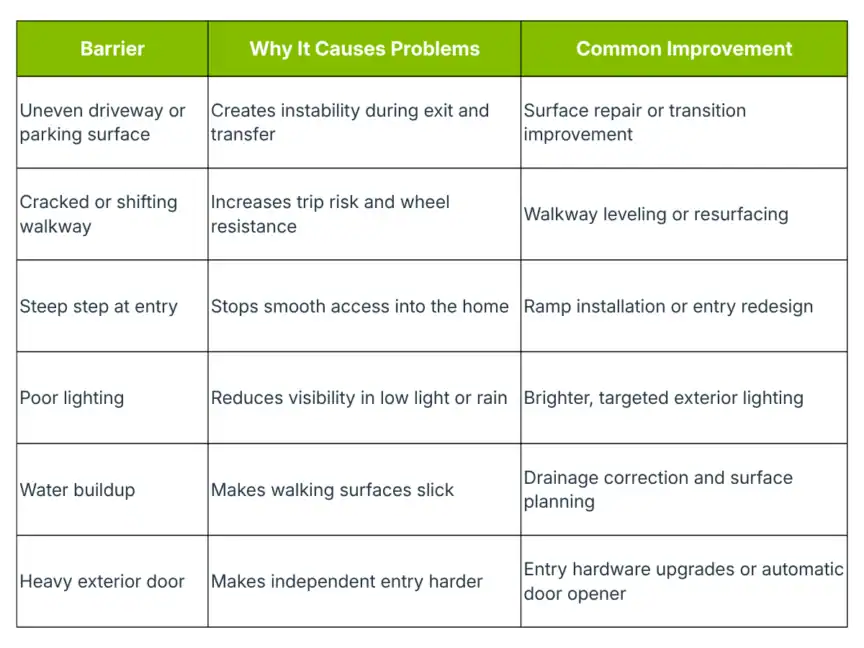
Common outdoor barriers that make entry harder
Here are the outdoor issues that most often interfere with safe home access:
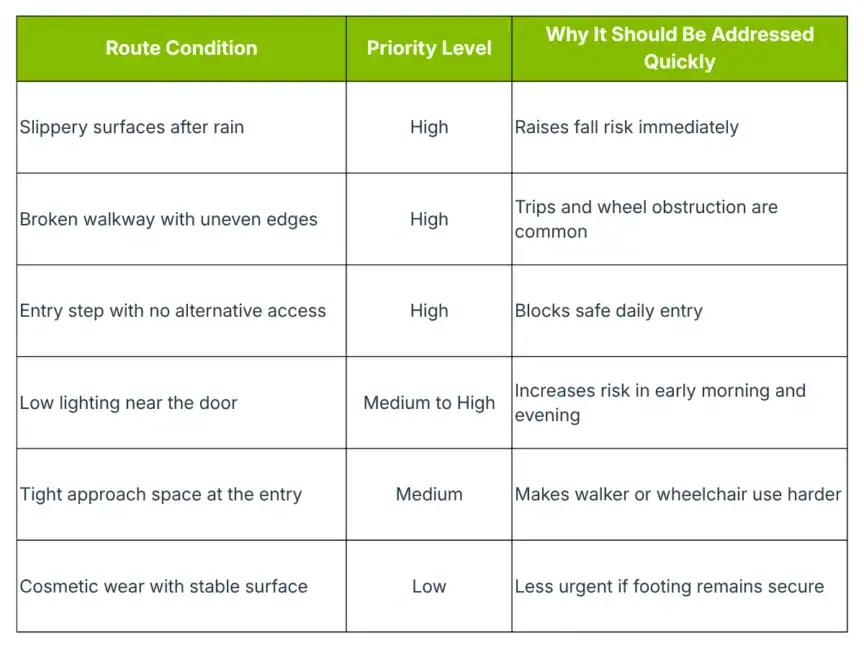
Outdoor access priority chart
Not every issue carries the same level of urgency. This chart helps identify what to address first.
Solutions that can improve outdoor accessibility in Laplace
The best solution depends on the route, the user, and how the home is laid out. A good plan focuses on the full path, not just one product.
Walkway improvements
A safer walkway often starts with better surfaces and better transitions.
Helpful improvements may include:
- Smoothing uneven sections
- Widening narrow paths where possible
- Reducing abrupt edges
- Improving traction
- Correcting drainage that leaves standing water
If the route is used with a walker, wheelchair, or scooter, small surface issues matter even more.
Ramp installation
When there is a step, stoop, or raised entry, ramp installation may be the clearest solution. A well-planned ramp can make entry more direct, more stable, and less physically demanding.
A ramp should be evaluated based on:
- Available space
- Rise at the entry
- Approach angle
- Landing needs
- Handrail requirements
- How the route performs in wet weather
Not every entry can take the same type of ramp. That is why on-site assessment matters.
Lighting and visibility
Lighting is one of the simplest ways to improve outdoor safety, but it needs to be placed with intention.
Focus on:
- Driveway-to-walkway transitions
- Changes in elevation
- Corners and turns
- The front door and lock area
- Any ramp or porch surface
Better lighting supports safer movement and helps family members, guests, and caregivers too.
Entry and door access
Even if the route is smooth, the final barrier may be the door itself. For some homes, easier entry means pairing route improvements with better door access.
That can include:
- Reducing threshold difficulty
- Improving clearance
- Changing hardware
- Adding an automatic door opener for simpler operation
For homes where the exterior route is only part of a larger accessibility challenge, it may also help to explore broader outdoor accessibility solutions or connect the project to other mobility upgrades through the local 101 Mobility New Orleans team.
When a ramp is enough and when you may need another solution
A ramp is often the right answer when the main problem is one or more entry steps. But some properties need a broader plan.
A ramp may be enough when:
- The route is otherwise stable
- There is room for proper layout
- The main barrier is elevation at the entry
A broader solution may be needed when:
- The outdoor staircase is long or complex
- The path includes multiple changes in elevation
- The route is narrow or heavily constrained
- The door area also limits access
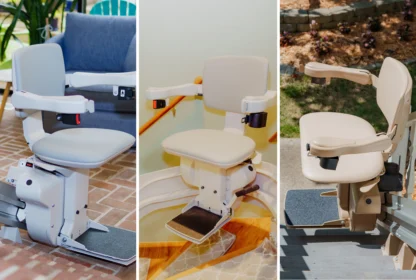
In some cases, homeowners also consider weather-resistant stair access solutions for exterior stairs. The right recommendation depends on the property and the person using the route every day.
What to look for during a home accessibility assessment
A useful assessment should look at the entire route in real conditions, not just measurements on paper.
Outdoor route checklist
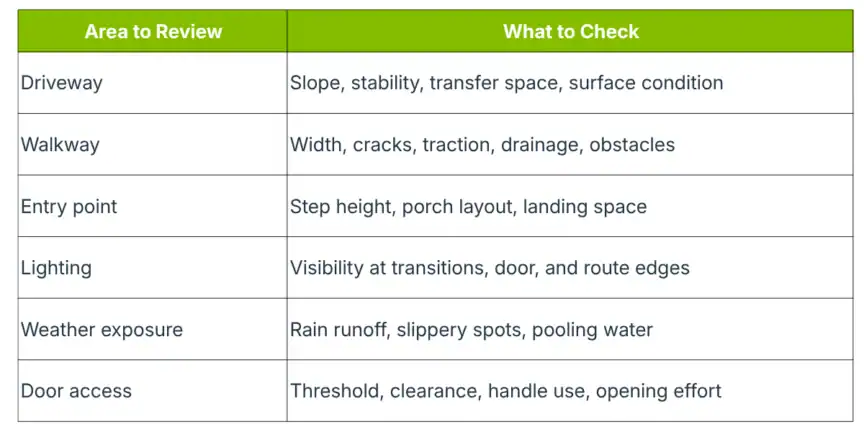
That kind of review helps identify the most effective path toward safer accessible outdoor routes without overbuilding or missing key hazards.
Key takeaways
- Outdoor safety begins at the driveway, not the front door.
- Walkway safety, drainage, lighting, and entry design all work together.
- Ramp installation can be highly effective, but only when it fits the site properly.
- Wet conditions and uneven surfaces can make small barriers much more serious.
- A full-route assessment helps uncover the right solution for daily use.
FAQ
What does outdoor accessibility in Laplace usually include?
It usually includes the full route from arrival to entry, such as driveway access, walkway condition, ramps, lighting, drainage, thresholds, and door usability.
How do I know if my walkway is a safety risk?
If the surface is uneven, cracked, slippery, narrow, or difficult to navigate with a walker or wheelchair, it is worth evaluating. Small height changes outdoors can create bigger risks than many homeowners expect.
When is ramp installation the right choice?
Ramp installation is often the right choice when a step or raised entry is the main obstacle and there is enough room to create a safe approach and landing.
Can lighting really make that much difference?
Yes. Better exterior lighting improves visibility at transitions, edges, and entry points, which can reduce hesitation and help prevent missteps.
What if the problem is more than just one entry step?
That usually means the route should be assessed as a whole. The right answer may involve multiple improvements working together rather than a single fix.
Take the next step
If getting from the driveway to the door feels harder than it should, it may be time to evaluate the full route. The right changes can make daily entry safer, easier, and more manageable in all kinds of conditions.
To explore practical options for outdoor accessibility in Laplace, including safer walkways, ramp installation, and easier entry solutions, Book a Free Consultation with 101 Mobility.