When I Recommend a Harmar Highlander II: Vertical Platform Lift Planning in Baker
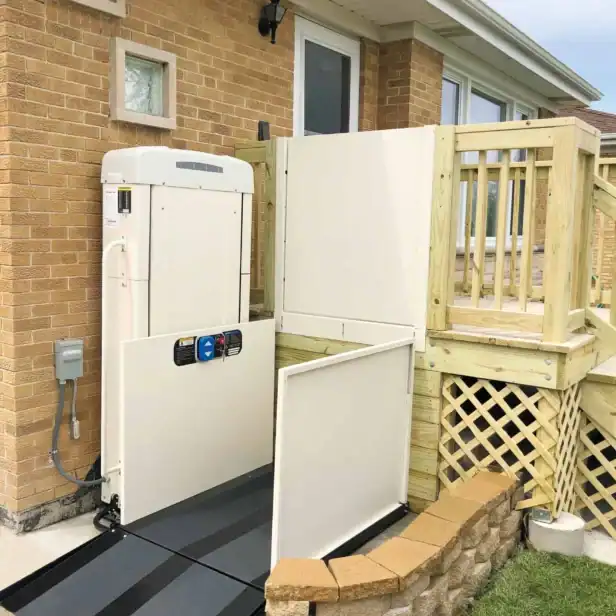
When I handle vertical platform lift planning in Baker, I do not start by deciding that a Harmar Highlander II or Bruno VPL is automatically the right choice.
I start with the home.
I look at how high the entry sits, how much space is available around the porch, how a wheelchair approaches the lift, where the person needs to exit at the upper landing, and how often that route will be used.
For Baker homes with a raised porch, deck, or garage entrance, a vertical platform lift can be an especially practical option when a ramp would require more space than the property comfortably allows.
The goal is not simply to fit a lift beside the house. It is to create an access route that works comfortably as part of everyday life.
Key Takeaways
- I consider the entire wheelchair route, not just the height of the porch.
- Limited horizontal space can make a vertical platform lift a practical ramp alternative.
- Upper and lower landing space must work with the wheelchair and the user’s approach.
- Gate location and entry direction can influence which lift configuration fits best.
- Outdoor exposure, drainage, and power planning deserve attention in Baker.
- I compare the Harmar Highlander II and Bruno VPL based on the property and user rather than brand name alone.
What I Look at During Vertical Platform Lift Planning in Baker
Every property presents a different combination of space, height, and access needs.
These are some of the first factors I review:
| Planning Factor | What I Evaluate |
|---|---|
| Raised entry height | The vertical distance the lift needs to cover |
| Available ground space | Whether there is enough usable room for the lift and wheelchair approach |
| Upper landing | Space for entering or exiting the platform and reaching the doorway |
| Wheelchair or power chair | How the device fits and maneuvers along the route |
| Gate alignment | Which entry and exit orientation works with the porch and doorway |
| Weather exposure | Rain, moisture, drainage, and how exposed the installation will be |
| Daily use | How important the lift will be to routine entry and exit |
| Power planning | Electrical location and whether backup-power options should be considered |
This is why I prefer evaluating the property before recommending a specific model.
A lift can look appropriate on paper and still be a poor fit if the wheelchair cannot comfortably reach it or leave it at the upper landing.
When a Vertical Platform Lift Becomes a Practical Ramp Alternative
A ramp is often one of the first solutions families consider for raised entry access.
And when a property has enough room, a ramp may be an excellent choice.
The challenge is that a ramp needs horizontal space. As the entry gets higher, the amount of property needed for a usable ramp route can increase significantly.
That can become difficult when a Baker home has:
- a raised porch with limited yard space
- a driveway close to the entrance
- landscaping or property boundaries near the approach
- little room beside the house
- a high deck or garage entry
- an awkward route between the parking area and door
A wheelchair platform lift moves primarily vertically instead. That can make it a practical ramp alternative when preserving usable yard, driveway, or walkway space is important.
I still compare both options when appropriate. I do not recommend a lift simply because one will fit. I want the route as a whole to make sense.
I Start With the Wheelchair Route, Not the Lift
For someone who uses a wheelchair every day, access starts well before they reach the platform.
I look at how that person moves from the vehicle, driveway, garage, or sidewalk to the lower landing.
Then I follow the route all the way through the doorway.
Questions I commonly consider include:
- Can the wheelchair approach the platform comfortably?
- Is there room to line up with the entrance?
- Does the user need to turn before entering?
- Is there enough clear space at the upper landing?
- Which direction should the wheelchair leave the platform?
- Is the home’s door positioned conveniently relative to the lift?
- Does a caregiver need additional maneuvering space?
This complete-route approach is important because the best porch lift in Baker is not necessarily the smallest one or the one with the longest list of features. It is the configuration that works with the way the person actually enters and leaves the home.
Travel Height and Landing Space Shape the Installation
The height of a raised porch is one of the obvious measurements, but it is not the only one I care about.
I also evaluate what happens at both ends of the lift.
At ground level, there needs to be a practical approach to the platform.
At the upper level, the user needs a usable transition between the platform and the porch, deck, or doorway.
That means I may look closely at:
- porch dimensions
- available landing area
- door location
- wheelchair turning space
- railings and existing gates
- the direction of travel
- surrounding steps or obstacles
The selected lift and its configuration need to fit those conditions rather than forcing an awkward route around them.
Gate Alignment Can Make or Break the Layout
One detail homeowners sometimes overlook is where the wheelchair enters and exits the platform.
Gate alignment affects how the lift interacts with the porch and the door.
For one home, a straightforward entrance and exit may work perfectly. At another, the porch layout may make a different platform orientation more practical.
This is one reason I measure the complete landing instead of simply measuring the height from the ground to the porch.
If the wheelchair reaches the top but cannot comfortably turn toward the door, the access problem has not really been solved.
Weather Exposure Matters in Baker
Outdoor accessibility equipment in South Louisiana needs to be planned with exposure in mind.
When I evaluate an outdoor VPL location, I look at where rainwater moves, whether water tends to collect near the proposed lift area, and how exposed the equipment will be.
Both the Harmar Highlander II VPL and Bruno VPL offer configurations intended for outdoor accessibility applications.
The product itself, however, is only part of the planning.
Placement matters too.
A good outdoor layout should consider drainage and everyday access so that the lift works as part of the property rather than becoming another obstacle around the entrance.
Daily Wheelchair Use Changes What I Prioritize
There is a difference between a lift that will be used occasionally and one that serves as someone’s primary entrance every day.
When the VPL is central to daily wheelchair access, I pay additional attention to:
- how direct the route is
- ease of boarding and exiting
- platform and landing configuration
- control placement
- gate operation
- outdoor exposure
- electrical planning
- available backup-power options
- long-term service access
I also think about the other people using the entrance.
The best layout should improve wheelchair access without unnecessarily making the porch, driveway, or walkway harder for everyone else to use.
Harmar Highlander II vs. Bruno VPL: How I Compare Them
I do not consider either model the universal winner.
I compare the available configurations against what I measured at the home.
| Consideration | Harmar Highlander II | Bruno VPL |
|---|---|---|
| Residential raised-entry use | Strong option to evaluate | Strong option to evaluate |
| Outdoor applications | Available | Available |
| Platform choices | Multiple configurations available | Multiple configurations available |
| Travel-height options | Multiple models available | Multiple models available |
| Gate and control options | Available options can be matched to the project | Available options can be matched to the project |
| Best choice | Depends on site measurements and user needs | Depends on site measurements and user needs |
I may lean toward the Harmar Highlander II when its available platform, gate, travel-height, and control configuration lines up especially well with the site.
I may lean toward the Bruno VPL when its available platform arrangement, entry orientation, power configuration, or other options better solve the particular landing.
The important point is that I make that comparison after evaluating the property.
My Vertical Platform Lift Planning Checklist for Baker Homes
Here is the basic decision path I use:
| Question | Why It Matters |
|---|---|
| How high is the entry? | Establishes the required vertical travel |
| Is there room for a practical ramp? | Helps determine whether a VPL should be considered |
| Where will the wheelchair approach? | Determines the lower-platform layout |
| Where should the wheelchair exit? | Helps determine platform and gate orientation |
| Is the upper landing large enough? | Supports a usable transition toward the door |
| How exposed is the location? | Helps guide outdoor placement |
| Will the lift be used every day? | Makes convenience and dependable access especially important |
| What mobility device will use it? | Ensures the layout is planned around real-world use |
| What does the rest of the entry route look like? | Prevents solving one barrier while creating another |
No single measurement tells me whether a lift is right for the home.
I need the complete picture.
What Happens During a 101 Mobility Consultation
You do not need to know whether you need a Harmar Highlander II, Bruno VPL, or even a platform lift before scheduling a consultation.
That is what the evaluation is for.
When I review a Baker property, I start by learning who will use the entrance, what mobility device they use, and where they need to travel.
From there, I can review the property, take the necessary measurements, compare practical options, and explain why one solution may fit better than another.
The 101 Mobility of Baton Rouge team can help with the process from the initial home evaluation through product selection and installation coordination.
If you are still comparing your options, you can also explore our vertical platform lifts and learn more about vertical platform lift pricing before your consultation.
Frequently Asked Questions
Is a porch lift the same as a vertical platform lift?
In residential conversations, “porch lift” commonly refers to a vertical platform lift used to move a wheelchair or power chair between ground level and a raised porch, deck, or entrance.
When is a vertical platform lift better than a ramp?
I typically consider a VPL more closely when the entry is elevated and a ramp would require more horizontal space than the property can comfortably provide. The decision should also account for the wheelchair route, landing space, user needs, and overall property layout.
Can a vertical platform lift be installed outdoors?
Many vertical platform lifts are designed for outdoor applications. I still evaluate the specific product configuration, installation location, drainage, electrical needs, and weather exposure before recommending an outdoor setup.
Which is better: the Harmar Highlander II or Bruno VPL?
Neither is automatically better for every Baker home. I compare their available configurations with the travel height, platform space, entry orientation, power needs, and everyday use requirements of the property.
What should I prepare before a platform lift consultation?
It helps to know which entrance you want to improve, what mobility device will use the lift, how often the route is used, and whether there are specific concerns about space or weather exposure. Detailed measurements are not necessary before an in-home evaluation.
Book a Free Consultation
If a raised porch, deck, or garage entry is making everyday wheelchair access difficult, the first step does not have to be choosing a product.
Start by evaluating the route.
Book a Free Consultation with 101 Mobility. I can review your Baker home, measure the entry and landing, understand how the wheelchair is used each day, and determine whether a Harmar Highlander II, Bruno VPL, ramp, or another accessibility solution makes the most sense.
About the Author
Jonas Boutte is the owner of 101 Mobility of South Louisiana. With hands-on training from leading accessibility manufacturers, including Bruno and Harmar, he helps Baton Rouge-area families evaluate stairlifts, platform lifts, ramps, home elevators, and other mobility solutions based on their homes, daily routines, and long-term accessibility needs.