Shower Transfer Options for a Small Bathroom in Gretna
I will need to understand the parameters of a shower transfer in order to recommend the most appropriate equipment. These would include how much space is available to position the user and caregiver to facilitate the transfer. The design and size of the bathroom can impact the types of equipment that can be used.
I often work with clients from the surrounding areas of Gretna, Marrero, Harvey and Westwego. At 101 Mobility of New Orleans, when addressing clients with a shower or tub in their bathroom, I often want to evaluate the situation beyond the equipment to understand the client’s overall goal and the challenges the client faces.
Some of the information that I want to gather includes the following:
- Beginning of the Transfer: Where does the user come from?
- End of the Transfer: Where does the user need to get to?
- Where does the caregiver stand?
- Are there any obstacles that create space constraints? For example, are there equipment or assistive devices that can be positioned in a small bathroom to provide the needed space?
- What is the configuration of the bathing area? Is it a standard bathtub or a roll in shower?
- What kind of space is available to facilitate the transfer?
- If there is a toilet in the bathing area, where is the nearest fixture to the tub? Is it in front of the tub? Is it to the side of the tub?
Each route creates a different type of equipment challenge.
I need to understand:
- Whether the user approaches from the right or the left
- Whether the user transfers pivotally or sidely
- How the caregiver positions himself/herself
- Where the clear working space is relative to the bathroom door, toilet, and bathroom sink
- How the equipment is removed from the bathroom
Why Caregiver Working Space is Important
A product may fit between the toilet and sink. However, it still may not allow a caregiver to work in the bathroom.
For equipment design, I consider the footprint of equipment and the space required for a caregiver to work. Small differences in layout and design can influence the caregiver working space and equipment footprint.
ShowerGlyde SG-3 may Eliminate the Need for Floor Space
If the only way to maneuver a rolling piece of equipment through a bathroom is to use the existing bathroom clear floor space, then a sliding bathroom equipment transfer system may be the best option.
The ShowerGlyde SG-3 is designed to provide bathroom equipment transfer systems for small baths.
Rather than rolling a person and his/her chair through the bathing area, the chair seat is equipped with a sliding seat rail.
The published specs say the SG-3 has a seat height adjustment for tubs up to 19 inches, and, with extension legs, up to 25 inches.
Having these features means the SG-3 may be a good option with ShowerGlyde in New Orleans. However, having these features does not mean the SG-3 will be a good fit.
I still need to find out:
- Where a user transfers to the seat
- Which side of the tub offers the best approach
- If the rails obstruct other controls on the tub
- Where the caregiver stands
- If the seat obstructs the tub controls
- If the seat obstructs the door to the bathroom
If a seat slide is used, there may be less clear space in the bathroom for a user to maneuver a shower chair.
A sliding seat may offer greater independence to a user compared to a rolling seat.
A rolling shower bench is a good choice if a user can safely transfer to and from the rolling bench to use a shower.
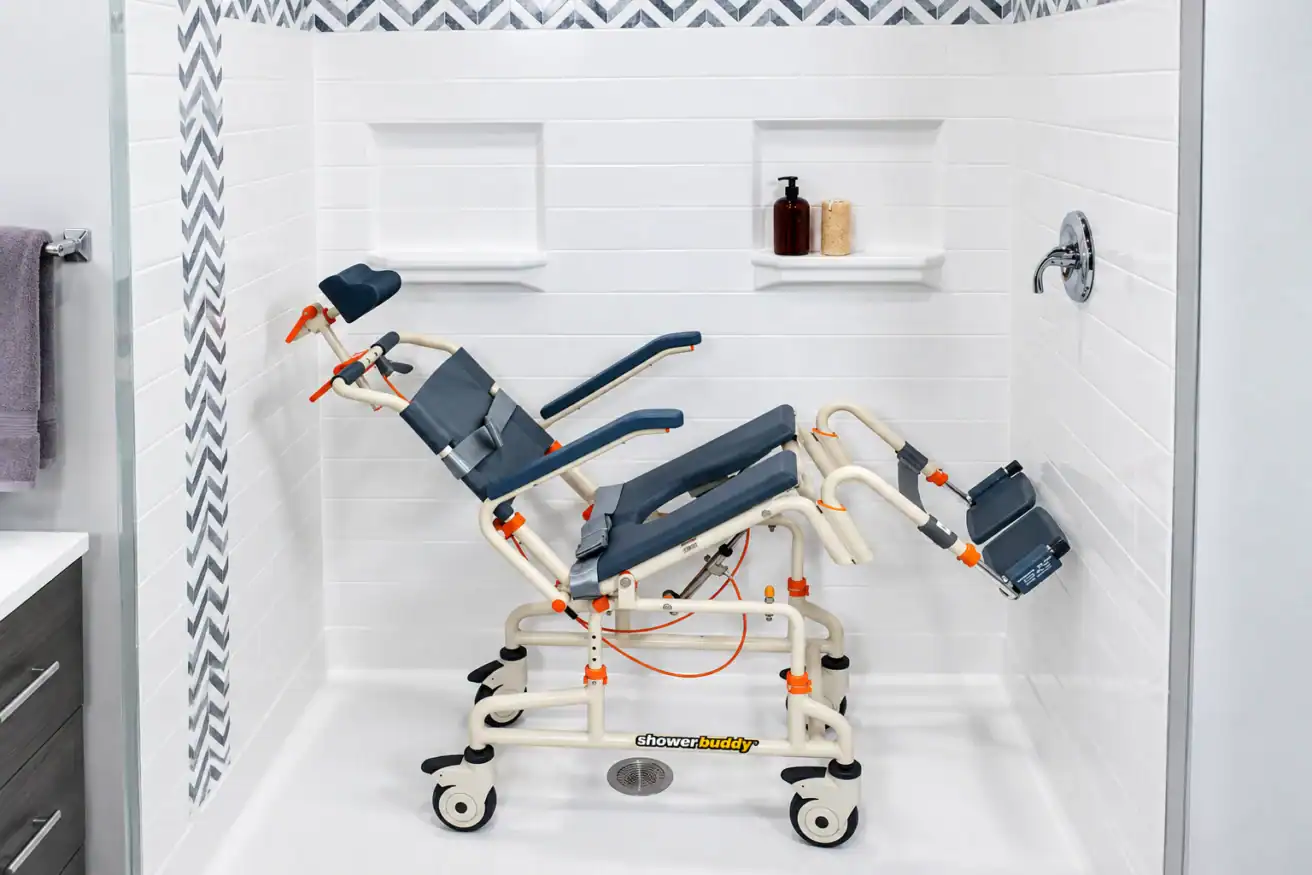
The Roll-In Shower Buddy SB3-T has roll-in shower bench features. It can also roll over a shower curtain and shower controls to roll into a roll-in shower. It also has four locking caster wheels and can be adjusted to various heights. Like other rolling seats, it can also be modified to take a tilt and offer other controls to the user.
I pay less attention to whether the Shower Buddy chair fits in the available space in a room and more attention to whether the chair rolls easily and is functional.
- Can the chair roll through the bathroom door?
- Can it roll close enough to the toilet for a seat-to-stand or stand-to-sit transfer?
- Is the shower stall large enough for the entire chair to roll in?
- Can the caregiver move with the chair?
- Can the chair easily roll and turn to the various areas of the bathroom?
Rolling systems are effective in facilitating transfers when the environment supports it.
If there are restrictions, like a shower threshold, a tub wall, or a door and fixture combination which blocks a path, then the SB3-T is of no use.
Rolling systems are less effective compared to the ShowerGlyde SG-3.
In such cases, it would be judicious to look at the bathing area for potential solutions rather than using a rolling system and an additional device.
The Bestbath Multi-Piece Accessible Shower is one solution for modifying the bathing area.
Thresholds range from 0.75″ to 2″ in various designs.
Depending on the drain, direction of entry, and configuration of the bathroom, thresholds can help us design an accessible shower in Gretna.
Replacing a shower, however, is a larger project.
I wouldn’t recommend changing the shower for the sake of a better accessible design.
There may be cases, however, where the best solution to a functional movement of a shower is to use an SG-3 or other similar equipment.
If the best solution to functional movement of a shower requires the use of various pieces of equipment and the shower still is not usable, then it may be justified to make the larger alteration to the shower.
What Happens after It’s Installed?
After equipment is installed or brought to the location, we will observe how the client is transferred to the shower to determine the functional movement of the equipment.
Was the equipment effective in achieving the desired movement?
Was the equipment creating a barrier to functional movement?
If the equipment is not adequate to achieve the movement and transfer to the shower, what adjustments or equipment is available to help achieve the movement?
What if the transferred user is not adequately positioned once equipment is used to achieve the movement?
If the user is not adequately positioned, what adjustments or equipment is available to help achieve positioning?
I will show the family the full transfer process, not just the product controls.
Once product installation is complete, our service and support team is always available to assist with answering product-use related queries, and to perform preventive-maintenance and repair tasks on the accessibility-related products.
If you are in Gretna, Marrero, Harvey or Westwego and wish to know the best possible solution for a small bathroom shower transfer, then kindly schedule a free in-home consultation. We will assess the transfer path, caregiver workspace and the bathroom-occupant’s desired showering position to determine the best functional solution.
What are the best Shower Transfer Options for small bathrooms?
What is the major difference between the ShowerGlyde SG-3 and a Rolling Shower Chair?
In general, a rolling shower chair is more convenient when the caregiver has to transfer the occupant across the bathroom, and into an appropriate accessible shower. The best solution depends on available space, and the caregiver’s workspace.
Is the ShowerGlyde SG-3 an ideal product for small bathrooms?
Yes. For small bathrooms, the ShowerGlyde SG-3 may work well. However, the adjacent workspace and transfer routes must also be assessed.
Does the Roll-In Shower Buddy SB3-T work with an In-Shower Curtain?
The Roll-In Shower Buddy SB3-T is designed for roll-in showers. I will assess the caregiver’s workspace to determine if the roll-in shower chair is able to fulfill the required functional bathroom task.
Can a rolling shower chair go over a toilet?
The Roll-In Shower Buddy SB3-T can roll over most standard toilets. Factors such as the shape of the toilet, the clearance of the room, and the chair set up should be evaluated, in addition to the bathroom layout.
When should I be consider changing showers instead of using aids for transfer?
I would recommend changing the shower to be more accessible if the bathtub/shower is blocking the only means of safe and adequate transfer. Prior to making this change, I would evaluate the placement of other fixtures, the clearance through doorways, and the space available to caregivers.
How do I determine what type of equipment I need to help with shower transfers?
First, determine the clearances through doorways and the relationships of other fixtures. Then, consider the space required for caregiver support and the transfer direction. Next, determine the layout of the bathing area. Based on this information I can advise on what type of equipment to use, or recommend a more extensive shower change.
About the Author
Jonas Boutte is the owner of 101 Mobility of South Louisiana and has hands-on training from mobility and accessibility manufacturers including Bruno, Harmar, Stiltz, Staying Home, EZ-ACCESS, National Ramp, and others. He helps families throughout Greater New Orleans evaluate bathroom-accessibility and transfer solutions based on the home layout, caregiver needs, transfer routine, and long-term plans.