Wheelchair Ramp Installation in Baton Rouge: What to Expect
Our first step to installing a wheelchair ramp in Baton Rouge is to determine how the individual currently gets from the driveway or sidewalk to the entrance. We look at the type of mobility equipment used, how the door works, and how much usable space the property provides. All of these determine the type of ramp needed and the route it takes.
At 101 Mobility of Baton Rouge, I try to match the ramp to the route you currently use to enter and leave your home.
This starts with determining the ramp’s route, not choosing a ramp from a catalog.
What Happens During the Free Ramp Consultation?
During a ramp consultation, I like to understand your entire trip to enter your house. I want to know where your trip begins.
Do you take a car to your destination? If so, where do you park?
I am also interested in the route you take if you arrive from a sidewalk or driveway. How do you get from there to the entrance?
Once I understand that, I look at the mobility equipment you use. Each piece of equipment can change how much space the route requires.
Of course, the entrance can also limit how long the route can be. I look at the door, landing, threshold, and surrounding space. Not all of the usable space on the property is a good candidate for the ramp route.
This process is similar for families looking at wheelchair ramps in Baton Rouge, Denham Springs, Zachary, and Prairieville, LA. Each house has a unique layout, so recommendations are based on the exact location.
You also get a free consultation to help you explain your situation.
Maybe the need is because a front step has become too much for a wheelchair user to manage.
Maybe a gradual ascent is needed for a doorway to accommodate a person who uses a walker.
Maybe the need is only temporary, and you don’t want to make a permanent change to the structure.
Different situations can also suggest the type of ramp needed.
What Types of Wheelchair Ramps are Available?
Each home has different challenges, and not every ramp fits every situation. 101 Mobility offers several options, and the best category largely depends on the height being crossed, the path, and the mobility device.
| Ramp Types | Typical Needs | Main Concerns |
|---|---|---|
| Threshold Ramp | Small transition at a doorway | Height of threshold and approach to door |
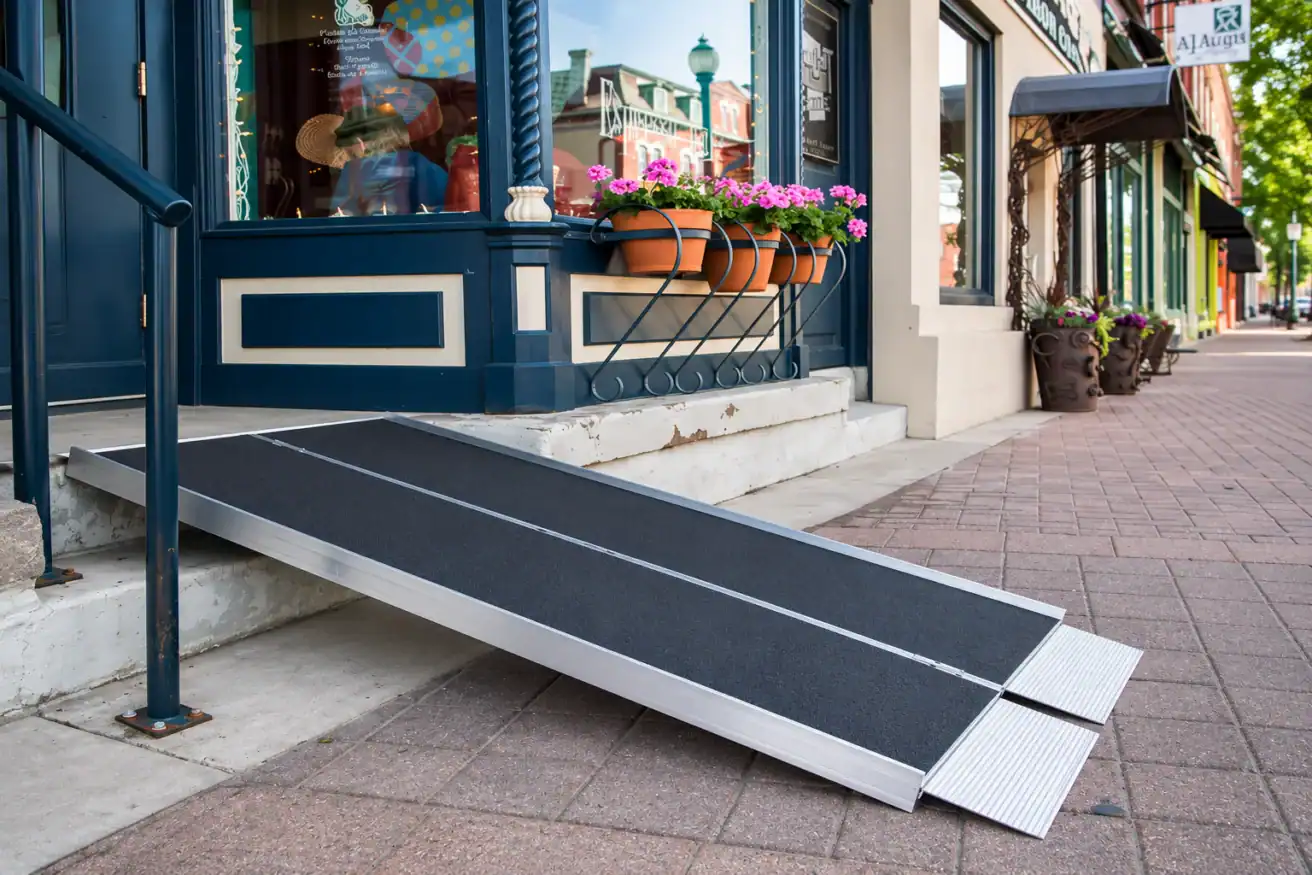
| Portable or Multi-Fold Ramp | Temporary access or a route where portability is a concern | Rise, ramp length, and mobility device |
| Modular Aluminum Ramp | Change in elevation of the home with steps | Landings, turns, and the approach to a doorway |
A threshold ramp is a completely different solution compared to a modular system.
If the only barrier at the doorway is a small lip, a modular ramp of this length would probably be overdesigned for the situation.
Portable and multi-fold ramps can be good options when portability or temporary use matters, but they still need to match the entrance and mobility device.
Aluminum modular ramps are designed for larger entryways. The system uses different sections and elements to create a route that fits the property.
What about the simpler ramps? I recommend these when they adequately solve the issue.
How Does 101 Mobility Decide Where the Ramp Goes?
Choosing the route is not as simple as pointing from the ground to the front door.
First, I consider the rise. This is the elevation that the route has to overcome.
Next, I consider the usable path.
Usable path can be affected by many things, including:
· The configuration of the driveway and sidewalks
· Landscaping
· Parking and
· The configuration of the porch
· Existing stairs and the door
· Upper and Lower landing space
· Other members of the household and the way they use the entrance
Door swing is also very important.
Ramps can achieve the required elevation, but if the wheelchair user does not have clear approach space to the door, the ramp can still make an awkward entrance.
Sometimes the most obvious route is not the best route.
One entrance may have a better configuration than the other. During the consultation, we can evaluate the options available and determine where the equipment should be placed.
I’m not going to turn that conversation into a construction lesson.
The focus for the family is to understand why the planned path works best for the individual, the mobility device, and the house.
What Does Professional Ramp Installation Involve?
Once the ramp design is finalized, the construction phase turns the planned path into an actual pathway.
A modular aluminum system is quick and easy to construct. Contractors assemble the ramp in sections, connecting them to a system of supports and other components.
Based on the entrance, the route may have turns and bends, and may include platforms and rails.
After the route is determined and constructed, it is checked to see whether it reaches the intended landing.
Is the pathway obstructing other households from using the space as planned?
Does the route allow the person using the mobility device to reach the entrance?
Grant’s brief is accurate in stating that every wheelchair ramp installation doesn’t take the same number of hours or days.
A small, simple project does not take as long as a large, complex one.
The schedule should be based on the system and the property, not an estimated schedule from a different project.
What is Included Beyond the Physical Ramp?
The contractor’s job is not complete once the last piece of the ramp has been installed.
Customers must be able to visualize the route created.
As I continue to build routes, I gain a better understanding of what elements make up a route and what aids help users transition through it to their destination.
People using the route should understand the use of turn and/or platform elements.
This walk-through also highlights practical concerns that may not be apparent to users if the focus remains on the ramp alone.
- What will be the route to the door?
- Does the door function as expected?
- Is there a clear path from the vehicle to the house?
- Will the route be clear to the caregiver who is assisting the user?
The finished product is the complete access route, not just the aluminum ramp under the wheelchair.
What Happens After Installation?
The modular ramp becomes part of the house, and so questions may arise later.
The family may have questions about the equipment. The family’s needs may change over time. Circumstances may require altering elements of the modular system.
101 Mobility offers service and support for the equipment it installs.
It is important to maintain a relationship with the local provider. You never know when you will need to contact them for equipment-related concerns.
Many of the modular systems offer flexibility and can be altered to suit new requirements.
Sometimes flexibility helps with temporary mobility needs, a change in occupants, or future changes to the property.
How Do I Understand the Cost of Wheelchair Ramp Installation?
The cost of a wheelchair ramp typically depends on the distance, configuration, type, and the property it serves.
A simple threshold ramp differs from a modular aluminum ramp that requires multiple sections and landings.
The biggest factors include distance, configuration, and the property it serves.
Rather than using a made-up sample project, I recommend using the wheelchair ramp pricing guide on the 101 Mobility website to learn about residential wheelchair ramp pricing.
Then we can measure the actual property.
In general, a price range is little help in determining the actual installed cost.
The right number for a family in Baton Rouge, Denham Springs, Zachary, or Prairieville is not what someone else’s ramp cost. The right number is what your entrance ramp will cost.
Frequently Asked Questions
Can a ramp go over front steps?
A ramp can provide an accessible route over an entrance with front steps, based on available space and the rise of the steps. The ramp should be assessed along with the rest of the entry to ensure it provides an accessible route to the rest of the entry in use, including the doorway and landings.
Is a portable ramp the right solution for every situation?
Not necessarily. There are a number of factors to consider in addition to the height of the step or threshold, the length of the ramp required, the wheelchair, how the wheelchair is approached, and how the ramp will be used. Entrance requirements may warrant a threshold, portable ramp, or modular ramp.
What is a modular wheelchair ramp?
A modular wheelchair ramp is a ramp system built from manufactured components. It can be configured to accommodate platforms, turns, and various lengths and used to provide access to a residential entry. Modular aluminum systems are the most widely used wheelchair ramp systems for overcoming thresholds and providing access over steps and other obstacles beyond the scope of a small portable ramp.
Can a modular wheelchair ramp be removed?
Yes, a modular aluminum wheelchair ramp can be removed and reconfigured as necessary. This flexibility makes these systems the most used when a family does not want to construct a permanent wheelchair ramp on their property.
Do I need a large yard to construct a wheelchair ramp?
Not necessarily. The more relevant issue is whether the property has adequate usable space for the required ramp route. A ramp may include turns and landings, but the route still needs to be assessed with the door and threshold clearance, other property constraints, and the accessibility of the driveway and walkways.
Who should I talk to about wheelchair ramp options?
101 Mobility has a team of Accessibility Specialists who, during a free in-home consultation, can look at the entrance and determine the best ramp type for the situation. We consider the ramp user, the type and size of the wheelchair or mobility device, the clear path length, the doorway, and how the family uses the ramp.
For wheelchair ramp installations in the Baton Rouge area, contact us to discuss your options and determine the right ramp type. We offer free consultations to evaluate your mobility device, measure the space, and identify the best ramp route.
About the Author
Jonas Boutte is the owner of 101 Mobility of South Louisiana. He has hands-on training from accessibility equipment manufacturers like Bruno, Harmar, Stiltz, Staying Home, EZ-ACCESS, National Ramp, etc. He is actively involved in the Baton Rouge community, helping assess ramp and accessibility solutions and assisting with equipment selection, ramp route evaluation, installation and training, and follow-up support.