Storm Evacuation With a Scooter or Power Chair: How I Plan the Route in New Orleans
To prepare for a hurricane evacuation, I take my mobility scooter on a trial run. I test the route from scooter, to transportation, to loading, and finally to the destination. A mobility scooter or power chair isn’t very useful if it can’t be loaded and transported to the family. There are a number of factors that affect the success of transporting this equipment.
This process is more about mobility than it is about hurricane or emergency planning. For up to date information regarding evacuation orders and plans regarding hurricanes in the New Orleans area, follow NOLA Ready.
Through 101 Mobility of New Orleans, I examine equipment routes for people using mobility scooters, power chairs, or other similar equipment in the New Orleans, Metairie, Kenner, Chalmette, and Slidell areas prior to transport being necessary. The process starts where the equipment is normally located, and ends with it being loaded for transport.
| Route Step | Purpose |
|---|---|
| Equipment Parking Location | Equipment is charged and located for convenient access |
| First Doorway | Is the doorway wide enough for equipment to pass through? |
| Path to Vehicle | Are there obstacles that would prevent equipment from taking a straightforward route to the transportation vehicle? |
| Transportation Vehicle | Is there enough space for an equipment loading system to be employed? |
| Destination | Is equipment loaded for transportation and is it located for convenient access? |
Equipment is charged and prepared for transport prior to hurricane arrival.
Equipment is charged for transport before the storm for what is typically a post-hurricane evacuation process.
Scooters and power chairs should be situated by the family’s stake so it is charging automatically and not in the way.
I expect the evacuation path for my mobility device to be clear and to not require the moving of furniture or boxes to reach it. The same is expected of power chairs.
The Pride Go Chair can be disassembled, and according to the manufacturer, its width and length with the front rigging is 33 inches and 25.5 inches, respectively.
These dimensions can be taken into account when planning a route to charge the device, but the more pertinent factor is the path from the charging location to the transport vehicle.
Can the chair pass through doorways?
Are there obstacles in the path?
Does the mobility device have the clearance to make a required turn?
Where is the best location to disassemble the device?
Even if a device is charged and ready to go, it does not mean it is easily transported.
Prior Knowledge of Lifting and Clearance
It is better to determine the lift’s clearance and the place where the vehicle will be positioned before a storm, if at all possible.
This is especially true if the lift lowers in a driveway or garage.
The Bruno Out-Sider lift allows users of certain mobility devices to access higher levels. Mobility devices, like power wheelchairs and scooters, can be equipped with this lift to provide access similar to the Bruno lift. According to 101 Mobility, the Out-Sider can be installed on a receiver hitch with a Class II or III rating and can accommodate mobility devices up to 350 lbs. and has a 28.5-inch wide platform.
101 Mobility also notes that in the absence of powered operation, the Out-Sider can be lowered using a manual crank located on the rear of the platform.
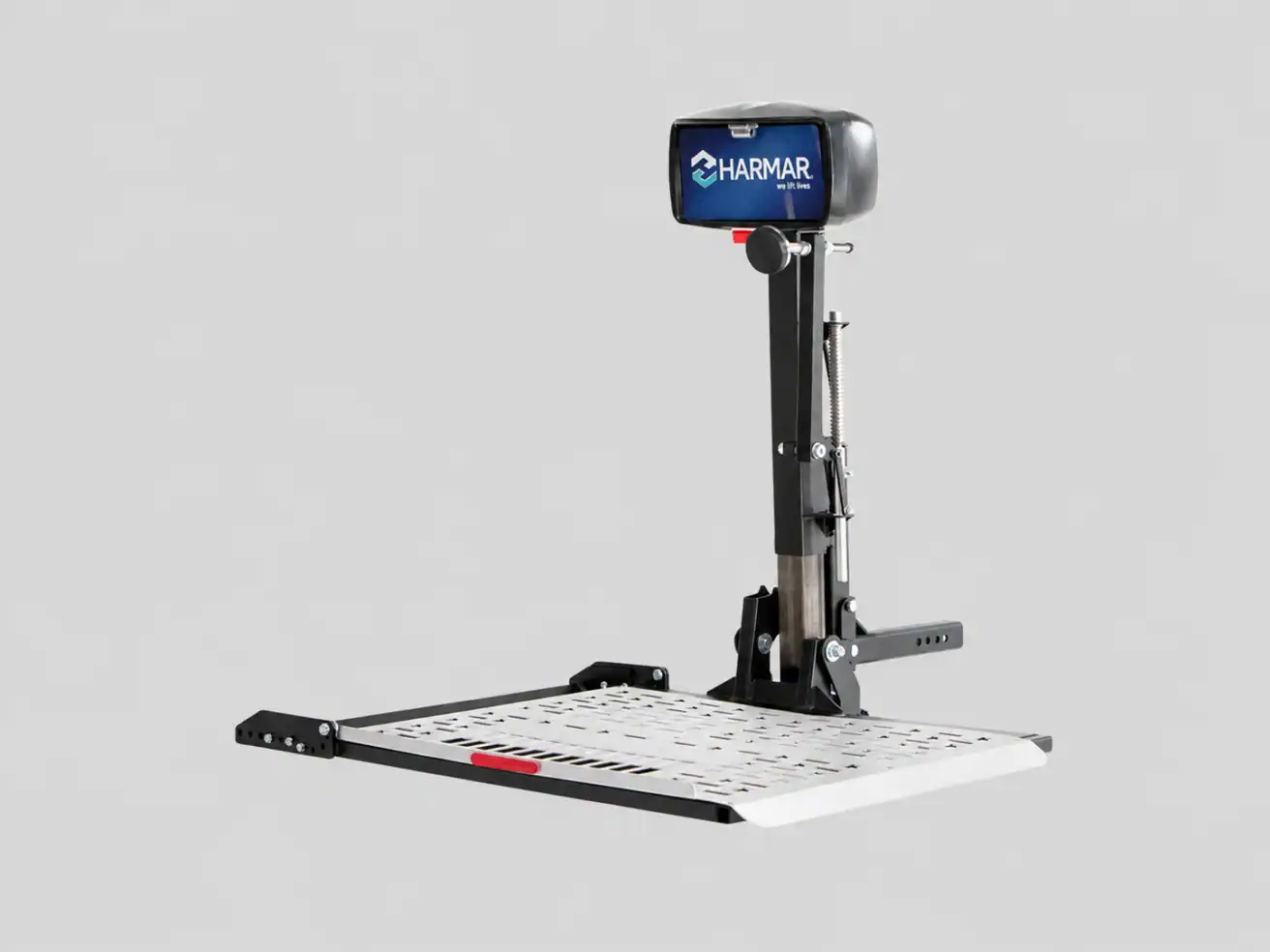
Harmar, Inc., offers another external-platform vehicle lift, the Harmar AL100/AL100HD. Both models have a 27.5-inch by 39-inch platform. The AL100 is rated up to 350 lbs. and the AL100HD is rated up to 400 lbs. Like the Out-Sider, these models also have a manual crank located on the rear of the platform as a backup.
Preparation is still essential for the use of these lifts.
When creating a storm plan to transport a mobility device using a vehicle lift, I consider the following:
- Exactly which mobility device will be transported?
- Which vehicle will be used and in what configuration is the hitch?
- Where on a lift will the mobility device be parked?
- What is the clearance required to lift the platform?
- How does the mobility device interface with the vehicle lift?
- Is the family who will be operating the vehicle during the transport familiar with the operation of the vehicle lift?
- Are there controls on the vehicle that appear to modify the function of the lift?
Like the Bruno Lifts, the Out-Sider and AL100 series lifts can only be employed on certain vehicles.
I do not recommend using an evacuation lift system that has not been tested on the vehicle and with the mobility device.
If using a vehicle with a lift to transport a mobility device, I would evaluate other available options first.
What Else Moves With the Mobility Device?
In addition to the mobility device, what do families need to identify the items that the device depends on and that also travel with the family?
Examples of these items are:
- The correct charger to be used with the scooter or power chair
- Charging accessories provided by the manufacturer
- Control accessories provided by the manufacturer
- Other accessories that help with the operation of the mobility device
- User manuals and product information
- Contact information to report and get service on the equipment
- A personal travel data (PTD) item if it is used by the family on a normal basis
What is on the above lists will vary with what mobility equipment is used by the family.
It is not advisable to develop a standard emergency accessory kit to be used with all mobility devices used by a family.
The above equipment is to be evaluated to understand what is needed to operate the equipment for an extended period of time to be away from the equipment’s normal charging location.
This is particularly relevant to the situation with power chairs that are normally located and used within the house.
A power chair that is normally disassembled and stored within the house would have to be transported to and used in a similar manner outside of the house during the course of an evacuation.
A power chair that has been used for transport is not to be assumed to be operational for the purposes of use at the final destination.
What to Inspect prior to Equipment Use After It Has Come Into Contact With Water or other Contaminants
Before operating any piece of equipment, inspect it for visual irregularities. Debris can indicate looseness or malfunction of nearby components and controls, and damaged insulation can indicate shorts and arcing. Water can reach internal components of the equipment and cause corrosion; the presence of corroded components can indicate malfunction. If you see something that makes you uncomfortable about the condition of the equipment, do not attempt to repair it.
Vehicle lifts also need to be inspected and tested. A control or a component of a lifting assembly could be damaged but the vehicle lift platform could still be raised or lowered.
When equipment does not function as intended, do not attempt to use the equipment.
For mobility equipment, I assess only the equipment and how it is transported.
What happens after a trip? The equipment is checked and service contacts are made.
After a trip, I check the equipment route to determine if anything is amiss. Was a component of the mobility equipment, such as a charger, a lift, or a chair, functioning as intended? Was something loose before or did something collect debris? Was something difficult to load? Anything that increased the difficulty of loading the equipment should also be addressed.
Once your mobility equipment has been installed, the 101 Mobility team is available to provide service and support with maintenance and equipment-related questions. We also provide repair services.
Do you have trouble accessing your vehicle? We offer a free in-home consultation to assist you. During these consultations, we will assess your power chair or scooter, the doorways of your home and your vehicle, and the equipment that is used to transport you and your mobility device.
Frequently Asked Questions (FAQ) about Power Chair and Scooter Storm Evacuations
Should scooters and power chairs be charged prior to a hurricane?
Prior to a storm, it’s a good idea to fully charge your mobility device. You will want to make sure the charged device can be transported to the vehicle over the normal route.
Should a practice evacuation of the mobility device be conducted?
Prior to a storm it’s a good idea to practice a complete evacuation of your mobility device to identify any issues with the device, controls, vehicle, or the route to the lift.
What is the minimum clearance required for a vehicle lift?
Minimum clearance required for a vehicle lift to be used for the transport of a power chair or scooter will vary based on several factors including the type of lift, the power chair or scooter, and the surface the lift is used to load the power chair or scooter. The best way to evaluate this clearance is to determine what the clearance will be behind the vehicle.
What can I bring with my scooter or power chair on the plane?
You are allowed to bring any item that helps you use your power chair or scooter. This can include the charger, control or keys, accessories, or any other information or equipment related to your power chair or scooter.
Can I use my scooter or power chair after it comes in contact with water or debris?
Just because water or debris do not permanently damage your power chair or scooter, it does not mean there is not something wrong. Water and debris can damage your chair in a way that is not apparent to you. If you see changes to your chair, do not use it and have it serviced.
How can I find out about hurricane evacuations for New Orleans?
NOLA Ready and the City of New Orleans’ website both have Hurricane evacuation information. 101 Mobility can only assist you with your mobility and transport needs within a certain limit. Hurricane evacuation information, orders and transportation assistance are provided by other organizations.
About the Author
Jonas Boutte is the owner of 101 Mobility of South Louisiana and has hands-on training from accessibility-equipment manufacturers including Bruno, Harmar, Stiltz, Staying Home, EZ-ACCESS, National Ramp, and others. He helps families throughout Greater New Orleans evaluate mobility equipment, vehicle lifts, ramps, stairlifts, and other accessibility solutions based on the person, property, vehicle, and daily route.