Quick Takeaways:
- If your parent qualifies as your dependent for medical expense purposes, medical equipment for them may be a qualified expense for your HSA or FSA. FSA claims are reviewed by your plan administrator; with an HSA, you’re responsible for keeping records that show the expense qualified.
- Stairlifts, ramps, and bath safety equipment are often eligible when supported by a letter of medical necessity. Eligibility depends on your plan and how the expense is documented.
- Permanent modifications are treated as capital expenses: you count the cost minus any increase in home value, and ramps and similar work typically add none. Confirm this with your plan administrator or tax professional.
- You will need an itemized invoice that separates equipment from installation labor.
If your parent meets the IRS medical expense dependent test, you may be able to use your HSA or FSA for their mobility equipment, provided that the purchase is properly documented as medically necessary. Stairlifts, ramps, and bathroom safety modifications may qualify under HSA and FSA rules, depending on your plan’s documentation requirements.
There are three things that decide whether money actually comes back to you: which dependent test applies, how the IRS handles a permanent change to a house, and what your installer should put on the invoice so your FSA administrator can approve the claim, or so your HSA records will hold up if the IRS asks.
Below you’ll find a clear path, including information on financing for home mobility products that can help to cover whatever your accounts do not.
Can you use an HSA or FSA for a parent’s mobility equipment?
Yes, with two conditions. Your parent has to meet the IRS dependent test for medical expenses, and the purchase has to be substantiated as medically necessary. Both HSA and FSA plans draw their eligibility definitions from the same source, IRS Publication 502, so an item that qualifies for one generally qualifies for the other.
The question most caregivers have is whose account does it come from? The answer is, it comes from yours. You are the account holder, your parent is the person the equipment is for, and that arrangement is allowed.
Does your parent have to be your dependent?
They have to qualify as your dependent for medical expense purposes, which is a looser standard than claiming them on your tax return. Publication 502 lets you include someone’s medical expenses if they would qualify as your dependent except for the gross income test or the joint return test.
That exception does a lot of work. A parent whose Social Security and pension income puts them well above the usual dependent income threshold can still qualify, provided you supply more than half of their support for the year. Support includes what you spend on their housing, food, and care, which for a parent living in your home adds up fast. Keep in mind that any of your parent’s own income they spend on their own living costs counts as support they provided, so a parent with substantial Social Security or pension income may still be covering more than half of their own support. Run your specific situation past a tax professional before you submit, since the support calculation is where these claims get challenged.
What mobility equipment counts as HSA-eligible medical equipment?
Most permanent accessibility equipment qualifies when a physician documents the need. The table below covers what caregivers ask about most, and what your plan will usually want alongside the receipt.
| Equipment | Typically eligible | Usual substantiation |
|---|---|---|
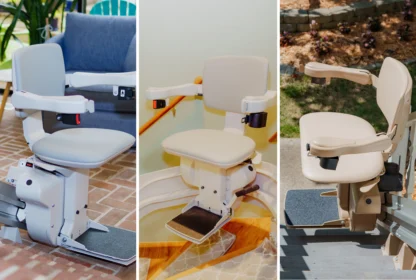
| Stairlifts, straight or curved | Yes | Letter of medical necessity, itemized invoice |
| Wheelchair ramps | Yes | Letter of medical necessity, itemized invoice |
| Vertical platform lifts | Yes | Letter of medical necessity, capital expense worksheet |
| Grab bars and bath safety | Yes | Letter of medical necessity for larger modifications |
| Automatic door openers | Usually | Letter of medical necessity tying it to the diagnosis |
| Lift chairs | Usually | Letter of medical necessity; some plans want a prescription |
| Cosmetic upgrades chosen alongside | No | Not reimbursable; keep them off the medical invoice |
Installation labor is typically covered along with the equipment when both are part of the same medically necessary modification. That is why stairlifts are usually approved as a single line of reasoning rather than a product purchase plus a separate home improvement project.
Why does the IRS treat a stairlift differently from a home remodel?
Anything permanently attached to the house is a capital expense, and the rule for capital expenses is the cost minus any increase in the home’s value. Only the difference counts as a medical expense. Publication 502 names entrance and exit ramps, widened doorways, grab bars, porch lifts, and similar accessibility work as improvements that ordinarily do not increase a home’s value. When that is true, the entire cost counts.
Operating and maintenance costs on a qualifying modification count too, for as long as the modification is medically necessary. If you are also looking at the deduction side of this, whether a stairlift is tax deductible follows the same capital expense logic. Just note that you can’t use both benefits for the same dollars: any amount paid from an HSA or FSA can’t also be claimed as an itemized medical deduction.
What paperwork does your plan need for HSA eligible medical equipment?
These four items cover what an FSA administrator typically asks for, and they’re the same records you should keep on file if you’re paying from an HSA.
- A letter of medical necessity from your parent’s physician, naming the diagnosis, the functional limitation, and the specific equipment. Generic letters get rejected.
- An itemized invoice that separates equipment cost from installation labor, with the model installed named on it.
- Proof of payment showing you paid, not your parent, if the funds are coming from your account.
- A capital expense worksheet, if your administrator requires one for permanent modifications.
Item two is the one to handle before the work starts. A lump-sum contract that reads “stairlift installed, $4,800” gives the FSA administrator nothing to evaluate, leaves your HSA records thin, and getting a revised invoice after the fact takes longer than asking for the right format up front. Ask your local 101 Mobility team to itemize the quote when they write it.
If your accounts will not cover the full cost, the gap is usually closed with a grant, a state program, or a payment plan. Our guide to how to pay for ADA home modifications walks through those options, and the stairlift pricing guide gives you a real number to plan a contribution against.
Should you use the FSA or the HSA first?
Most people have one or the other. If you or your spouse has a general-purpose health FSA, you generally can’t contribute to an HSA that year, though you can still spend any HSA balance you built up in earlier years. If you’re in that situation, using FSA dollars first usually makes sense, because they expire and HSA dollars don’t. If your employer offers a limited-purpose FSA alongside your HSA, check its rules: those typically cover only dental and vision expenses until you’ve met your health plan’s deductible. Also note that an HSA can only be used for expenses incurred after the account was opened.
| FSA | HSA | |
|---|---|---|
| Unused funds | Forfeited at plan year end, with limited grace or carryover | Roll over indefinitely |
| Funds available | Full annual election available from day one | Only what you have contributed so far |
| If you change jobs | Generally ends with employment | Yours, it goes with you |
| Plan requirement | Employer-offered | Requires an HSA-eligible health plan to contribute; existing funds can be spent anytime |
That second row matters more than it looks when a parent is being discharged in two weeks. An FSA hands you the whole annual election on he first day of your plan year, which means a ramp can be funded in full a few weeks from an account you have barely paid into.
Frequently Asked Questions
Can I use my HSA for my mom’s stairlift if she lives with me?
Usually yes. Living with you strengthens the support calculation that the dependent test turns on, since her housing costs become part of what you provide. You still need the letter of medical necessity and an itemized invoice, and the stairlift is treated as a permanent modification rather than a product purchase.
Can I use my FSA for a parent’s mobility equipment if I do not claim them on my taxes?
Often, yes. The medical expense rules use a modified dependent test that ignores the gross income limit and the joint return requirement. So a parent you cannot claim as a dependent because of their retirement income may still qualify for this purpose, as long as you provide more than half their support.
Does a parent’s mobility equipment need a prescription to be HSA eligible?
A prescription is not always required, but a letter of medical necessity almost always is for anything attached to the house. Some FSA administrators accept a prescription in its place for portable items like a lift chair. Ask yours which form they want before the physician writes anything, so you only ask once. If you’re paying from an HSA, keep the letter with your records in case the IRS asks.
Can I use HSA funds for a ramp installed on my house rather than my parent’s?
Yes, when the ramp exists because of your parent’s condition and they qualify as your dependent for medical expense purposes. The location of the modification does not disqualify it. The capital expense rule still applies, so the reimbursable amount is the cost minus any increase in your home’s value, which for a ramp is typically zero.
Can I use my FSA and my HSA for the same purchase?
Usually not, because having a general-purpose health FSA generally makes you ineligible to contribute to an HSA. The exception is if you have HSA money left from earlier years. In that case you can split the cost, but never apply both accounts to the same dollar. Keep separate records for each, and don’t submit to your FSA any amount you’ve already paid from your HSA.
What should you do before your plan year closes?
Three moves, in sequence. Ask your parent’s physician for a letter of medical necessity that names the equipment. Get an itemized quote that separates equipment from labor. Submit both with proof of payment to your FSA as soon as the work is done, or file them with your HSA records.
| Your local 101 Mobility team is locally owned and operated. We live and work right where you do. We install your equipment, then prepare an invoice for your FSA claim or HSA records. When you request your quote, ask for it to be itemized. You’ll see exactly what you’re paying for.Schedule a free in-home consultation and get a quote your benefits accounts can work with. |