Fall Prevention Walkthrough in Baton Rouge: How I Use Bruno and Harmar Options
When I perform a fall prevention walkthrough in Baton Rouge, I don’t start by deciding which piece of equipment someone needs. I start by watching how that person actually moves through the home.
Which entrance do they use every day? Where do they hesitate? Are stairs becoming tiring? Is there a doorway threshold that catches a walker? Does getting into the shower require an awkward step or turn?
Those details tell me much more than a generic checklist.
My goal is to identify mobility hazards, separate simple fixes from larger accessibility barriers, and determine whether products such as a Bruno Elan or Harmar Pinnacle stairlift, an EZ-ACCESS threshold ramp, or a bathroom-safety solution could make a frequently used route easier and safer.
For homeowners and families planning ahead, this type of walkthrough can also become an aging in place review that helps prioritize improvements over time.
What I Look for During a Fall Prevention Walkthrough in Baton Rouge
A fall-prevention walkthrough is a practical review of the routes, surfaces, transfers, elevation changes, and support points someone encounters throughout a normal day.
I typically look at:
- The entrance used most often
- Steps and doorway thresholds
- Interior staircases
- Bathroom transfers
- Bedroom-to-bathroom routes
- Lighting
- Rugs, cords, and furniture placement
- Changes between flooring surfaces
- Frequently used living areas
- The space needed for a walker, wheelchair, or caregiver
I also ask questions.
Has the person stopped using part of the house? Are they holding furniture for support? Do they avoid the stairs when no one else is home? Has a walker or wheelchair changed how they approach a doorway?
That information turns a home safety assessment in Baton Rouge into a plan based on real routines instead of assumptions.
I Start With the Entrance the Person Actually Uses
The front door isn’t always the most important entrance.
In Baton Rouge-area homes, I may find that someone enters through a garage, carport, side door, or back porch almost every day. That is the entrance I want to evaluate first.
I look at the entire sequence:
Vehicle → walking surface → step or ramp → landing → threshold → doorway → interior floor
A problem anywhere along that route can make the whole entrance difficult.
I check for things such as:
- Uneven walking surfaces
- Steps that are difficult to manage
- Limited landing space
- Slippery surfaces
- Doorways that are difficult to open while using a mobility device
- Raised thresholds
- Changes in surface height
- Insufficient room to turn or reposition
Sometimes the improvement is straightforward. Other times, a physical elevation change remains even after small hazards are addressed.
That is when I begin considering accessibility equipment for safer home access.
When I Consider an EZ-ACCESS Threshold Ramp
A small doorway rise can feel insignificant until someone is using a walker, wheelchair, or scooter.
If a threshold repeatedly interrupts an otherwise usable route, I may evaluate an EZ-ACCESS Transitions Modular Entry Ramp.
This type of solution is designed for relatively small changes in elevation at a doorway. The key is matching the ramp to the actual rise, available space, door movement, mobility device, and person using it.
I don’t treat every step as a threshold-ramp problem.
A larger elevation change may call for a longer wheelchair ramp, a modular ramp configuration, or another access solution altogether.
That is why measurements matter.
The question isn’t simply, “Can we put a ramp here?”
It is, “What creates a usable approach without introducing another difficult transition?”
What I Check on the Stairs
Interior stairs require a different type of review.
I first look for basic issues:
- Is the staircase well lit?
- Are the handrails secure?
- Are the stair surfaces stable?
- Is anything stored on the steps?
- Does the person carry laundry or other objects while climbing?
- Is getting on or off the staircase harder than climbing it?
- Does fatigue increase near the top?
- Has the person begun avoiding one floor of the house?
The CDC’s Check for Safety home checklist also encourages homeowners to address stair clutter, uneven steps, lighting, loose surfaces, and handrails.
Those basics matter.
But sometimes the staircase itself remains the barrier even after the surrounding hazards have been corrected.
If a person can sit down and transfer safely but climbing the stairs has become difficult, that is when I may start discussing a straight stairlift.
When the Bruno Elan May Fit the Plan
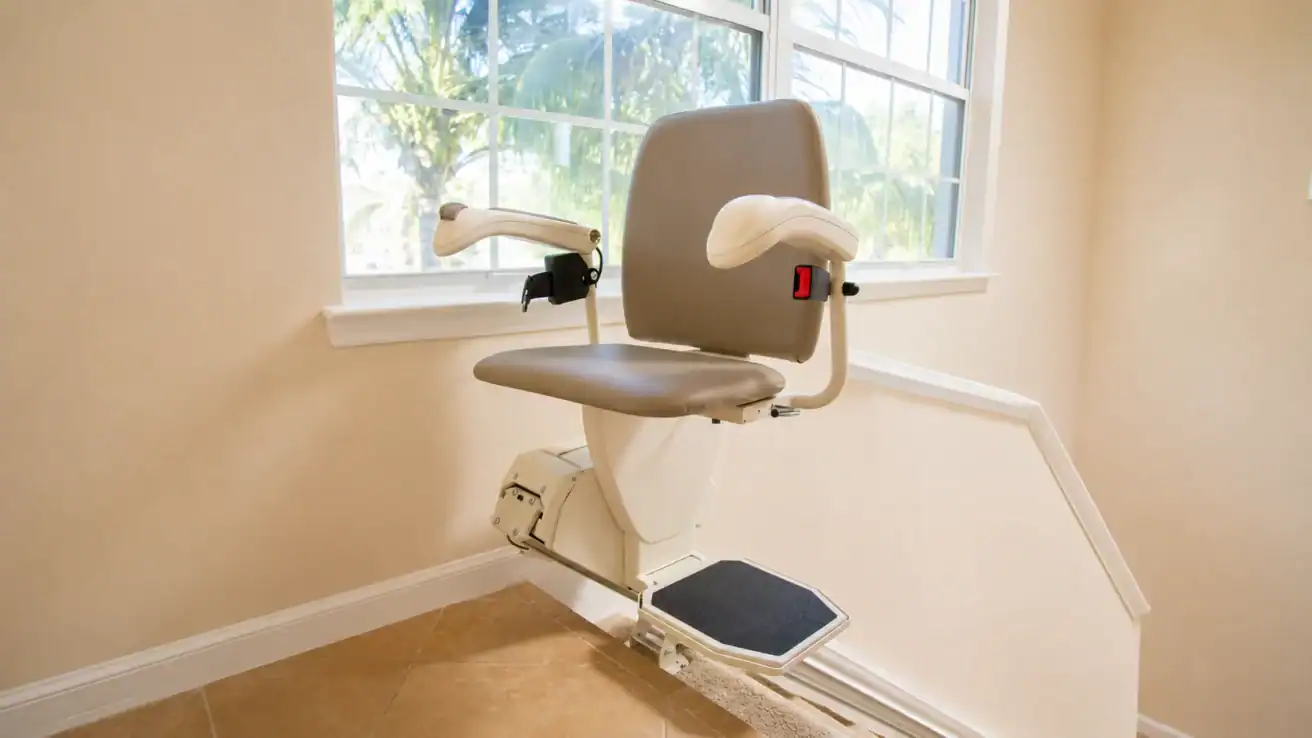
For a straight staircase, one option I may evaluate is the Bruno Elan Straight Rail Stairlift.
The Elan is designed specifically for straight stairways. Its seat, arms, and footrest can fold to help preserve stair space when the lift isn’t being used.
It is also battery operated, which means the lift can continue operating for a period during a household power outage.
For the right person and staircase, those characteristics can make it a practical option.
But product specifications are only part of the decision.
I still need to look at:
- Stair width
- Landing configuration
- Seat and transfer position
- User height and size
- Space required by other people using the stairs
- Doorways or hallways near the rail
- Current and anticipated mobility needs
I recommend the model only after determining that the overall setup works for the person and the home.
When I May Compare the Harmar Pinnacle
I may also compare the Harmar Pinnacle for a straight staircase.
The Pinnacle line includes multiple configurations, so it gives me different options to evaluate depending on the user, required capacity, available stair space, and other practical considerations.
I don’t approach the comparison as “Bruno versus Harmar” in isolation.
Instead, I ask which model better fits the complete situation.
| What I Compare | Why It Matters |
|---|---|
| Staircase dimensions | Determines whether the equipment fits without creating new access problems |
| User size and transfer needs | Helps determine seating and capacity requirements |
| Landing space | Affects safe boarding and exiting |
| Folded footprint | Matters when other family members still use the staircase |
| Nearby doors or hallways | May affect rail configuration |
| Long-term mobility plans | Helps avoid solving only today’s problem |
A stairlift is most useful when it fits naturally into the resident’s daily routine.
How I Review Bathrooms for Fall-Related Barriers
Bathrooms deserve close attention because they combine water, tight spaces, transfers, sitting, standing, and changes in direction.
I don’t just ask whether the bathroom has grab bars.
I look at the complete movement path.
Shower or Tub
Can the person approach the bathing area comfortably?
Do they have to step over a high edge?
Are they turning and stepping at the same time?
Would a seated transfer make the routine more manageable?
Toilet
Is standing back up becoming difficult?
Is support positioned where the user can actually reach it?
Is there enough room for a walker or caregiver?
Flooring
Are there loose rugs or slick areas?
Where does water tend to collect?
Does the person have a stable place to stand when drying off?
Lighting
Is the bathroom easy to see at night?
Are there shadows around the toilet, shower, or entry?
Depending on what I find, I may discuss bathroom safety solutions such as professionally installed grab bars, shower seating, transfer equipment, accessible shower options, or other modifications.
The product should support the transfer that is actually difficult.
I don’t want someone reaching across the room for a bar simply because that happened to be the easiest wall on which to install one.
I Check the Route From the Bedroom to the Bathroom
One of the most important routes in the house may only be used when someone is half awake.
I walk the route from the bed to the bathroom and look at:
- Lighting near the bed
- Nightlights or automatic lighting
- Throw rugs
- Electrical cords
- Furniture corners
- Narrow passages
- Floor transitions
- Mobility-device clearance
- The final bathroom entry
The CDC home checklist specifically calls attention to keeping a light within reach of the bed and improving visibility along the nighttime path to the bathroom.
These aren’t complicated changes, but they can remove unnecessary obstacles from a route someone may travel several times every night.
Living Room, Kitchen, and Everyday Movement Paths
A house does not need to look cluttered to have an awkward movement path.
Sometimes furniture placement requires repeated turns around a coffee table. A rug may shift under a walker. A cord may cross the shortest route to a favorite chair.
In the kitchen, frequently used items may be stored too high, encouraging unnecessary reaching or use of a step stool.
During the walkthrough, I pay attention to where the resident naturally wants to go.
If that path is blocked, narrow, uneven, or unnecessarily complicated, I look for a way to simplify it.
The best accessibility improvement is often the one that makes an ordinary daily task easier every single day.
How I Turn an Aging in Place Review Into Priorities
Not every recommendation needs to happen at once.
I usually think about improvements in three categories:
| Priority | Examples | Goal |
|---|---|---|
| Correct now | Loose rugs, clutter, poor lighting, unstable surfaces | Remove avoidable mobility hazards |
| Evaluate equipment | Difficult staircase, persistent threshold, challenging bathroom transfer | Address barriers that remain after simple corrections |
| Plan ahead | Future stair access, changing mobility needs, long-term bathroom accessibility | Support aging in place before the need becomes urgent |
This helps families focus first on the routes and barriers that affect everyday life.
It also keeps the conversation from becoming a shopping list.
A good plan should solve specific problems.
What a Home Safety Assessment in Baton Rouge Should Accomplish
A useful home safety assessment should leave you with a clear understanding of:
- Where movement is becoming difficult
- Which hazards can be corrected simply
- Which physical barriers may require accessibility equipment
- What should be addressed first
- What may be worth planning for later
At 101 Mobility of Baton Rouge & Lafayette, my role is to help connect those findings to practical accessibility options.
Sometimes that means a small threshold solution.
Sometimes it means comparing straight stairlifts such as the Bruno Elan and Harmar Pinnacle.
Sometimes the biggest improvement is in the bathroom.
And sometimes the best recommendation is simply to make a few changes before considering equipment at all.
The walkthrough helps us determine the difference.
Frequently Asked Questions
What happens during a fall prevention walkthrough in Baton Rouge?
I review the routes a resident uses during a typical day, including entrances, stairs, bathrooms, bedrooms, living spaces, lighting, thresholds, flooring, transfers, and mobility-device clearance. I then identify simple corrections, persistent accessibility barriers, and areas that may require further planning.
Does every mobility hazard require accessibility equipment?
No. Some problems may be addressed by removing clutter, improving lighting, securing flooring, rearranging furniture, or making other basic changes. I recommend equipment when a physical barrier remains and a specific accessibility product fits the person’s needs and the home’s layout.
How do I choose between a Bruno Elan and Harmar Pinnacle stairlift?
Both may be options for straight staircases, but the appropriate choice depends on the staircase dimensions, user requirements, transfer needs, capacity, available landing space, nearby doors, and long-term plans. I compare the installation and user needs before recommending a model.
When does an EZ-ACCESS threshold ramp make sense?
A threshold ramp may make sense when a relatively small rise at a doorway creates difficulty for a wheelchair, walker, scooter, or someone with limited step clearance. The rise, doorway configuration, available space, and mobility device should all be evaluated before choosing a ramp.
What should I look for in the bathroom?
Pay attention to shower or tub entry, toilet transfers, slippery surfaces, loose rugs, available support, lighting, turning space, and the room required for a caregiver or mobility device. The right solution depends on which part of the routine is difficult.
Can a walkthrough help if we’re planning ahead rather than solving an immediate problem?
Yes. An aging in place review can help identify which parts of the home are likely to become more difficult if mobility changes. That allows a family to prioritize current improvements while planning more substantial accessibility changes over time.
Book a Free Consultation
If you’re noticing a difficult threshold, an increasingly challenging staircase, an awkward bathroom transfer, or another mobility barrier at home, I can help you evaluate the complete route instead of guessing at a product.
Start with 101 Mobility of Baton Rouge & Lafayette to explore local accessibility options, or book a free consultation so we can review your home, your routine, and the solutions that may make everyday movement easier.
About the Author
Jonas Boutte is the owner of 101 Mobility of South Louisiana. He has hands-on training with leading accessibility manufacturers, including Bruno, Harmar, EZ-ACCESS, and others, and works directly with families to assess homes, recommend mobility solutions, coordinate installation, and support safer, more independent living.