Caring for Aging Parents at Home While Working Full-Time: A Practical Guide for Caregivers
You are keeping a job, managing your own household, and trying to make sure a parent is safe at home. What you probably do not have is a clear picture of which changes would actually reduce the daily friction, the calls mid-meeting, the weekend drives across town, the mental load of wondering if something has happened. That is what this guide is for.
Caring for aging parents at home while working full-time is something millions of people are doing right now, often without much of a playbook. The families who manage it best are not the ones doing more, they are the ones who have built a better-structured support system. This guide covers the practical components of that structure, starting with the home itself.
Why Caring for Aging Parents at Home Is Harder Than It Looks from the Outside
The challenge is rarely any single task. It is the accumulation of unpredictable demands on a schedule that has no margin for them. A parent who has a fall is not just a medical event; it is a disrupted workday, a panicked decision about next steps, and a weeks-long ripple of follow-up logistics.
Care gets harder when every task still lands on you. The goal is a safer home and a lighter routine. The structural approach looks different, and it starts with the home.
Start With the Home: What Modifications Make the Biggest Difference When Caring for Aging Parents at Home
The home environment is the variable most directly within your control. A parent who can navigate their own home safely, independently, and without daily assistance needs substantially less of your time than one who cannot. Home modifications are not about managing decline; they are about building a safer environment that extends independence and reduces the caregiving load simultaneously.
The categories of modification that deliver the most immediate impact for working caregivers:
Bathroom Safety
The bathroom is one of the most common places for falls at home, and it is typically the room that most urgently needs modification. Grab bars at the toilet and shower, a walk-in shower conversion or tub cut-out, and a shower bench reduce both fall risk and the daily anxiety of a parent navigating a slippery space alone. See the full breakdown at How to Improve Bathroom Safety for Your Aging Parent.
Stair Access
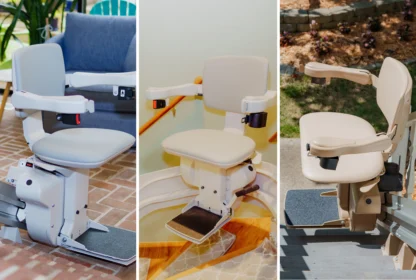
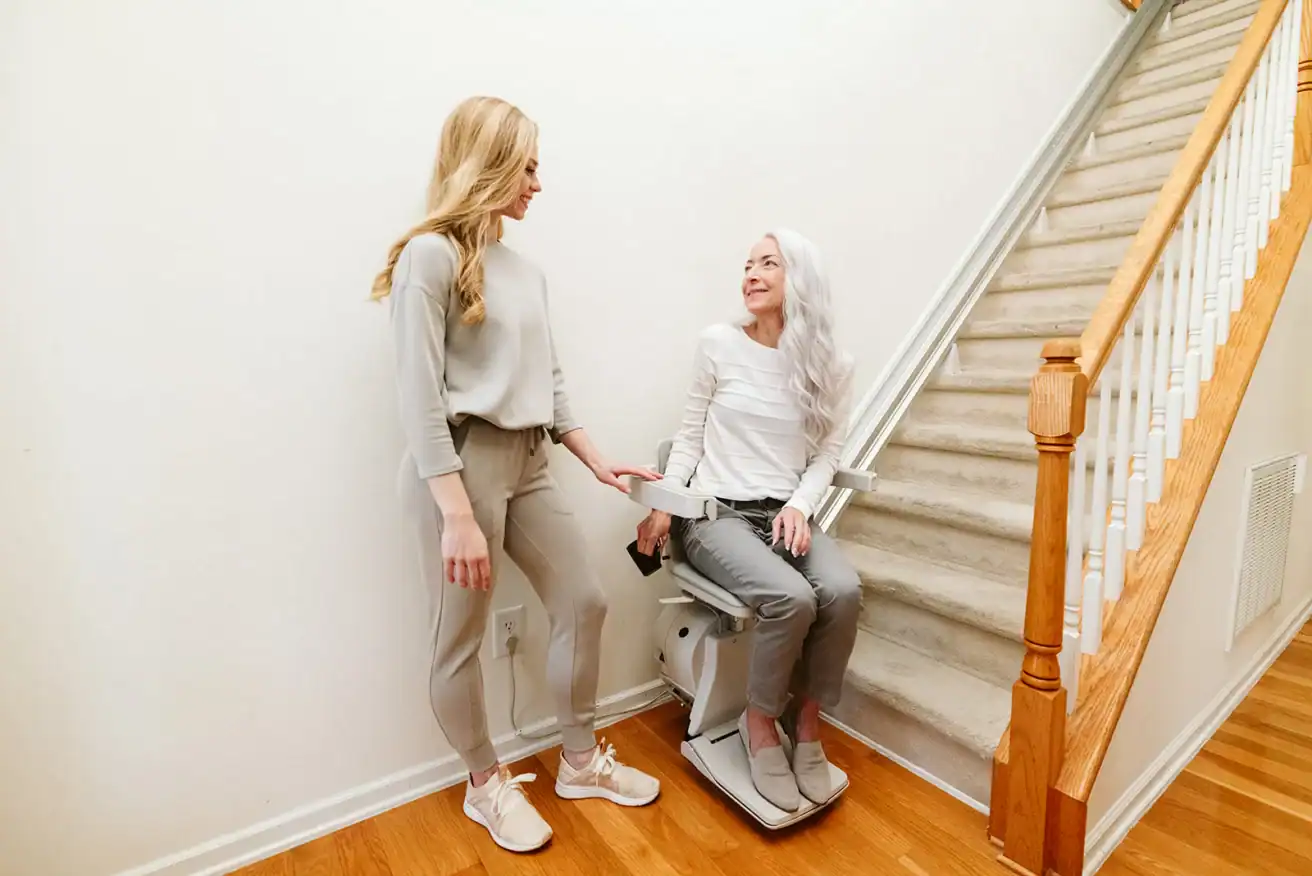
For a parent who has difficulty with stairs but refuses to give up a bedroom on the second floor, a stairlift changes the daily equation. A parent who can move between floors safely without assistance is a parent who does not need you there for that task. Many installations wrap up in a single appointment, depending on the product and your home’s layout, and the equipment needs no daily management from you.
Entry and Threshold Modifications
Step-free entry, threshold ramps, and wider door clearances matter more than they might appear. These modifications determine whether your parent can get in and out of the house independently, which affects whether medical appointments, errands, and social contact require a caregiver escort every time.
For a broader look at what aging in place involves, see What Is Aging in Place?.
Building a Support System That Does Not Depend Entirely on You
One of the most common mistakes working caregivers make is building a care system that requires their personal involvement for tasks that do not actually need them specifically. The goal is to reserve your involvement for the decisions, conversations, and presence that only you can provide, and delegate the rest.
Practical components of a sustainable structure:
- Use a coordination tool for anyone else involved. The Free Printable Caregiver Daily Checklist from 101 Mobility gives you a shareable daily framework for tracking medications, appointments, and safety checks.
- Identify a part-time aide or family member who can handle in-person tasks during work hours, even two days a week creates meaningful relief.
- Work with one provider who handles product selection, installation, and follow-up service for home accessibility needs. A single point of contact eliminates the hassle of juggling multiple contractors.
- Set up regular check-in calls on a schedule rather than responding reactively. A 10-minute morning call is far less disruptive than an unplanned 45-minute conversation in the middle of your workday.
101 Mobility’s white-glove model is built around the working caregiver’s reality. One call leads to one in-home assessment, which leads to a complete installation handled by the same local team from the first visit through installation and follow-up.
Managing Caregiver Burnout Before It Becomes a Crisis
Burnout does not arrive all at once. It builds through the accumulation of unrelieved demand over time. The warning signs for working caregivers tend to show up as reduced patience at work, difficulty concentrating, growing resentment toward the caregiving role, and a creeping sense that you are failing at everything simultaneously.
Two levers matter most:
First, reduce the number of tasks that require your physical presence. Every home modification that makes a parent safer independently is a direct reduction in demand on you. This is not about abandoning a parent, it is about making it possible to sustain care over the long term without depleting yourself.
Second, build redundancy into the system. A care arrangement that depends entirely on you is one emergency away from collapse. A care arrangement that includes reliable home infrastructure, a regular aide or family rotation, and a professional provider for home modifications can absorb disruption without defaulting to you.
The families who manage long-term caregiving best are the ones who treated it as a system design problem early, before the crisis forced their hand.
How 101 Mobility Helps Caregivers Do More With Less Time
For a working caregiver, time is the constraint. Every vendor interaction, every follow-up call, every appointment that requires your personal involvement adds to a load that is already at capacity. 101 Mobility’s model is specifically structured to minimize that overhead.
A local 101 Mobility specialist handles the full scope of a home accessibility project in a single coordinated sequence: the in-home assessment, product recommendation, installation, and any follow-up service. You are involved for the decisions that matter, what modifications to prioritize, what the timeline looks like, and the rest is handled without requiring your ongoing management.
That structure makes a real difference when you are managing this alongside a full-time job. A single appointment that addresses multiple safety concerns is worth far more than a series of separate contractor visits stretched across several weeks.
Frequently Asked Questions
How do I know which home modifications my parent actually needs?
An in-home assessment with a certified local installer is the fastest way to get a clear, prioritized picture. A specialist will walk through the home, identify the highest-risk areas, and give you a concrete recommendation. You do not need to diagnose the problem yourself before making the call.
What is the first modification to prioritize for a parent who is starting to have mobility challenges?
Bathroom safety is almost always the right starting point. It is where falls are most likely to happen and where even basic modifications — grab bars, a non-slip surface, a shower bench — create immediate, measurable safety improvement. Stair access is typically the second priority if the parent’s bedroom is on a different floor.
How do I talk to my parent about making home modifications?
Frame modifications as home improvements, not medical interventions. A stairlift is a convenience upgrade that keeps them in their own home on their own terms. Grab bars are a safety feature that any well-designed home should have. The framing matters — focus on what the modification enables, not what it’s compensating for. See How to Talk to Your Parents About a Stairlift for specific conversation guidance.
How do I handle the situation if I am the only person involved in a parent’s care?
Start by reducing the tasks that require your physical presence, because those are the highest-friction demand on a working schedule. Home modifications are the fastest way to accomplish this. From there, explore community resources, adult day programs, and part-time home aide options. Most local 101 Mobility consultations also surface additional resources specific to your area.
What does aging in place actually require at a practical level?
Aging in place at a practical level means the home is modified to match the person’s changing mobility, the care support system is reliable and not dependent on any single person, and the caregiving family has a clear plan for what triggers the next level of support. It is not a single decision — it is an ongoing structure. For a foundational overview, see What Is Aging in Place?.
Take One Step Today
Getting the home right is one of the most helpful first steps you can take. It does not eliminate the caregiving role, it makes the role sustainable. A home where a parent can move safely and independently is a home that requires less reactive intervention, fewer emergency calls, and less of your time spent on logistics rather than genuine connection.
You do not have to figure out all of it today. One consultation, one assessment, one well-chosen modification can change the daily rhythm in a way that compounds over time.