Front Door Accessibility in Breaux Bridge: How I Handle These Evaluations
For front door wheelchair accessibility in Lafayette and Breaux Bridge, I examine the process in the order: approach, landing, threshold, door, and the first turn in the inside space. Correction of just the threshold will not help if the wheelchair cannot align to the doorway, the door gobbles the landing, or there is no space to turn once inside.
Because of this, I do not automatically assume that every problematic entrance requires a ramp.
When I analyze the entrance in Breaux Bridge, St. Martinville, Lafayette, or New Iberia, I want to know where forward movement becomes restricted or where it stops altogether. During our assessments at 101 Mobility of Lafayette we evaluate the entire route to determine where a particular product would be best suited for the door.
| Part of the Entry | What I Check | What It Can Change |
|---|---|---|
| Approach | Direction, width, alignment, surface | Whether the mobility device can reach the landing correctly |
| Landing | Usable space before the door | Whether there is enough room to stop, operate the door, and reposition |
| Threshold | Vertical rise and transition | Whether a threshold ramp may address the level change |
| Door | Swing direction, opening, handle access | Whether the door itself blocks or complicates entry |
| Interior route | First turn and available space | Whether the person can continue moving after crossing the doorway |
Threshold Height Vs. Landing Space
Threshold height is one of the many considerations.
I need to know what happens before the threshold in the interest of complete analysis. What makes a product a poor choice is not just the measured rise, but also the size of the landings and whether there is enough space to come up to it in the correct alignment.
When considering a wheelchair, the approach matters. The chair needs enough landing space to close the gap to the doorway. If the landing space is too short the wheelchair user will have to take a transfer to negotiate the door as the user will be occupying the space that the wheelchair needs to continue moving.
This is why having a threshold ramp in Breaux Bridge is not as simple as selection based on threshold height.
I take into consideration:
- Raises measured
- Doorway width
- Landing area
- Approach direction
- The mobility device
- Doorway clearance
- What happens in adjacent spaces
How a person approaches the door matters.
Landing space can be a restriction even if the threshold space is small.
An outward-swinging door may block the space that an outward-swinging threshold solution occupies. An inward-swinging door is unlikely to obstruct the ramp, but will block the threshold solution and create a space restriction when a person enters.
I have to address both sides of the doorway.
Door Swing and Handle Reach
Crossing the threshold is just one part of the process of entering a house.
The person also has to reach and operate the door, cross the opening and move beyond the opening to allow the door to close.
Those tasks can become difficult even if the threshold has been corrected.
Swing clearance is usually the first thing I check because it alters the space a clear path must traverse to be usable.
If the door swings into the approach zone, I must determine the position of a wheelchair, scooter, or walker during door leaving clearance. If door swing is inwards, I assess the first internal landing and turn.
Access to the door handle is important too.
Just because a person is able to access the doorway, does not mean they have the capacity to operate the door handle without significantly repositioning. Reaching the handle, pulling or pushing the door, and moving through the opening are all separate acts.
Measuring the width of the opening is a gross oversimplification of the issues.
Evaluating the need for access in Louisiana is better understood as a sequencing of movements than a measurement of openings and doors.
A large opening does not address all of the accessibility issues.
When a Threshold Ramp is the Solution
A threshold ramp is the simplest response to a raise in level that is contiguous and everything else in the approach is functional.
Rubber Threshold Ramps by 101 Mobility are designed for an incline of up to 2 inches and utilize a modular design that provides flexibility for varying entry widths.
I would consider that type of solution for a low rise and if the door and landing, along with the approach, provide sufficient clearance.
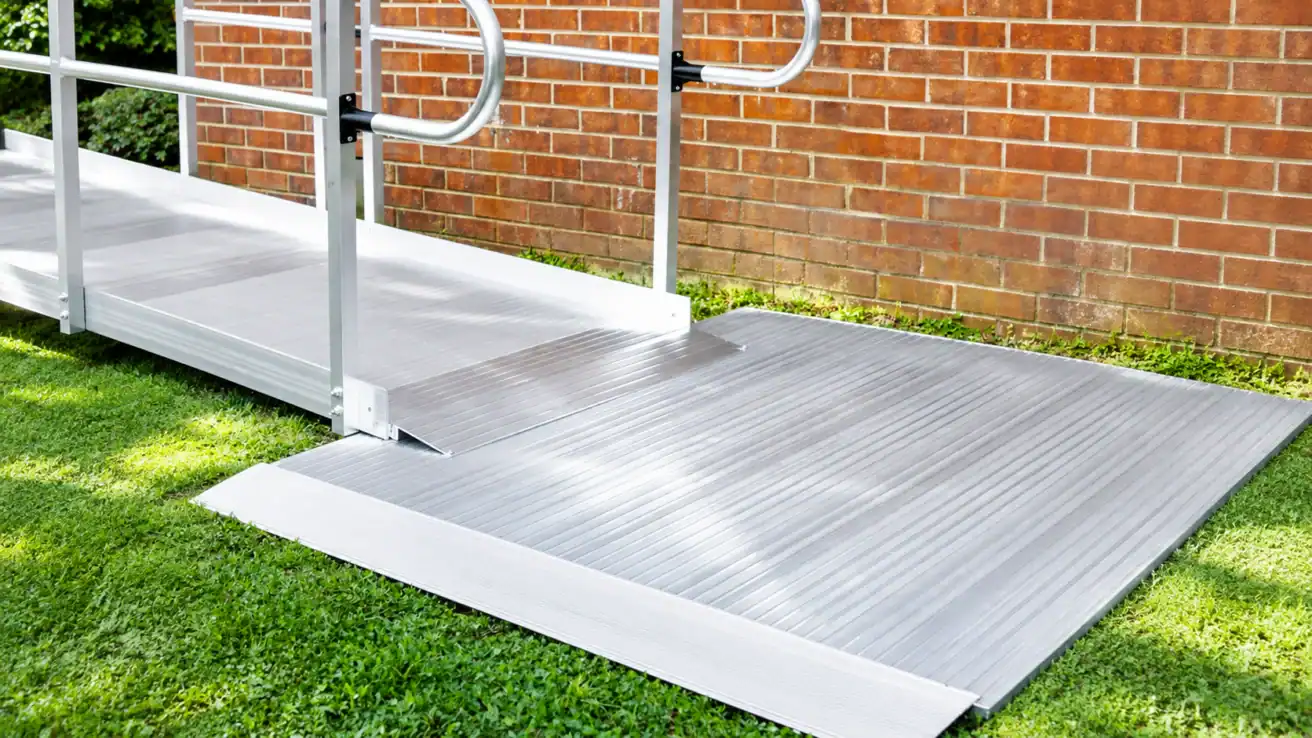
Single threshold rises higher than three inches require additional categories from the B.E.T.R. Threshold Ramp. The ramp is constructed from solid aluminum, and available for threshold risers from three to six inches with an easy to use 42-inch width. Optional handrails are available.
The published ranges help a little with limiting product categories, but custom measuring the entrance is the only way to verify the exact products needed.
A threshold ramp may be the answer when:
- The threshold is the only barrier
- The rise is in the product’s range
- There’s enough clearance at the approach
- The landing is large enough
- The door is able to operate
- There are no steps immediately before or after the threshold
- The route is usable beyond the door
There are also situations where I’d advise a different product.
When there are multiple steps, a larger change in elevation, tight mobility device landing spaces, or other significant issues with the primary route, a threshold ramp may address an inch of rise, or several inches of rise, but still won’t address the issue of the entrance itself.
In that situation, I would advise evaluating other accessibility options.
When Door Automation Changes the Experience
Not always is the level change the problem. Getting a door opener may answer all the questions.
The difficult part may be operating the door while also using a wheelchair, scooter, walker, or other mobility device.
That is where an automatic door opener in Acadiana may change the discussion.
The Open Sesame Residential Door System is an automated solution to control opening and closing of your existing residential doors. The system has programmable push pad and transmitter controls.
101 Mobility provides programmable door openers with hold-open time adjustable from 5 to 50 seconds. System clutches engage and disengage automatically to allow continuous manual operation of the door.
I am still against door automation.
I like to treat door problems as stand-alone situations.
If the wheelchair cannot reach the threshold, then door automation does not resolve the problem.
If the front casters hit a threshold, automation does not resolve that issue.
If there is not enough room to make a full circle, then automation of opening the door does not create more usable area.
However, if the approach, threshold, doorway, and the adjoining circulation space are adequate and the only concern is manipulating the door, then door automation solves the problem.
That is the distinction between door automation and resolving the problem of the approach and the threshold.
What Happens After Installation?
After installing a threshold or door-opening system, I still look at the complete route.
I do not stop at the product.
For a threshold, I am interested to see how the mobility device approaches it, crosses the transition, reaches the doorway, and continues to the interior surface.
We will analyze the controls and the operation of the door and door system. In the case of Open Sesame, this can include the activation method and the programmed hold open function.
I also analyze how the entrance impacts the other household members.
If a door still needs to be manually operated, this needs to be accounted for in the plan. Also, if the ramp alters the approach to the landing, the route needs to be analyzed as well.
101 Mobility offers service and support after the installation for questions regarding the equipment, maintenance, and repairs.
If the front entry of your home in Breaux Bridge, St. Martinville, Lafayette or New Iberia combines a threshold, tight landing, difficult door, or awkward approach, a free in-home consultation can be performed to help determine a solution to your challenge at no cost. We can measure the entry and follow you along the access path to determine the individual barriers. We can then help recommend the best solution to resolve the issues that are resulting in the problems at the entrance of your home.
FAQ: Front Door Accessibility
In making a front door wheelchair accessible what is the best place to start?
I tend to start with the access and not the product. I assess how the wheelchair gets to the landing and consider if there is sufficient unobstructed space, how high the threshold is, how big the door opening is, in what direction the door swings, how the door is controlled, how to navigate the first internal turn etc.
How do I determine if I need a threshold ramp?
Threshold ramps are appropriate for changes of level that are barriers, so long as the surrounding approach, doorway, landing, and adjoining interior pathway are all functional. The measured rise determines the appropriate threshold ramp.
What’s the difference between rubber and B.E.T.R. threshold ramps?
Rubber Threshold Ramps are designed to address rise in level of up to 2 inches, while B.E.T.R. Threshold Ramps address rise from 3 to 6 inches. I assess the approach, landing, doorway and operation of the door before I recommend either of these ramps.
Can a residential doorway be automated to include an opener to replace the need for an able bodied person?
The Open Sesame Residential Door System is designed to be retrofitted to an existing residential door or lintel with little or no modification to the surrounding architecture. I still assess the doorway and the surrounding entry because the automation of the door addresses only one potential barrier.
Will an automated door opener resolve a restricted doorway landing?
No. Automation of the door does not increase the available space. If the mobility device is not able to approach, reposition, or cross the doorway, then I must assess the potential constraints.
What happens if there’s a threshold and a hard-to-open door?
If there are both a rise and a landing, a hard-to-open door, restrictions in the clear path of travel, and limited space for maneuverability, this could present many accessibility issues. You may need to combine a threshold solution, automate the door, choose another accessibility solution, or use an alternate entry plan.
About the Author
Jonas Boutte is the owner of 101 Mobility of South Louisiana and has hands-on training from mobility and accessibility manufacturers including Bruno, Harmar, Stiltz, Staying Home, EZ-ACCESS, National Ramp, and others. He works with families throughout Lafayette and surrounding communities to evaluate entrances, ramps, stair access, lifts, and other mobility solutions based on the person, property, and daily route.