Summer Mobility Assessment in Chalmette: What to Review Room by Room

A summer mobility assessment in Chalmette can help you spot access issues before they become daily obstacles. Warmer months often bring more outdoor activity, more visitors, and more time spent moving between entryways, patios, bathrooms, bedrooms, and living spaces. That makes summer a smart time to review how safely and comfortably a home supports everyday movement.
Whether you are planning ahead, supporting a loved one, or looking at options for aging in place, a room-by-room review helps you focus on what matters most: safe access, easier transfers, and fewer barriers throughout the home.
Why a Summer Mobility Assessment Matters
Summer can highlight mobility challenges that are easier to miss during the rest of the year. Wet exterior surfaces, uneven walkways, hot thresholds, and frequent in-and-out traffic can all increase risk. It is also a common season for family visits, home updates, and proactive planning.
A good review does not start with products. It starts with how the home is used every day.
Ask:
- Where does movement feel harder than it should?
- Which areas create hesitation, fatigue, or fall risk?
- Are there rooms someone avoids because access feels difficult?
- Is caregiving becoming more physically demanding?
These answers help shape a more useful home accessibility assessment.
Start at the Entrance and Main Walkway
The entrance often sets the tone for the entire home. If access is difficult at the front door, side entry, or garage entry, the rest of the layout becomes harder to manage.
Review these areas first:
- Cracked or uneven walkways
- Slippery surfaces after rain
- Steps without sturdy handrails
- High door thresholds
- Narrow clearance at the doorway
- Poor lighting near entrances
- Limited space to turn or pause with a walker or wheelchair
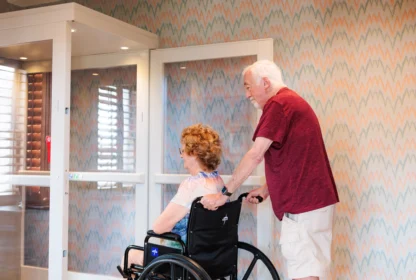
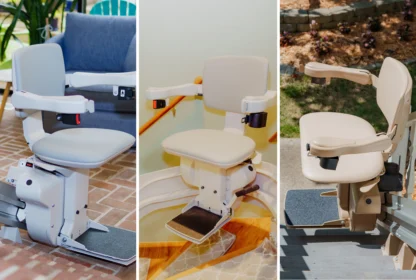
If one or two steps are already creating a problem, it may be time to look at a ramp, rail, or lift solution. If the challenge is mainly balance, grip, or stability, the right support at the entry can make daily routines much easier.
For local product and service information, link naturally here: 101 Mobility New Orleans.
Review Stairs and Changes in Elevation
Stairs deserve close attention during any aging in place review. Even a short flight between levels, a few porch steps, or a step down into a garage can become a serious barrier over time.
Look for:
- Difficulty climbing or descending safely
- Dependence on walls or furniture for support
- Missed steps or hesitation
- Trouble carrying items while using the stairs
- Fatigue after one trip up or down
- Avoidance of upper or lower levels
Also check smaller elevation changes, such as:
- Sunken living rooms
- Raised showers
- Patio door thresholds
- Garage step-ups
- Porch transitions
If stairs are limiting access to bedrooms, bathrooms, or main living areas, this is often the clearest sign that a more permanent mobility solution should be considered.
Check the Bedroom for Daily Comfort and Safer Transfers
The bedroom should support rest, dressing, and safe transfers. Small layout problems here can create major frustration at the start and end of each day.
Review:
- Is the bed too high or too low for safe transfers?
- Is there enough room to move around both sides of the bed?
- Are pathways clear for a walker, wheelchair, or cane?
- Are lamps, phones, and medications within easy reach?
- Is there safe lighting for nighttime bathroom trips?
- Are rugs, cords, or tight furniture gaps creating hazards?
A bedroom that works well usually has open pathways, stable surfaces, and enough clearance for turning and repositioning without strain.
Assess the Bathroom for Slip and Transfer Risks
Bathrooms often need the closest review because they combine moisture, hard surfaces, and tight spaces. A room-by-room safety check should spend extra time here.
Focus on:
- Stepping over the tub wall
- Slippery tile or wet flooring
- Low toilets that are hard to stand from
- Lack of support near the shower or toilet
- Tight turning space
- Awkward reaching for towels or toiletries
Bathroom review points
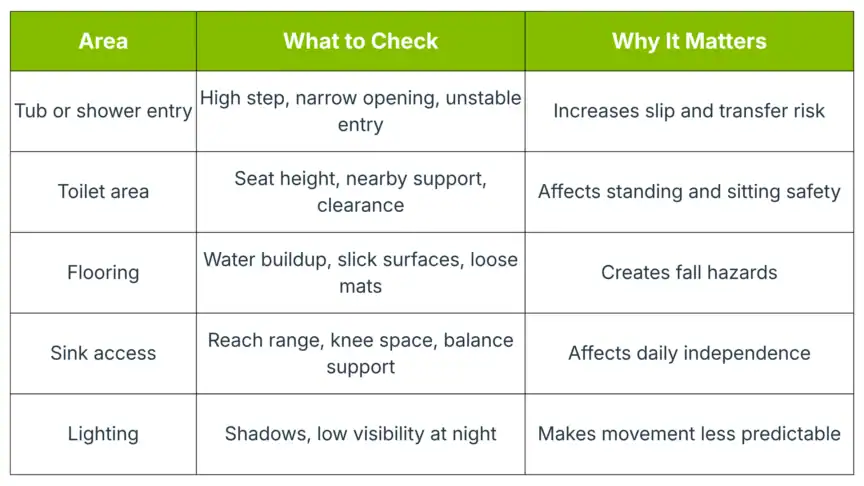
If basic bathroom routines are starting to feel rushed, tiring, or unsafe, that is usually a sign to review practical modifications sooner rather than later.
Evaluate Living Areas, Kitchen, and Everyday Pathways
A useful summer mobility assessment in Chalmette should also cover the rooms people use most often during the day. These are the spaces where repeated small obstacles add up.
Check living areas for:
- Furniture that narrows walking paths
- Loose rugs
- Extension cords across traffic areas
- Chairs that are too low or soft
- Difficulty getting in and out of favorite seating
Check the kitchen for:
- Frequently used items stored too high or too low
- Limited room to turn with mobility equipment
- Floors that become slick
- Tight corners around islands or tables
- Long reaches that strain balance
This is where home accessibility assessment work often becomes very practical. The goal is not to redesign everything. The goal is to reduce unnecessary effort and improve everyday use.
Don’t Overlook Outdoor Areas in Summer
Outdoor access matters more in summer because people naturally spend more time outside. Patios, porches, decks, driveways, and backyard routes should all be part of the review.
Look at:
- Surface stability on walkways and patios
- Railings on exterior steps
- Drainage and puddling after rain
- Heat exposure on dark surfaces
- Access to seating areas
- Safe entry to a porch, garden, or vehicle
- Pool or yard access if used regularly
Outdoor changes are easy to postpone, but they often make a major difference in independence. A person may be able to move through the home fairly well and still feel cut off from outdoor spaces because of a single unsafe transition.
Include Caregiver Needs in the Review
Caregiver strain is often one of the clearest signs that a home setup needs attention. If helping someone move through the house is becoming physically demanding, the layout may no longer be doing enough work.
Review questions include:
- Does the caregiver need to lift or steady someone often?
- Are transfers into bed, the shower, or a chair becoming harder?
- Is one room creating repeated stress each day?
- Does supervision increase during stairs or bathroom use?
- Would a better setup reduce strain and save time?
A strong room-by-room safety review looks at both the person receiving care and the person providing it.
A Simple Room-by-Room Mobility Checklist
Use this quick checklist to guide an aging in place review at home:
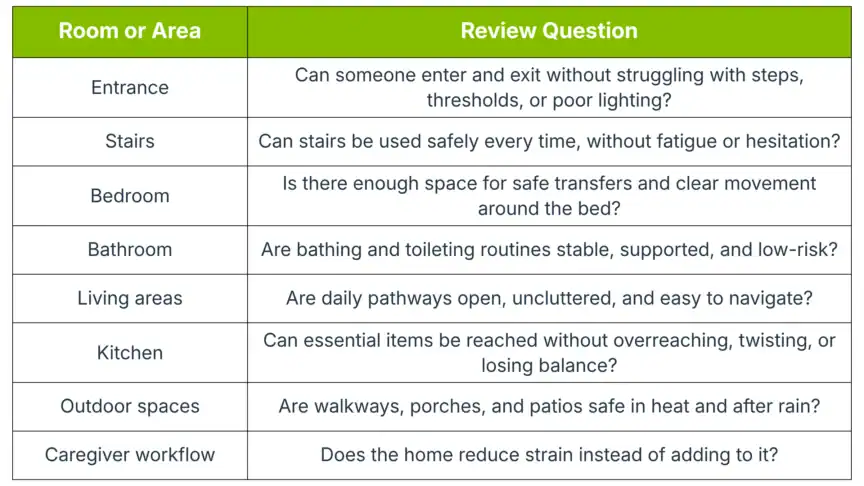
When a Home Accessibility Assessment Makes Sense
A self-review is a good first step, but some issues are easier to solve when an expert sees the layout in person. That is especially true when multiple rooms are involved or when stairs, bathroom access, and entry points are all creating concern at the same time.
A professional home accessibility assessment can help identify where small fixes may be enough and where larger mobility solutions in Chalmette may be worth considering. It can also help families prioritize changes based on safety, daily use, and long-term planning.
If you are comparing next steps, a natural internal link belongs here: Book a Free Consultation.
FAQ
What is a summer mobility assessment in Chalmette?
A summer mobility assessment in Chalmette is a room-by-room review of how safely and comfortably a home supports movement during daily routines, with extra attention to entrances, stairs, bathrooms, outdoor areas, and seasonal conditions.
What rooms should be included in a home accessibility assessment?
A home accessibility assessment should usually cover entrances, stairs, bedrooms, bathrooms, living areas, kitchens, and outdoor spaces. If a caregiver is involved, the review should also include transfer points and areas where physical assistance is most common.
When should a family do an aging in place review?
Aging in place reviews are most useful before a mobility issue becomes urgent. Good times include after a fall, after surgery, during recovery, when stairs become harder to manage, or when caregiving starts to feel more physically demanding.
What are common mobility problems found room by room?
Common room by room safety concerns include slippery bathrooms, unsafe stairs, narrow pathways, hard-to-use entrances, poor lighting, low seating, and outdoor surfaces that become uneven or slick.
How do I know if it is time to explore mobility solutions in Chalmette?
It may be time to explore mobility solutions in Chalmette when someone avoids part of the home, needs more support with stairs or transfers, or when daily routines start taking more effort, more time, or more physical help than they used to.
Final Takeaway
The best summer mobility assessment is simple: walk through the home the way it is actually used and note where movement feels harder, less stable, or more tiring than it should. Entrances, stairs, bedrooms, bathrooms, outdoor areas, and caregiver routines usually reveal the clearest priorities first.
If you want a clearer plan for safer access at home, Book a Free Consultation.