Garage Accessibility in Westwego: Often-Overlooked Summer Safety Upgrades for Side Doors and Garage Entries
When people think about home accessibility, they usually picture the front door first. But for many households, the garage or side entrance is the door that gets used the most.
That matters because the most familiar route is often the one with the most risk. A single step from the garage, a high threshold at the side door, a slick surface during summer rain, or an awkward transfer from the car can turn a normal daily routine into a frustrating or unsafe one.
If you are looking at garage accessibility in Westwego, start with the places your household actually uses every day. In many homes, that means the garage entry, the side door, and the path between the car and the house.
Why garage and side-door access matter more than most homeowners realize
The front entry may look like the main access point, but daily life often happens elsewhere.
Many homeowners enter through the garage after errands. Family members may use the side door when bringing in groceries, taking out trash, getting to work, or returning home during bad weather. Caregivers may also prefer these routes because they are closer to parking and easier for short, repeated trips.
That is exactly why these spaces deserve attention. A small barrier at a high-use entrance creates repeated strain. Over time, that can affect confidence, safety, and independence.
Common problem areas around garage accessibility in Westwego
Garage steps and uneven transitions
A single garage step can be harder than it looks. It may not seem like much when a person is moving slowly and empty-handed. But add a walker, cane, wheelchair, recovery after surgery, or a bag of groceries, and the step becomes a daily obstacle.
Uneven transitions can also create trouble for caregivers who are helping someone move in and out safely.
Side doors with high thresholds or limited landing space
A side entrance may be closer to the driveway, but it is not always easier to use. Many side doors have raised thresholds, narrow approach areas, or a step that was never designed for limited mobility.
That is where side door access Westwego concerns often show up. The issue is not always a full staircase. Sometimes it is a smaller height change that still makes the doorway unsafe or awkward.
Car transfers in wet or rushed conditions
Summer weather can make a routine exit more difficult. Rain on concrete, wet shoes, and the need to move quickly from the car to the house can create a risky combination.
Transfers are also harder when there is no stable, predictable route from the vehicle to the entry point. If someone must pivot around a step, manage a mobility device, or balance while carrying items, the path is not working well enough.
Repetition turns small issues into real safety concerns
A barrier does not have to be dramatic to matter. If it affects the route someone uses several times a day, it deserves a closer look.
That is why home access safety is often improved not by a major remodel, but by fixing the exact transition that causes the most daily stress.
Practical summer upgrades that improve home access safety
The right solution depends on the height change, the amount of available space, and how the entrance is used. A good accessibility plan connects the problem to the right product, not the other way around.
Threshold ramps for small height changes
If the main issue is a raised threshold or a small lip at the doorway, a threshold ramp may be the simplest fix.
These can help smooth out the transition at a garage side door or service entry where wheels, walkers, or careful foot placement are getting caught. For homes dealing with modest height changes, this kind of upgrade can improve usability without making the entry feel overbuilt.
A garage entry ramp for steps or bigger elevation changes
If there is a full step or a more significant rise from the driveway, garage floor, or side walkway into the home, a garage entry ramp may be the better answer.
This is especially helpful when the goal is more consistent access for wheelchair users, scooter users, walker users, or anyone who needs a gentler path into the home. A properly planned ramp can also support caregivers and reduce the strain of repeated daily assistance.
Better layout and surfaces for outdoor accessibility
Not every problem starts at the door itself. Sometimes the issue is the approach.
A route from the car to the side entry may need a clearer path, a better transition, or safer navigation around the doorway. These details matter for outdoor accessibility, especially when the route is exposed to weather or used during rushed in-and-out trips.
How to know which access solution fits your home
The best accessibility upgrade is the one that fits the actual conditions of the home and the person using it.
Here are the main questions to ask:
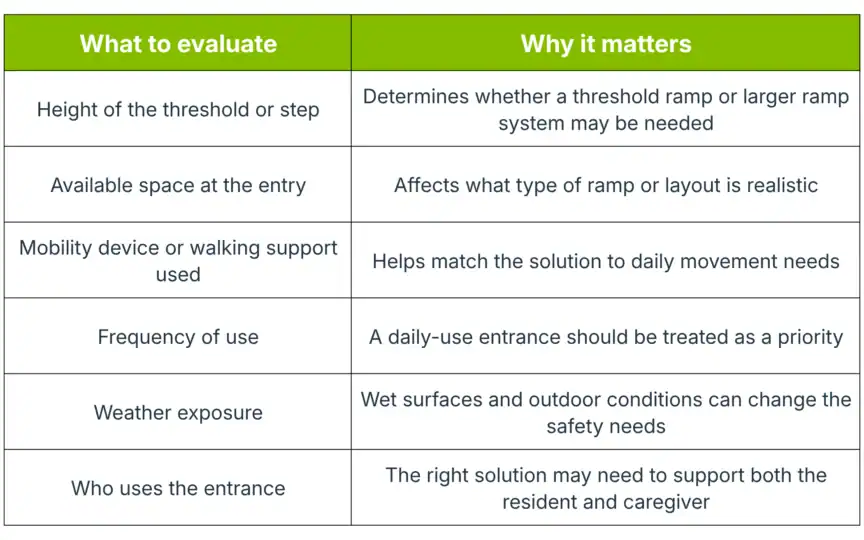
A home with a small threshold issue at a side door needs a different solution than a garage with a step down from the interior entry. That is why a one-size-fits-all approach usually falls short.
Who should consider garage and side-door upgrades now
These upgrades are worth considering if:
- You or a loved one uses a wheelchair, walker, cane, or scooter
- A recent surgery or injury has made entry more difficult
- Carrying groceries or moving between the car and the house feels less steady than it used to
- A caregiver is helping with daily entry and exit
- You want to plan ahead before the need becomes urgent
- The safest route into the home is not the front door
In many cases, the best time to improve access is before a close call happens.
Quick checklist: what to look at this week
Walk your most-used entrance and check for these issues:
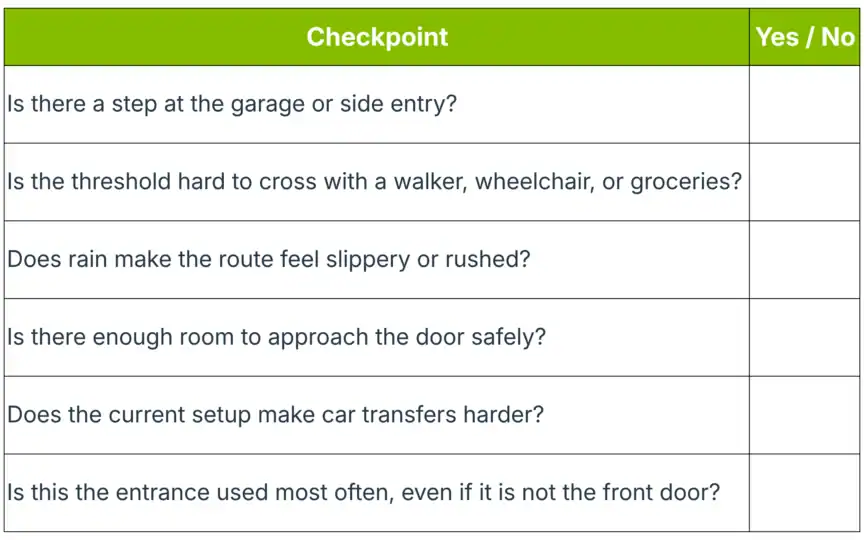
If you checked “yes” to more than one, the entry point may be a strong candidate for an accessibility upgrade.
Why professional guidance matters
A good accessibility improvement is not just about adding a product. It is about making the route safer, easier, and more usable every day.
That means looking at the full path:
- Where the person exits the vehicle
- How they approach the home
- What happens at the threshold or step
- How much support they need during transfers
- Whether the solution works for both current and future needs
That is also why many homeowners start with a consultation rather than trying to guess which product will fit.
For local support, explore the 101 Mobility New Orleans location or learn more about outdoor accessibility solutions.
FAQ
What is the most common garage accessibility issue at home?
One of the most common problems is a single step or uneven transition between the garage and the interior door. High thresholds and limited maneuvering space are also common.
When does a threshold ramp make sense?
A threshold ramp is often a good fit when the height change is relatively small but still makes a doorway difficult to cross safely with wheels, walkers, or careful foot placement.
When is a garage entry ramp a better option?
A garage entry ramp is usually the better choice when there is a full step or a larger elevation change that needs a smoother, more reliable path into the home.
Are side-door upgrades worth it if the front door already works?
Yes. If the side door or garage entry is the route used most often, that is the access point that should be evaluated first. The safest entrance is the one that supports real daily routines.
Who should schedule an accessibility consultation?
Anyone noticing difficulty with entry and exit, transfers from the car, repeated strain on caregivers, or growing concern about slips, steps, and thresholds should consider a consultation.
Make the entrance you use most the one that works best
The safest entry to your home is not always the front one. In many Westwego households, the garage or side door plays the biggest role in everyday access.
If that route includes a step, a threshold, a difficult transfer, or a weather-exposed transition, now is a smart time to address it. The right upgrade can make daily movement easier, reduce risk, and support long-term independence.
Book a Free Consultation to talk through your garage or side-door access needs and find a solution that fits your home.