Emergency Preparedness for People With Disabilities: A Caregiver's Plan

Quick Takeaways:
- Emergency preparedness for people with disabilities comes down to four layers: the equipment, one reliable exit route, a go-kit built around mobility needs, and the people who need to know the plan.
- County checklists will tell you to store water and copies of prescriptions. What they rarely address is how many trips your stairlift has left once the power cuts, or whether the ramp you count on every day remains safe to use in wet or icy conditions at night.
- This guide offers a clear, practical path to being ready for any emergency.
What does emergency preparedness for people with disabilities actually require?
When preparing for an emergency, you’ll want to look at this in four layers, and in this order: equipment, exit, kit, people. Each one has a clear finish line, so you can audit what you already have rather than starting from scratch.
- Equipment. You know what each device does on battery power, roughly how long it lasts, and how to lower it manually if needed.
- Exit. One route out of the house works without power, without stairs, in the dark and in poor weather.
- Kit. Chargers, model numbers, medications, and documents live in one bag you can carry with one hand.
- People. Local emergency services are registered where a program is available, two neighbors know the plan, and every adult in the family has walked through it at least once.
What happens to a stairlift or platform lift when the power goes out?
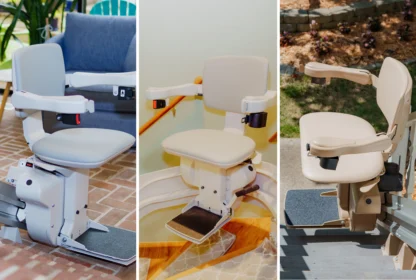
Most modern stairlifts run on batteries that recharge whenever the chair sits at a parking point, so they keep working for a limited number of trips after an outage begins. Platform lifts vary more widely, with some models having a battery backup as a standard, while on others it is an option that may or may not have been purchased with the unit.
The three things worth confirming with your local mobility provider before you need them: whether the unit has battery backup at all, roughly how many trips it holds when fully charged, and exactly how the manual lowering procedure works for your model.
Manufacturer specifications vary by model and are updated over time, so it is worth asking these questions directly rather than relying on general estimates. Your local 101 Mobility team can walk through your specific equipment and let you know exactly what to expect.
One design detail that shapes everything else: many lift systems use continuous-pressure controls, meaning the user or a caregiver must actively hold the switch throughout operation. This is a safety feature, and it also means the lift cannot run unattended while you are managing something else. If the home does not yet have a lift and the stairs are already a daily problem, stairlift installation is worth sorting out before storm season rather than during it.
How do you get someone out of the house who cannot use the stairs?
Pick one ground-floor exit, make it work without power, and walk it with the family member at least once. A rehearsed route is one that you can rely on.
- Choose the exit with the shortest clear path from where your family member sleeps.
- Keep it clear year-round. Nothing stored in that hallway, ever, including seasonally.
- Light it independently. Battery lanterns or motion lights at the door and along the path.
- Check the route in poor conditions. Walk it in the rain before you need it in the rain.
- Stage the mobility device on that route overnight, not in another room.
- Rehearse it once with everyone who might be the only adult in the house during an emergency.
If you are evaluating wheelchair ramps with emergencies in mind, ask about handrails, non-slip surfacing, and performance in wet conditions, not just the grade.
What belongs in a go-kit when mobility equipment is involved?
The standard kit advice holds: water, medications, documents, cash, and phone chargers. The additions below are the ones that come from having mobility equipment in the house, and they are the ones that are commonly missed.
| Item | Why it matters | Where it lives |
|---|---|---|
| Equipment chargers and spare batteries | Devices fail in the order they were last charged | In the go-bag, not on the nightstand |
| Model and serial numbers, photographed | Any repair, part, or replacement starts with these | Phone, plus a printed copy |
| Your local mobility provider’s direct number | A local service line beats a national queue after a storm | Saved in phone favorites and tucked into your bag |
| Photos of the installed equipment | Insurance claims move faster with before images | Cloud storage and printed copy |
| Printed medication and equipment list | Works when phones are dead, and networks are down | Go-bag front pocket |
| Manual lowering instructions | You will want these accessible and easy to read under stress | Laminated, taped inside a nearby cabinet |
The serial number detail catches most people off guard.. The label is usually on the unit itself, often in the least reachable spot, and the moment you need it is the moment you cannot get to it. Photograph it today. Our printable caregiver checklist is a reasonable place to keep the rest of the recurring items.
How do you plan for the week after the emergency?
The days following an emergency are often when mobility-related challenges become most pressing. Power comes back intermittently, equipment may have sustained water or environmental damage, parts are backordered, and the house may not be livable. In most situations, families are working through three options: repair, rent, or temporarily relocate.
Renting is the most underused of the three. It covers the gap when a unit is waiting on parts, when the family relocates to a relative’s house that has stairs, or when a temporary setup is genuinely all that is needed. Short-term accessibility equipment rentals can be installed in a house that is not yours and removed when you leave. Ask your local 101 Mobility team about short-term rental options as availability varies by market and equipment type.
If an emergency leads to a more permanent change in where or how your family member lives, that is a different conversation than a repair. Our guide on how to choose the right mobility solution is the right starting point once the immediate crisis has passed.
Who needs to know the plan before anything happens?
Local emergency services, two neighbors, and every adult who might be alone in the house with your family member. Many counties maintain a voluntary registry for residents with access and functional needs, and Ready.gov points to the local programs worth signing up for.
It is worth being clear about what registry participation does and does not provide. It is not a guarantee of rescue timing, and it does not put you first in line for power restoration. What it does is put your address on a list responders may consult, which is a meaningful step but not a substitute for a broader plan.
Neighbors matter more than people expect, because they are the ones who are physically closest when something happens. Give two of them a key, the exit plan, and one sentence about what help would actually look like.
One practical note: keeping the exit route clear year-round, which is the same discipline as common trip hazards and fall prevention, not just a use case in emergencies.
Frequently Asked Questions
How do I prepare for a power outage if my family member uses a stairlift?
Start by confirming with their local mobility provider whether the unit has battery backup and roughly how many trips it holds, then learn the manual lowering procedure and post it somewhere nearby. Keep the chair parked at a charging point when it is not in use, since that is when it recharges. For outages lasting more than a day, it may be worth considering whether a ground-floor arrangement would be more comfortable and practical during that time.
What should be in an emergency kit for someone with limited mobility?
Everything in a standard kit, plus the equipment layer: chargers, spare batteries, photographed model and serial numbers, your local mobility provider’s direct number, and laminated manual lowering instructions. Keep it in a bag you can carry while pushing a wheelchair.
Should I register my family member with local emergency services?
Yes, where a registry exists. It takes about fifteen minutes and puts the address on a list responders may check during an event. It is not a guarantee of rescue or of priority power restoration, it is just another layer in the larger plan.
How often should we practice the plan?
Twice a year is a reasonable goal, timed to whatever season your region worries about. Walk the exit route, test the lanterns, check the battery charge, and confirm the go-bag contents have not been raided for a road trip. Anyone new to the household runs it once before their first overnight stay.
What is the first step in emergency preparedness for people with disabilities?
Walk the exit route under low-light conditions with the power to that hallway switched off. Everything else in this plan follows from knowing whether that route actually works.
| Your local 101 Mobility team is locally owned, services what it installs, and can tell you exactly how your equipment behaves without power.Book a free in-home consultation and get your exit route assessed before you need it. |