Compact Power Chair for Narrow Hallways: What I Check Before Recommending One
For a compact power chair in New Orleans, I consider the narrowest doorway or tightest turn along a person’s actual daily route. Paper size often isn’t indicative of whether a chair will fit down a hallway or work with a bedroom entrance, threshold, or furniture placement. Turning radius, charging, transferring, and vehicle transport all affect the final surrounding furniture placement.
With families in Metairie, River Ridge, Harahan, and Kenner, I want to know how the chair will get from the storage location to the important daily rooms and exits. I consider the route taken and then make a decision on the product at 101 Mobility of New Orleans.
| Route Factor | What I Check | Why It Matters |
|---|---|---|
| Narrowest doorway | Clear opening and approach angle | Chair width is not enough to determine if a chair fits in an opening |
| Tightest turn | Hallway width and direction change | Turning radius matters at corners and when entering a room |
| Threshold | Height and available approach | Small changes in elevation can disrupt a usable route |
| Furniture | Fixed and movable obstacles | A chair can not simply fit in an empty space |
| Transfer location | Space beside the chair | The user still has to have a way to get on and off the chair |
| Charging location | Outlet and parking position | A chair has to charge and not block a route |
| Vehicle route | Door, garage, storage, and loading method | How the vehicle changes which chair is used |
Turning and Doorway Checks Before Device Selection
A power chair should be matched to the entire route, not one doorway.
I start by looking at the places the user has least amount of space to work with. This could be a bedroom doorway, a bathroom hallway turn, space around the dining table, or the path to the exterior door.
The point that is the narrowest is important, but this is not the only factor that needs to be considered.
Just because a chair can fit through an opening doesn’t mean that it can be aligned with the opening. If the hallway ends with the doorway, the chair has to make the turn to line up with the opening and use the space that is available.
It is at that point that the turning radius becomes important.
I also consider thresholds. A low threshold that interrupts a usable path may warrant the use of Rubber Threshold Ramps. The threshold truck has to address the elevation, the clearance, the mobility aid, and the surrounding doorway.
For a searcher interested in a narrow power chair for use in a hallway, I would evaluate:
- The chair width,
- Turning radius,
- Length,
- Clear opening of the doorway,
- Approach,
- Hallway width,
- Furniture,
- Thresholds,
- And space at the destination
The chair must complete the path, not just clear the front opening.
Use Cases for Pride Go-Chairs and Compact Power Chairs
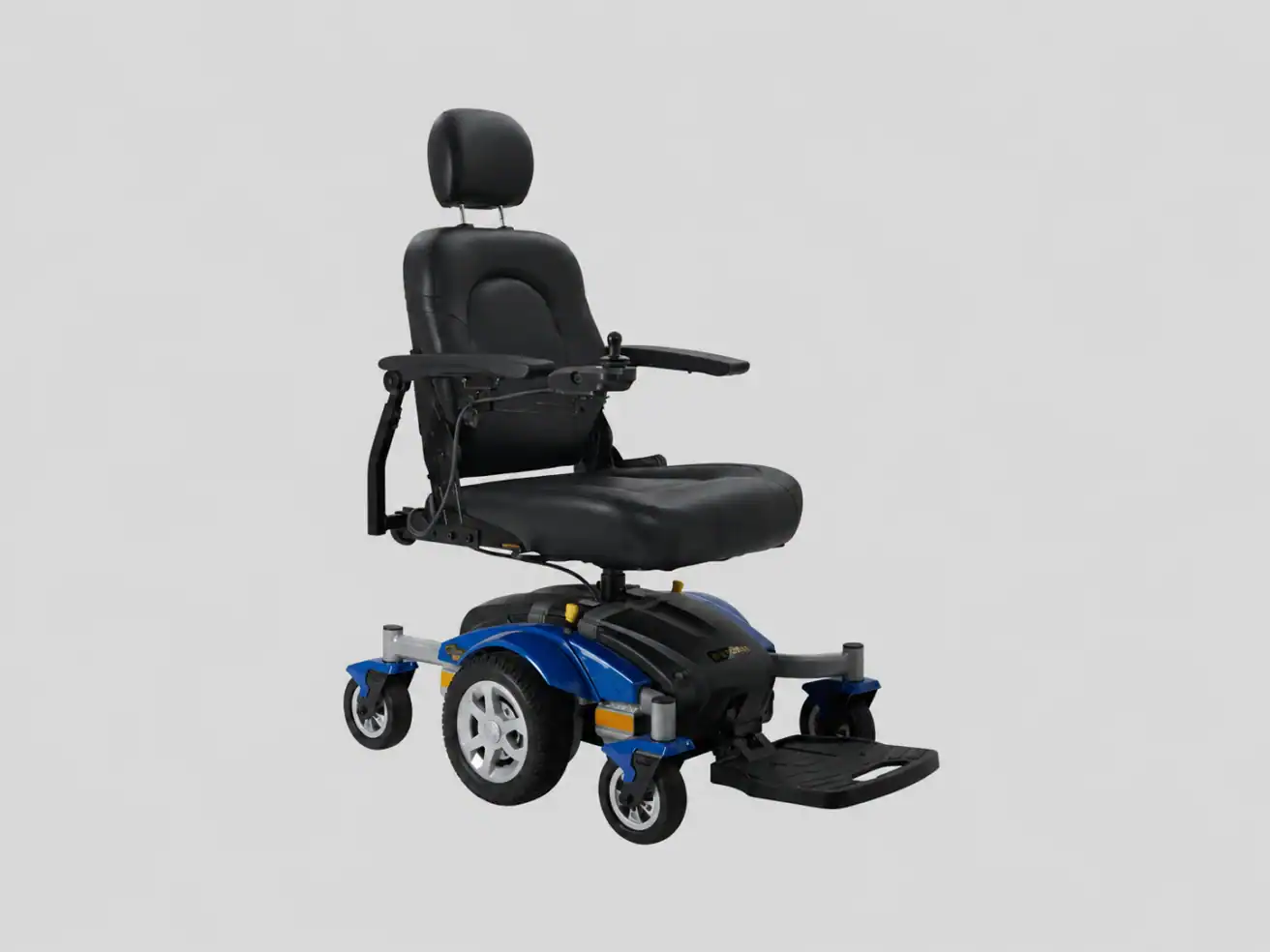
In the case I wish to address small footprints and high degrees of portability, I may consider Pride Go-Chairs.
101 Mobility publishes a product spec for the Go-Chair of 25.5 inch width, a 25.5 inch minimum turning radius, and an overall length of 33 inches with front rigging. It weighs 300 pounds.
One hand feather touch disassembly is also published. This is relevant when breaking the chair down for storage or transport.
I would not recommend the Pride Go-Chair in Metairie as a good option due to the small overall dimensions.
I need to know the turning radius as well to ensure it negotiates the tightest turn in the home and the chair approach direction is to the doorway.
I also consider Golden Power Chairs as seating and wheel position may be better for the route.
The Compass Series by Golden Technologies isn’t based on a single footprint. 101 Mobility claims a 24-inch width and a 19.5-inch turning radius for the Compass short, whereas the Compass HD has a 25-inch width and a 20-inch turning radius. One Compass chair version is not better than the other Go-Chair, but a smaller turning radius may be better in a cramped indoor environment. Choosing a chair involves many factors like seating size, weight capacity, transfer position, battery configuration, total dimensions, how it will be transported, and the surfaces over which it will be used. I use the given specifications for each chair to design a potential travel route and do not base my decisions on a single number.
Charging Location and Transfer Position
Like any other compact chair, a location has to be designated for charger placement when the chair is not in use.
The designated parking and charging space has to be convenient to the user’s everyday routine.
For example, if the chair has to charge in a room and the user has to be transported to that room, the designated parking location may be convenient to the user, but the storage solution may be a pain.
The storage solution has to be convenient to the user as well. If a parking position blocks the passageway for other people, we have potentially solved one problem but created another.
According to the given specifications, the Go-Chair by Pride Chairs requires an external power source to charge. Each of the Golden Technologies power chairs’ charging solutions can be different, so I like to confirm the charging solution for the selected chair before finalizing the rest of the configurations.
I also pay particular attention to the transfer position.
How do users get into the chair?
Where does this happen beside a bed, recliner, kitchen chair, or other location?
What is the space like beside the power chair?
The smallest chair isn’t always the best chair.
When selecting a compact wheelchair in River Ridge, this means I would rather map the chair along its charging route to the transfer point and then through the main areas, instead of choosing based solely on the published width.
The Size and Storage of a Wheelchair Are Highly Dependent on the Method of Transport Used
If the chair needs to be transported in a vehicle, the route used in the home is part of the decision.
Before I buy the power chair, I make sure to find out how it will get to the vehicle and how it will be transported.
The Pride Go-Chair is designed to disassemble for storage and transport. This is useful for transporting the chair in pieces if the plan is to transport the chair disassembled.
Portability has to be designed around the person and household doing the transport.
I have some questions:
- What is the parking spot like?
- How does the power chair travel from the house to the car?
- Will the chair have to travel over a threshold or enter a garage?
- Will it have to be disassembled and stored in the cargo area, or will another method be used to transport it?
- Is there space at the house to store the chair or disassembled parts?
- Can the regular transportation routine be completed without making each trip complicated?
This is one place where I would probably advise against choosing the smallest indoor option.
If a slightly different chair better matches the seating needs, the vehicle setup, or the outdoor daily routine, then choosing the narrowest possible solution may address the problem in the hallway, but create more issues everywhere else.
I want the chair to work with the entire routine.
What After Delivery?
After delivery, I would like to test the chair within the route we planned for it.
We go over the controls, normal driving operation, the charging procedure, and any folding or removable components of the selected model.
Once that is done, I re-evaluate the route.
Does the chair clear the doorway?
Can it make the turn in the hallway without needing to move it multiple times?
Does it approach the transfer spot correctly?
Can it reach its charging spot without blocking another important path?
If a threshold product is part of the plan, we see how the chair approaches it and how it crosses that threshold.
The route after delivery should be the same as the route we evaluated before buying the chair.
We make sure you know how to get in touch with us. 101 Mobility offers service and support related to accessibility and mobility equipment, specifically maintenance and repairs as well as product-related inquiries.
If you’re looking for compact power chairs for your home in Metairie, River Ridge, Harahan, and Kenner, a free in-home consultation is the way to go. I will evaluate the narrow sections of the path, turning space, thresholds, charging location, transfer position and the vehicle plan, prior to suggesting a specific device.
Compact Power Chairs for Tighter Hallways
What makes a power chair good for narrow hallways?
A good narrow hallway power chair has overall width combined with a turning radius that fits the corners and doorways of a given home. I also examine the length of a chair, furniture, thresholds, and the clearance required to line up to each doorway.
How wide is the Pride Go-Chair?
101 Mobility cites the Pride Go-Chair at 25.5 inches overall width. That number is useful for planning, but I still have to evaluate the clear opening of doors and the approach to each room.
What is the turning radius of the Pride Go-Chair?
The turning radius of the Pride Go-Chair is cited at 25.5 inches. Whether this is relevant for a home depends on the overall width of the hallways, furniture placement, doorway location, and the direction of the intended turn.
Do Golden Power Chairs Fit in Spaces with Less Room?
Some Golden Power Chairs have more compact published measurements. For example, the Compass short model is 24 inches wide with a 19.5 inch turning radius. Before suggesting this model, I consider the seating and capacity, the route, and transportation of the chair and the complete model.
Could a threshold impede a compact power chair from passing through an doorway?
Yes. A chair may have enough width and turning space, but it can still have issues at gaps and thresholds. I evaluate the gap or threshold, and determine if there is a need for a gap or threshold solution.
Should I get the smallest power chair I can find for my house?
Not necessarily. The smallest chair may be better for a tight turn, but seating, capacity, charging, storage, and outdoor use must also be considered. I would recommend the chair that fits the complete routine rather than the smallest published dimensions.