Aging in Place vs. Assisted Living Cost: What the Numbers Actually Show

Quick Takeaways:
- Assisted living pricing is often tiered, not truly flat. Many communities charge a base rate plus added fees as care needs grow.
- Aging in place costs split into mostly one-time modifications plus lighter ongoing care and maintenance.
- Over several years, the aging in place vs assisted living cost comparison often favors staying home, though the right answer depends on your care needs.
- National ranges are a starting point. Your actual number depends on your home and your care needs.
- A home assessment turns a general range into a real, personalized estimate.
Behind most versions of this question is a bigger worry: is staying home actually realistic, or is a facility the only financially responsible choice? Looking at aging in place vs assisted living cost side by side, with clear, honest ranges, instead of scare numbers, usually settles that worry faster than expected.
Here’s the short version, followed by the full breakdown: assisted living is a recurring monthly fee that continues indefinitely, while aging in place is mostly a one-time investment plus lighter ongoing costs. Over a few years, that structure often favors staying home, especially when care needs stay steady.
What Assisted Living Actually Costs Per Month
Assisted living costs vary widely by region and level of care, but national surveys generally put the typical range in the neighborhood of $4,500 to $5,500 per month, and often more in higher cost-of-living areas or for higher levels of care. That fee recurs for as long as someone lives there. It usually covers room, board, and a set amount of assistance, though many communities add tiered charges as care needs rise, and it rarely covers a fully personalized living space.
The number that matters most isn’t the national average. It’s what a specific facility in a specific area actually charges, since the range between markets can be significant.
What Aging in Place Costs Look Like Instead
Aging in place costs break down differently than a flat monthly fee. Most of the expense is front-loaded into one-time modifications, with a smaller ongoing cost after that, which changes the shape of the comparison considerably.
One-Time Costs: Modifications and Equipment
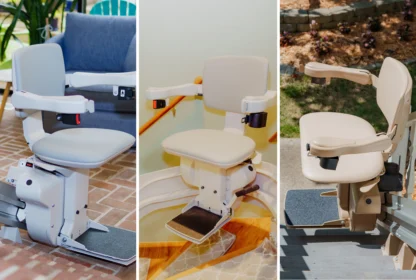
Stairlifts, wheelchair ramps, and bathroom safety upgrades are largely one-time investments rather than recurring fees. Costs vary by product and home layout, but they typically land in the low thousands for a single modification like a ramp, and can run higher for a stairlift or a full bathroom safety upgrade. Financing options can spread that cost out further, and a personalized quote from a pricing guide will always be more accurate than a general range.
Ongoing Costs: Care Hours and Home Maintenance
The recurring side of aging in place is usually lighter than people expect: occasional in-home care hours if and when they’re needed, plus normal home upkeep that most homeowners are already budgeting for. Unless full-time care becomes necessary, this ongoing cost tends to stay well below a facility’s monthly fee. When care needs grow, the gap narrows, which is exactly why your own numbers matter more than any average.
Why the Math Often Favors Staying Home Longer
Run the comparison over three or five years, and the structural difference becomes clear: a facility’s monthly fee keeps recurring at full price, while aging in place’s biggest costs are paid once, up front. Even accounting for occasional care hours, the total often comes in lower over time, though a change in care needs can shift that balance
That said, cost is one factor among several. Care needs are what should ultimately decide the right path. For many families, though, discovering that staying home is also the more affordable option removes one more reason to feel toward a move they didn’t actually want to make.
Get a Personalized Aging in Place Cost Estimate
National ranges are a useful starting point, not a final answer. The real number depends on your home’s layout, which modifications you actually need, and your local market. A home assessment turns a general estimate into a clear, personalized one that is built around your home and goals.
Aging in Place vs. Assisted Living: Cost Structure
| Aging in Place | Assisted Living | |
| Cost structure | Mostly one-time, plus lighter ongoing costs | Recurring monthly fee, often with tiered add-ons |
| Typical modifications | Stairlift, ramp, bath safety (one-time) | Not applicable, space is pre-built |
| Ongoing care | As-needed in-home care hours | Included, up to a set level |
| Control over space | Full control, stays your own home | Limited, shared or facility-managed space |
Frequently Asked Questions
Is aging in place always cheaper than assisted living?
Not always, but often, especially over multiple years, since aging in place costs are mostly one-time while assisted living is a recurring monthly fee. If full-time care becomes necessary, the gap narrows, which is why a personalized estimate matters more than a national average.
What is the average cost of aging in place home modifications?
It depends on which modifications a home needs, but individual upgrades like a ramp or a stairlift are typically a one-time cost in the low thousands rather than a recurring expense. Financing options can spread that cost out over time.
Does Medicare help pay for aging in place modifications?
Original Medicare generally does not cover home modifications, though some Medicare Advantage plans and VA benefits may help with certain costs. A financing or grant guide specific to your situation is the most reliable way to check.
How do I get an accurate cost estimate for staying in my home?
A home assessment is the most reliable way, since it accounts for your actual layout and care needs rather than a national average. That assessment is what turns a rough range into a real number.
The aging in place vs assisted living cost comparison usually comes down to a flat recurring fee versus a mostly one-time investment, and over time the math tends to favor staying home. The next step is turning that general comparison into a number specific to your house.
| 101 Mobility’s local experts walk your home, listen to what matters to you, and turn a national range into a clear estimate for your specific situation. No pressure. Just honest guidance from a team that lives and works nearby. Request a free consultation with 101 Mobility to get a real cost estimate for aging in place in your home. |