Getting a Stairlift Installed in Baton Rouge: What to Expect
A stairlift begins with a home visit and ends with a properly fitted stairlift. There is a lot of planning and assessment that goes into taking the safest and most effective stairlift use into consideration. We will look at how you utilize your staircase, assess the space, and determine where the best place is for you to get on and off your staircase.
When considering families in the Baton Rouge area including Central, Denham Springs, Walker, and Prairieville, I look at the entire staircase and the individual who uses it most to determine what equipment, if any, is best suited for the situation.
At 101 Mobility of Baton Rouge, LA that evaluation becomes the base of the entire process of selecting and installing the stairlift.
What happens at the first stairlift appointment?
The first appointment is to see if a stairlift is the right equipment for your specific situation and staircase. I first look at the individual. I determine where they enter and exit the staircase.
Then I take a look at the staircase. Stair width, configuration, and available space also play a role. I take into account all the household traffic and the effects on the location of stairlift pick-up and drop-off.
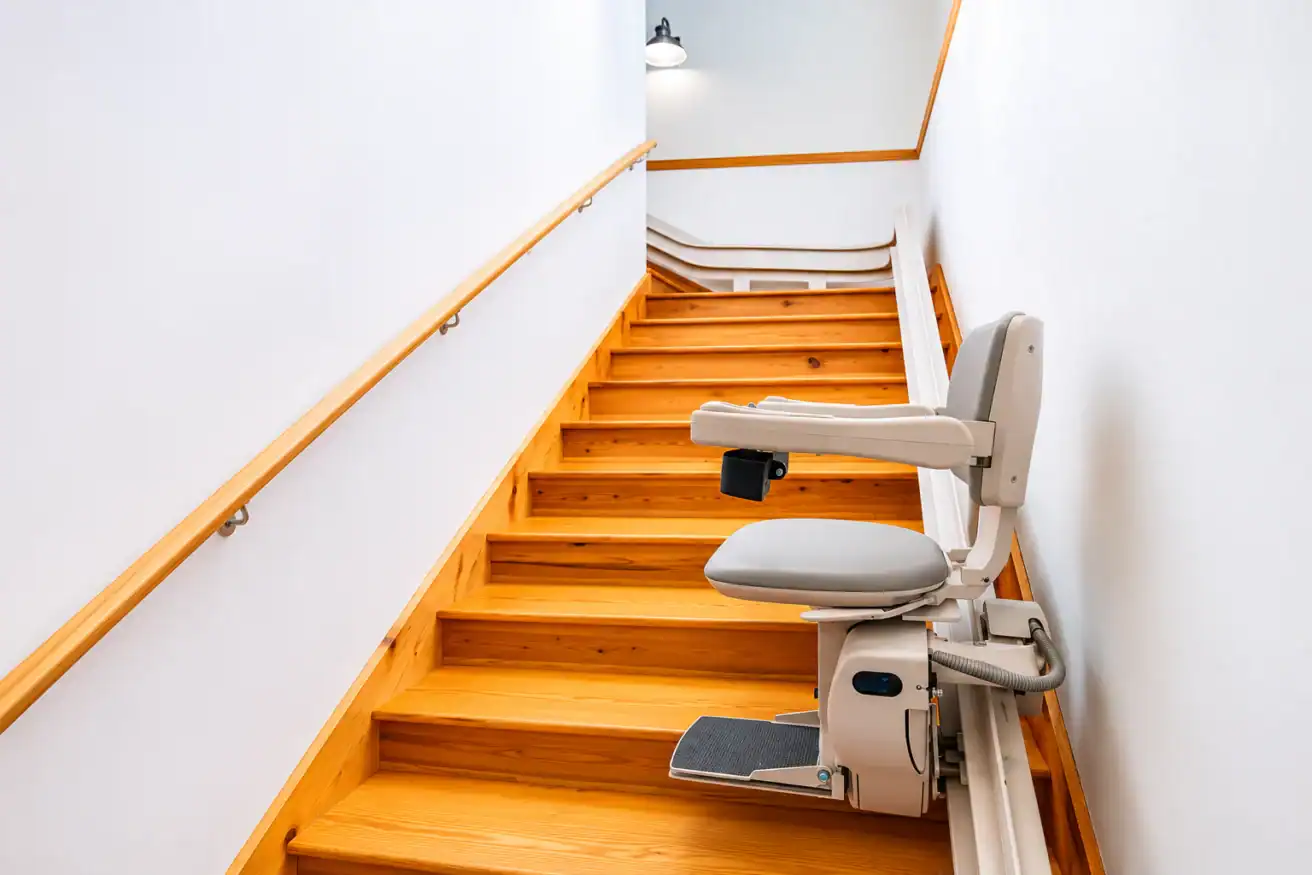
Our stairlifts are designed to give as much useable space on the staircase as possible, when the stairlift chair is parked or folded up against the wall. This means that we consider how much space remains on the stairs when the stairlift chair is not in use.
Our goal at 101 Mobility is to help determine the best stairlift to meet your needs and the needs of your staircase. We offer a free home consultation so that we can conduct an onsite evaluation to provide an equipment recommendation.
Straight and curved stairlifts do affect the process. A straight staircase is relatively easy to assess. A staircase with turns, and/or a curve may require a custom rail to adapt to the staircase.
What needs to be assessed
A straight rail can adapt to the length of the staircase, and boarding areas at the top and bottom.
A curved rail needs to adapt to the location and shape of the boarding areas, the geometry of the stairs, and the path the rail takes.
A complex staircase with a number of changes in direction may require a stairlift which moves in the opposite direction to which you would expect. This is something that should be evaluated in a configuration-specific assessment.
Understanding how the rail moves through changes in direction, and how a person uses the stairlift to enter and exit the boarding areas is important when assessing whether a straight or curved stairlift is required. A straight stairlift can not be used in a corner and extended to turn. The staircase rail needs to be shaped to the staircase.
You will have the opportunity to learn more about the different stairlift options during the in-home consultation. However, you will want to have a basic idea about options prior to the consultation based on what you know about your staircase.
I can say that I would avoid choosing a curved system just because it allows for a more customized rail. If stairs are straight and a straight stairlift solves the accessibility issue, there is no reason to make the project more complicated.
Is a Stairlift Attached to the Wall?
No. A stairlift is not attached to the wall.
The rail of the stairlift is mounted to the staircase treads using feet. The wall is not supporting the stairlift.
This is one of the questions I hear because many people assume the rail is attached to the wall like a handrail when they see a picture of a stairlift.
It is not.
It is tied directly to the staircase. The attachment points remain in the treads if the stairlift is removed, rather than the lift being anchored through the wall.
This information is important for the Baton Rouge family because they do not know anything about stairlifts and assume that having one installed means they will have to rebuild or open up a wall.
What happens on Installation Day?
The installation process takes the measurements and plan that are generated during the in-home consultation and turns it into the final stairlift system.
The rail is mounted to the treads based on the configuration selected.
The pieces are put together according to the stairlift being installed.
The next step is to check to see if the chair moves along the rail and if the controls and parts function like they should. The installer tests the system as it is intended to function.
The system also needs to make sense at the landings.
At one end of the stairlift, the person using it needs a boarding point and at the other end, they need a disembarking point. Reaching the top of the stairs isn’t the end of the journey. The user needs to transition between the chair and the landing.
No two stairlift installations are the same.
Something that might look simple to you, like straight rail versus a more complex custom curved rail, might vary the work load on the installer. The stairs, the equipment, and the conditions of the installation all affect the work involved.
The question the customer should be asking is not how fast another person’s stairlift was installed. It should be how will my stairlift be fitted to my home so it will be safe and effective for me to use.
Before the installer leaves what will he/she demonstrate for us?
The purpose of the installation is for you to learn how to safely use the stairlift. The installer demonstrates the use of the controls. The installer will also show us the chair in motion and traveling between the landings. We will also practice how to get on and off the seat at the intended boarding location.
A demonstration should be given for folding elements, if present. Several stairlift chair designs incorporate elements that allow for folding of portions of the chair to conserve space on the staircase when not in use, and the details of those designs depend on the specific equipment chosen.
Charging is also demonstrated.
Stairlifts use rechargeable battery systems, and the installer shows you how the charging system works and where the chair needs to be placed on the system to charge, if needed.
We don’t want you to learn how to repair stairlifts.
We want you to be able to learn the normal operations of the equipment, the folding features of the equipment (if any) that were installed, the charging system, and who to contact if things change.
You should be able to understand how the normal functions of the equipment work.
How is Installed Stairlift Pricing Determined?
Most of the installed stairlift pricing is determined by the specifics of the staircase, i.e. if the staircase is straight or curved, and by the specifics of the equipment used to serve the staircase.
One of the largest distinctions in stairlift pricing is whether the staircase is straight or curved.
Straight rail stairlifts have a different pricing structure than curved systems. Factors impacting straight rail stairlift pricing are discussed in the current straight rail stairlift pricing guide.
The pricing guide for curved rail systems covers the distinctions in that system.
Other configuration details and options can also impact the installed price.
Why wouldn’t I assume your staircase should cost the same as the others in Baton Rouge, Central, Denham Springs, Walker, and Prairieville? First, we have to look at your stairs.
What is a Consultation?
During a consultation, we assess things like whether your stairs are straight or curved, the configuration needed, what equipment works for the individual, and what options should be included in the recommendation.
What Happens After Installation?
Your stairlift will become part of a daily route through your house, so installation shouldn’t be the last time you know whom to call.
101 Mobility will always be here to answer equipment usage questions and provide required maintenance and repairs, and we will always have your back if something happens to your equipment.
We offer a 1 Year Limited Service Warranty for all newly sold and installed products.
This service warranty is for products sold and installed by 101 Mobility and isn’t a warranty for products sourced from other companies.
The manufacturer may have a warranty for equipment as well.
The most important thing to know is how to contact us for service and support, and what the norm should be for your stairlift.
What is a Curved Stairlift?
Curved stairlifts can travel around bends in a staircase, and can be used for stairs with landings. Like a staircase with a turn, a curved staircase also needs to be evaluated so the rail can follow the particular configuration of the stairs.
Does a stairlift damage the wall?
No. The wall is not used to provide support for the stairlift. Instead, the stairlift is mounted along the stair treads. The stairlift installation uses small attachment points to the stairs. So, the walls do not support the rail.
Can other people still use the stairs?
Yes, unless the staircase is very narrow. With some staircases, people may be able to use the stairs next to the rail. Available walking space depends on the dimensions of the staircase, position of the rail, size of the stairlift, and how it folds when not in use.
Does a stairlift use a battery?
Yes. Stairlifts use a rechargeable battery system to provide operation from stored power. While in use, a charging system keeps the batteries charged. The stairlift installer will explain how charging works for the stairlift that will be installed in your home.
Can the chair fold away?
Yes. Many stairlifts have folding components. These components help to minimize the space occupied by the stairlift when it is not in use. These folding components vary based on the model and configuration, so I only demonstrate what is actually installed.
How is stairlift fit decided?
I take into account both the person and the staircase. I consider stairs shape and width, landings, surrounding doors and hallways, clearance of other staircase components, how the person will use the stairlift and where they will board and exit, as well as the position of other rail elements.
We provide free home consultations to assess Baton Rouge area stairlifts. We will take the time to walk you through the process and explain elements that may not be obvious, such as the differences between straight and curved stairlifts. We also will help you visualize the process from the time you purchase the stairlift to the first time you use it.
About the Author
Jonas Boutte owns 101 Mobility of South Louisiana and can provide Baton Rouge area families with manufacturer training and hands-on experience with accessibility equipment from Bruno, Harmar, Stiltz, Staying Home, EZ-ACCESS, National Ramp, and others. He can evaluate stairlifts and other accessibility options and remains involved through the equipment installation.