When an Automatic Door Opener Makes More Sense Than Fixing the Threshold
In cases where no usable entry exists due to the door itself, an automatic door opener for wheelchair access in Baton Rouge is quite justified. First, as with any doorway, I assess whether the opening is clear, if there’s sufficient swing, space for approach, adequate threshold, and space beyond the doorway. Automation solves the door-opening problem; it does not remove other barriers.
This is important at a wheelchair front door in Prairieville. Even if you have a ramp to get you to the landing, you still need adequate space to approach the door, operate the door, cross the threshold, and enter the space beyond.
For the doors I evaluate as part of a complete route through 101 Mobility of Baton Rouge, I assess each door in Prairieville, Gonzales, Geismar, and Baton Rouge the same way as I do for doors in Baton Rouge.
The Four Door Variables I Check Before Recommending Automation
Prior to suggesting an automatic residential door opener, I need to understand why the existing door is not accessible.
These four factors are good indicators in most cases.
| Door Variable | What I Check | Why It Changes the Recommendation |
|---|---|---|
| Opening resistance | What it takes for the user to unlatch and move the door | Helps determine whether operating the door itself is the primary barrier |
| Door swing | Direction and area occupied as the door moves | Determines where the person and mobility device can wait |
| Clear opening | Actual usable opening with the door in operating position | Determines whether the wheelchair, walker or scooter can pass |
| Approach space | Alignment, turning room, handle position, and space beside the door | Determines whether the user can reach and move through the entrance practically |
1. Opening resistance
The first concern is always if the user can operate the door once they can reach it.
Reaching a door and unlatching it, pulling or pushing it, and controlling a mobility device through the opening can turn one doorway into several separate movements.
If that is the main problem, automating the opening of the door is warranted.
2. Door swing
I check the travel distance for the door.
An automatic opener does not address the physical swing of the door. A place to wait is needed for the wheelchair, walker or scooter while the door swings.
An outward swinging door needs the most planning since the approach has to stay clear of the door operating path.
3. Clear opening
I measure actual clear opening.
The mobiltiy device requires additional clearance beyond the clear opening provided by the door, frame, opening space, hinges, hardware, storm door and angle of opening.
Opening the door with a motor does not address the issue of space if the clear opening is the limiting factor.
4 Approach and Operating Space
I consider how the person is able to reach the doorway.
Will a wheelchair be able to position itself in line with the door? Will it be needed to execute a turn to align with the door? Where will a scooter need to be positioned to wait for the door to open? Where should the control to activate the door be placed to minimize the degree to which the user needs to maneuver?
For the City of Baton Rouge, the answers to these approach questions are as important as the difficulty presented by the door operator.
What the Open Sesame Residential Door System Changes and What It Does Not
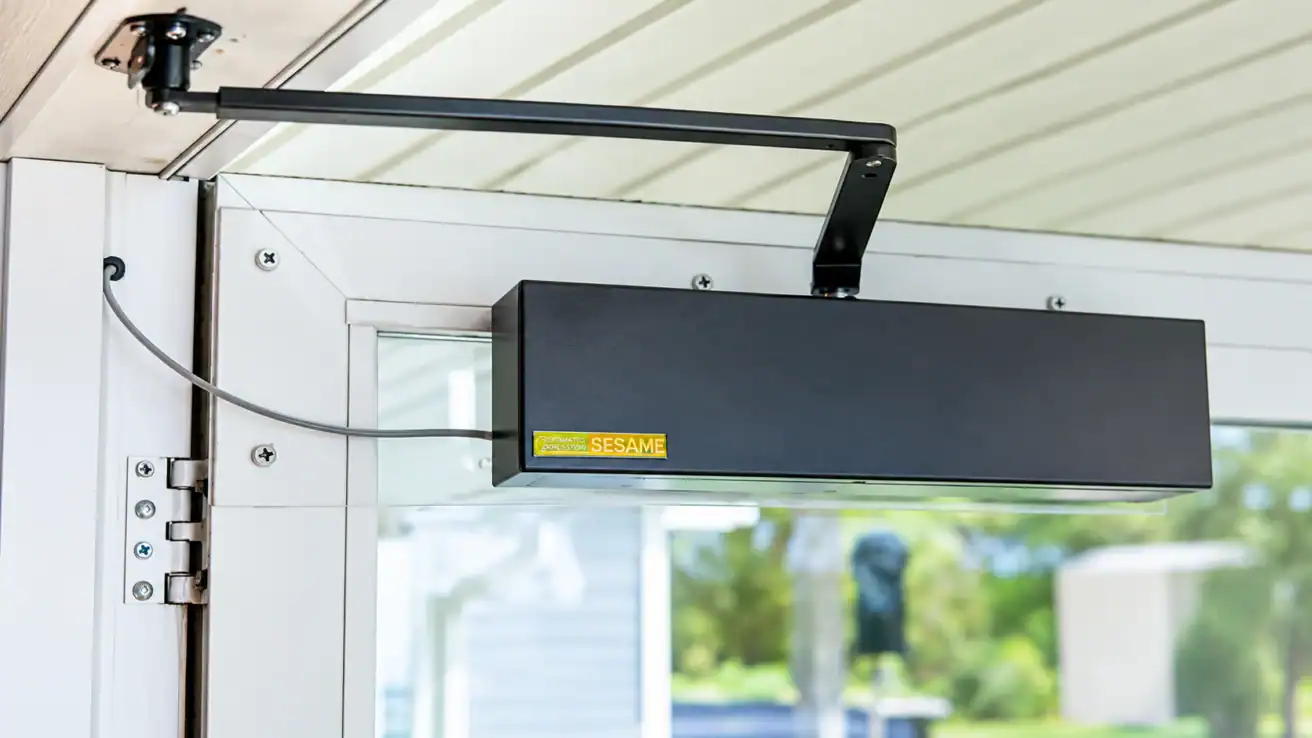
The intent of the Open Sesame Residential Door System is to install an automated door operator to an existing doorway.
The operator is designed to remove the barrier of manually unlatching and opening the door and can be activated by a variety of remote control systems. The door can remain manual and be available to be used in the absence of the automated system.
This can be a significant improvement to the entry routine if the hardest part is reaching, unlatching and moving the door.
I want to be clear on what system automation will not change.
It does not:
- Make a small entryway wider
- Create landing space
- Change how the door swings
- Make room for a turn
- Solve a twisted path to a door
- Make a difficult turn for a wheelchair or scooter easier
For these reasons, I don’t begin with, “Can we put an automatic door opener here?”
I begin by asking, “What keeps you from using this opening?”
If the opening is difficult to use because it is heavy and can’t be coordinated, then Open Sesame can be a great solution.
If the problem is something else, I choose to fix that instead.
When There is Still a Threshold to Concern Oneself With
Even if a door opening system works perfectly, the next issue that can occur immediately is the threshold.
Prior to installing the system, I record the height and shape of the transition on both sides of the opening. I also record how a wheelchair, scooter, or walker approaches the threshold.
If there is a low threshold, then Rubber Threshold Ramps can create a much easier transition. 101 Mobility’s current line of Rubber Threshold Ramps is designed for a maximum incline of 2 inches, and the true fit will depend on the opening and the path of travel.
The key idea is that door automation and threshold improvements provide solutions to different problems.
Even if you can easily use the door without difficulty but the threshold is preventing the front wheels of a mobility device from being used, I would recommend looking at options to fix the threshold first. I would not recommend an auto door system because it is the more complex product.
Reverse engineering is also possible. The threshold might do its job, while the part involving the door interrupts the route. Sometimes, both of those things need to be taken into account. I measure them both separately.
How I Plan the Approach From a Wheelchair, Walker, or Scooter
The same front door works differently depending on how you move through it.
Wheelchair approach
For a wheelchair, I look at alignment and turning radius.
Alignment means how the actual clear opening lines up with the door swing. If there is a sharp turn at the threshold, automating the door may not solve the problem.
I also look at the control placement. The activation should be done where the user naturally approaches and waits.
Walker approach
A walker changes the process.
I need to know if the difficulty is from using the door while maintaining the walker position, crossing the threshold, or if it is about having support right next to it.
If the difficulty is support, then probably another product type should be used.
For example, looking at the HealthCraft SuperPole if an interior support product provided a floor-to-ceiling support point that lined up with the user’s movement and space was available within the constraints of the installation then it solves a different problem.
Scooter approach
For a scooter, I look at the complete turning and stopping space.
What position does the scooter take with the door to open? Does the scooter back up to the threshold? How much space is there? What happens as soon as the door opens in the home?
A door opener should assist in removing challenges of using an entrance, not make the user go through a complicated series of moves to utilize it.
The equipment and pathway must work in conjunction with one another.
What Happens After Installation?
When we install an automatic door opener, we take you along the installed pathway.
We explain the series of moves for the selected control, and the behavior of the door when the control is activated. We explain the timing of the hold open setting for the control.
We then practice:
- Approach the door.
- Activate control (or) reach the control.
- Wait in planned position. The door opens.
- Move through the doorway and threshold.
- Clear the door before it closes.
I also want the household to understand that the threshold still operates as a normal doorway for other users.
Open Sesame system can be used for manual movement even when the automatic door opener is not used.
We examine the entire pathway again.
Do our planned moves for the wheelchair still work? Does the user on a walker reach the activation control? Does a scooter have enough time and space to cross? Does the threshold still work the same?
Installation is not complete just because the door moves.
101 Mobility provides service and support after the sale for accessibility equipment that requires maintenance or adjustments.
If a door in Prairieville, Gonzales, Geismar, St. Gabriel, or Baton Rouge is difficult to use, schedule a free in-home consultation. We will examine the door and measure the doorway, threshold, swing, approach, and the usable clearance. We will determine if automatic door operation is the best solution to this problem or if another type of entry solution is the best solution.
Automatic Door Openers for Home Accessibility: Common Questions
What does an automatic residential door opener do?
An automatic residential door opener has a control or transmitter that will activate a door to open and close. The Open Sesame system is designed to automatically unlatch the door so that it can still be used manually when the automatic system is not in use.
Is it possible to install an automatic door opener on my front door?
Potentially. The existing front door must be inspected to see if it is compatible with the system along with the surrounding area. The door, opening and closing controls and the clear opening are all inspected. Additionally, the frame and power source along with the approach and the threshold must be evaluated prior to installation.
Will installing an automatic door opener make my narrow entry even more narrow?
A door opener system does not alter the width of the doorway. The clear opening must still be evaluated to see if a doorway width, scooter, wheelchair, etc. sized opening is needed.
Do I need a threshold ramp if I install an automatic door opener?
Probably. Different barriers are addressed by different solutions. If the barrier caused by the threshold is a difficult transition for the mobility device, I would address it even if the door is automated.
Can someone still open the door if the automated system is notengaged?
Yes. The Open Sesame Residential Door System is designed to allow the door to be used manually while the automatic operator is not engaged. This allows other household members to use the doorway normally.
How do I know if my front door needs automation or other solutions to address accessibility?
It is important to know where the route fails to determine this. I look at the resistance to open the door, the swing of the door, the width of the clear opening, approach space, height of the threshold, the mobility device, and the space immediately inside the threshold. If the operation of the door is the main barrier, then automation may be the best solution. Otherwise, I address the barriers along the route which may be causing the problem.
About the Author
Jonas Boutte is the owner of 101 Mobility of South Louisiana and has hands-on training from accessibility-equipment manufacturers including Bruno, Harmar, Stiltz, Staying Home, EZ-ACCESS, National Ramp, and others. He helps Baton Rouge-area families evaluate stairlifts, lift chairs, ramps, platform lifts, home elevators, and other accessibility solutions based on the home and everyday mobility needs.